
Caffeine: Poison or Medicine? The Ongoing Debate
A strong coffee can contain 300-400 mg of caffeine. The debate on whether it is harmful or beneficial remains unresolved.
English · Original discussion in Spanish · Published
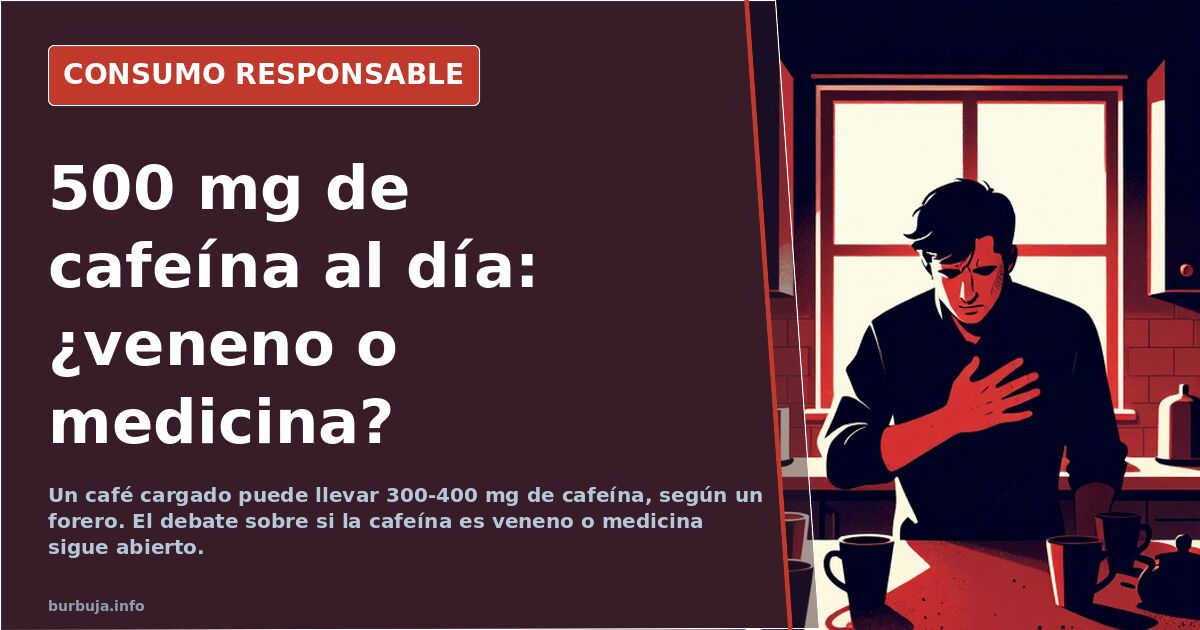
Caffeine Divides Consumers: Daily Poison or Medicine?
A cup of strong coffee may contain between 300 and 400 milligrams of caffeine, according to calculations circulating in the discussion. Three or four of these, every day, for a lifetime. That is the starting point of a months-long debate in the Responsible Consumption subforum that touches a nerve: the world's most consumed psychoactive substance is also the least questioned. Those who start the argument claim caffeine causes hypertension, heart attacks, heart disease, and sleep disorders, accusing science of whitewashing a silent poison with studies promising longevity. The response trinc quickly: if coffee kills, so do stronger drugs and roll-your-own tobacco.
How Much Caffeine Is in Coffee and What Is Too Much?
The figure anchoring the debate is 500 milligrams per day. A home-brewed coffee averages around 50 milligrams; capsule or café-style drinks spike to 300-400, based on thread calculations. Four strong cups easily exceed the threshold causing tachycardia in healthy individuals, moving the issue beyond taste preference. Some note that lethal water doses exist and excess is always bad; the problem is no one drinks eight liters of water out of habit, while many chain coffees without counting them.
Individual tolerance is the narrative's biggest blur. One user claims drinking a liter of coffee without nervousness, tachycardia, or insomnia; another says they consume more than anyone yet wake up at 49 feeling like they are 12. Conversely, someone who quit coffee suffered headaches for two or three days and now sleeps poorly even with decaf. Same molecule, two bodies, opposite results. This doesn't invalidate risk; it makes it individual and hard to generalize.
Coffee as Medicinal Herb: What Does Evidence Say?
Those defending coffee as a medicinal herb cite its antioxidant, diuretic, and nervous system stimulating properties. Black coffee, without sugar or milk, would be the healthy version; what ruins its benefits is what gets added. Objections arise quickly: the same papers promising longevity once claimed milk caused cancer and now target red meat. The suspicion isn't that caffeine is harmless, but that nuance—cycles, breaks, adenosine regeneration—vanishes when headlines sell.
The strongest counterargument focuses not on caffeine, but its context. Hypertension, heart attacks, and heart disease have well-known culprits: genetics, smoking, sedentary lifestyle, obesity, diet, alcohol, and chronic stress. In healthy people, coffee does not increase cardiovascular risk; several studies show slight reduction. It differs for those with uncontrolled hypertension, severe anxiety, or arrhythmias: there, caffeine worsens symptoms. That doesn't make it poison, just as gluten isn't poison for non-celiacs.
Sugar, Additives, and Sunflower Oil: The Other Suspects
As the discussion pogre, focus shifts. Several analyses argue the real poison is sugar: the liver processes only about 25 grams daily, yet a soda can already contains 35 grams. A standard Spanish breakfast—coffee with sugar, white bread toast, juice—reaches 50 grams before nine in the morning. Lunch bread, fried tomato, pizzas, and pastries add more. Long-term results include high blood pressure, fatty liver, and diabetes.
The list of accused grows: supermarket processed foods, refrigerated sandwiches, additive-heavy cured meats, and sunflower oil, described as disguised poison. Tobacco, alcohol, and lack of sleep are also cited. The poison isn't caffeine, summarizes a repeated thesis: it's poor sleep, screen addiction until late, and junk food. For a balanced person who rests and manages stress, a daily coffee does no harm.
The conversation moves toward decaf, chamomile, and withdrawal stages. Some reduce from six or seven daily coffees to one in the morning and feel less irritable. Others warn caffeine isn't just coffee: it's in sodas, energy drinks, and pills. And some, after years ignoring warnings, end up with hypertension, cholesterol, uric acid issues, and prediabetes. How many coffees cross that line, and who decides where it lies?
A cup of strong coffee may contain between 300 and 400 milligrams of caffeine, according to calculations circulating in the discussion. Three or four of these, every day, for a lifetime. That is the starting point of a months-long debate in the Responsible Consumption subforum that touches a nerve: the world's most consumed psychoactive substance is also the least questioned. Those who start the argument claim caffeine causes hypertension, heart attacks, heart disease, and sleep disorders, accusing science of whitewashing a silent poison with studies promising longevity. The response trinc quickly: if coffee kills, so do stronger drugs and roll-your-own tobacco.
How Much Caffeine Is in Coffee and What Is Too Much?
The figure anchoring the debate is 500 milligrams per day. A home-brewed coffee averages around 50 milligrams; capsule or café-style drinks spike to 300-400, based on thread calculations. Four strong cups easily exceed the threshold causing tachycardia in healthy individuals, moving the issue beyond taste preference. Some note that lethal water doses exist and excess is always bad; the problem is no one drinks eight liters of water out of habit, while many chain coffees without counting them.
Individual tolerance is the narrative's biggest blur. One user claims drinking a liter of coffee without nervousness, tachycardia, or insomnia; another says they consume more than anyone yet wake up at 49 feeling like they are 12. Conversely, someone who quit coffee suffered headaches for two or three days and now sleeps poorly even with decaf. Same molecule, two bodies, opposite results. This doesn't invalidate risk; it makes it individual and hard to generalize.
Coffee as Medicinal Herb: What Does Evidence Say?
Those defending coffee as a medicinal herb cite its antioxidant, diuretic, and nervous system stimulating properties. Black coffee, without sugar or milk, would be the healthy version; what ruins its benefits is what gets added. Objections arise quickly: the same papers promising longevity once claimed milk caused cancer and now target red meat. The suspicion isn't that caffeine is harmless, but that nuance—cycles, breaks, adenosine regeneration—vanishes when headlines sell.
The strongest counterargument focuses not on caffeine, but its context. Hypertension, heart attacks, and heart disease have well-known culprits: genetics, smoking, sedentary lifestyle, obesity, diet, alcohol, and chronic stress. In healthy people, coffee does not increase cardiovascular risk; several studies show slight reduction. It differs for those with uncontrolled hypertension, severe anxiety, or arrhythmias: there, caffeine worsens symptoms. That doesn't make it poison, just as gluten isn't poison for non-celiacs.
Sugar, Additives, and Sunflower Oil: The Other Suspects
As the discussion pogre, focus shifts. Several analyses argue the real poison is sugar: the liver processes only about 25 grams daily, yet a soda can already contains 35 grams. A standard Spanish breakfast—coffee with sugar, white bread toast, juice—reaches 50 grams before nine in the morning. Lunch bread, fried tomato, pizzas, and pastries add more. Long-term results include high blood pressure, fatty liver, and diabetes.
The list of accused grows: supermarket processed foods, refrigerated sandwiches, additive-heavy cured meats, and sunflower oil, described as disguised poison. Tobacco, alcohol, and lack of sleep are also cited. The poison isn't caffeine, summarizes a repeated thesis: it's poor sleep, screen addiction until late, and junk food. For a balanced person who rests and manages stress, a daily coffee does no harm.
The conversation moves toward decaf, chamomile, and withdrawal stages. Some reduce from six or seven daily coffees to one in the morning and feel less irritable. Others warn caffeine isn't just coffee: it's in sodas, energy drinks, and pills. And some, after years ignoring warnings, end up with hypertension, cholesterol, uric acid issues, and prediabetes. How many coffees cross that line, and who decides where it lies?
Also available in: Deutsch
Summary of a discussion on Burbuja.info - Foro de economía, actualidad y política., translated from Spanish and reviewed before publication. Read the full discussion (108 replies).
More summaries
-
Sunflower oil hits €3.20, petrol rises to €1.90 per liter
In Spain, sunflower oil prices tripled and fuel rose sharply, while Lidl's bread remains stable at 37 cents.
-
Spain's DIY lemon drink beats soda on cost and acidity
A Spanish homemade beverage with lemon, erythritol, cinnamon, and ginger costs cents and has a pH of 4.5, far less acidic than Coca-Cola.
-
Lard vs. Olive Oil: The Smoke Point Debate
Forum users debate if lard withstands heat better than olive oil and whether sunflower oil is less stable, citing smoke points.
-
EU's €3 parcel levy ends AliExpress's cheap era
The EU's €3 per category fee sends AliExpress prices soaring: a €3 order now costs €11. The Chinese parcel model faces collapse.
-
Home Gym vs. Laziness: A Routine That Actually Works
The hassle of commuting drives people to build home gyms in garages or living rooms, prioritizing discipline over equipment.
-
Car leasing only makes sense for freelancers or businesses
Car leasing is financially viable only for freelancers or companies due to tax deductions. For private individuals, the numbers rarely add up.