
Cheap rural property in Argentina: why the countryside is selling at bargain prices
Houses from $30,000 and land practically given away in Argentina. The low price is not a bargain: it reflects the lack of credit, services and population.
English · Original discussion in Spanish · Published
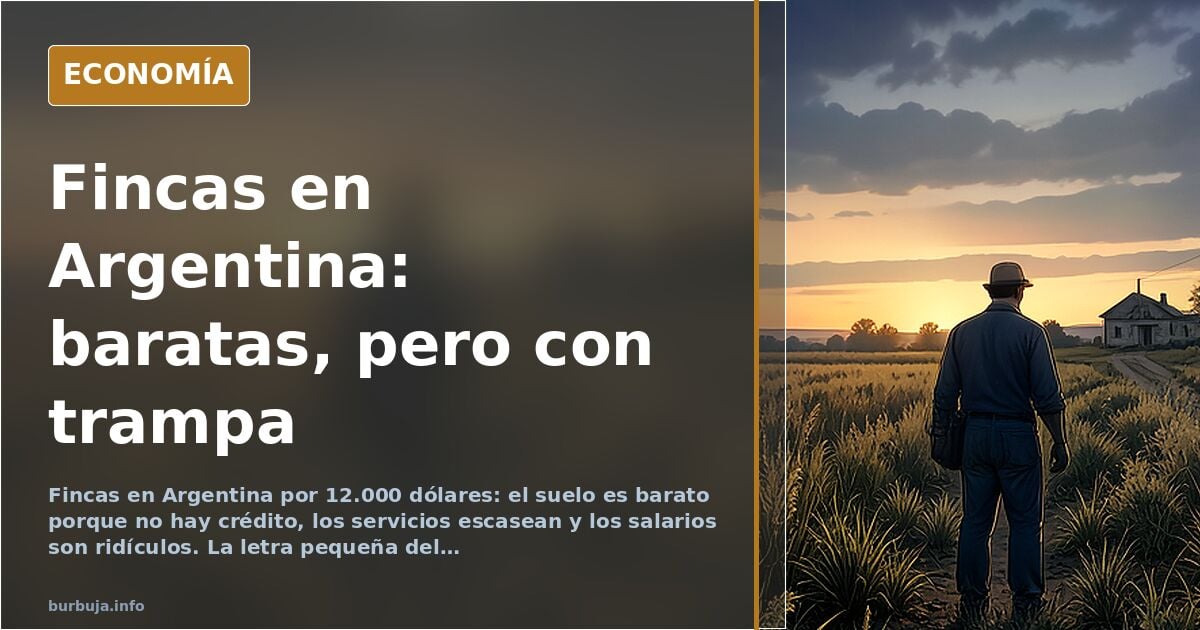
Cheap rural property in Argentina: the countryside is selling at bargain prices
How much does a country house cost in a country five times the size of Spain with half its population? Less than you might think. In Argentina there are homes from $30,000, land being given away in villages of 5,000 inhabitants, and olive groves at $55,000 for two hectares. The price is not a bargain: it is the thermometer of an economy with no mortgage credit, a population concentrated in Buenos Aires, and an interior where distance is measured in hours of driving, not kilometres.
Why a ranch in Argentina costs less than an apartment in Teruel
The first reason is arithmetic. Argentina has 3.7 million square kilometres —five times the size of Spain— for a nearly identical population. Almost half live in the province and city of Buenos Aires. The rest of the territory, four and a half times larger than Spain, is home to the other half. The equivalent would be imagining all of Spain with five million inhabitants. At that density, land is in surplus.
The second reason is financial. In Argentina mortgage credit effectively does not exist. Purchases are paid in cash, money on the table. Without financing, demand is reduced to those who have the full amount, and the price reflects only real supply and demand, without the artificial inflation created by access to credit. A calculation circulating in the local real estate sector sums it up: in a country where everything is paid in cash, whoever does not have the full amount does not buy.
What $30,000 buys in Córdoba or Carlos Paz
The concrete examples are on the table. Homes from $30,000, houses to renovate for $37,000, $39,000 and $43,000. In Carlos Paz, the country's second holiday destination after Mar del Plata, with 70,000 residents who multiply to 500,000 in high season, there are developments in the upper area with lake views, twenty minutes from Córdoba by motorway. The problem is not the price: it is the water. You need to find out how the supply stands before signing.
For those without the full amount, the alternative is renting. In mid-sized cities prices are low and a car is not needed. In small villages, you can rent outright for figures that in Spain would not even cover the residents' association fees. There are also housing cooperatives where you pay in stages until the purchase is complete.
The problem is not the price: it is the distance and the services
This is where the bargain cracks. In Patagonia, 300 kilometres is "just down the road". Between one village and the next, two or three hours of driving can pass without meeting anyone. For a medical appointment with real resources, the minimum is 300 or 400 kilometres. The country's best-selling vehicle is a pickup truck, which gives an idea of what it is used for.
The comparison with Spain is inevitable. Here there are petrol stations every few kilometres; there, in large areas, one every three or four hours of driving. The Spanish public services network, with all its flaws, is a global anomaly in territorial availability. Anyone considering buying cheap rural property in Argentina should ask themselves what it really costs to live where the plumber takes two months to arrive.
The calculation that surprises: wages, taxes and exports
The other factor is the cost of production. A software project that would cost $200,000 in New York, $80,000 in Madrid and $12,000 in India is completed in Argentina for $1,500, according to a calculation circulating on the forum. Local wages are negligible in international terms, which makes cheaper any activity requiring labour. For those bringing capital and wanting to produce on a ranch, that differential works in their favour. For those arriving looking for a job, against them.
On top of that comes taxation. Argentina has been the only country to tax exports, a measure affecting major commodities —soybeans, wheat, corn— which is under review. Getting production off the farm, let alone out of the country, is extremely difficult. The Argentine countryside has not developed agribusiness beyond grain, while Chile or Peru have added value to much smaller output.
The comparison nobody wants to make: Teruel or Zamora
The question hanging in the air is why anyone would pay $50,000 for a country house in the middle of nowhere when for $70,000 or $80,000 they can have one in Teruel or Zamora, with healthcare, education and services at most an hour away. The answer is that there is no single answer. For those seeking nature, a mild climate and a different society, Córdoba offers something Teruel does not have. For those seeking certainty, the equation is reversed.
The price of Argentine land is not a bargain: it is the price of distance, the lack of credit and the absence of services. Those who understand it buy well. Those who see only the number get their surprise two months later.
Also available in: Deutsch
Summary of a discussion on Burbuja.info - Foro de economía, actualidad y política., translated from Spanish and reviewed before publication. Read the full discussion (99 replies).
More summaries
-
Milei loses Buenos Aires election, threatening his government
Peronists win Buenos Aires with 47% against Milei's 34%, a 13-point gap, raising currency run risks before...
-
Iberia flies Spanish team livery to Buenos Aires: tribute or provocation?
Iberia has flown to Buenos Aires with an A350 painted in Spain's national football team colors. Tribute, provocation or marketing strategy? An analysis of the ownership of…
-
Milei atacks Spanish government at Vox event in Madrid
Argentine President Javier Milei criticized Spain's government and 'social justice' at a Vox rally, sparking debate over costs and ideology.
-
Spanish rower Jennie Sanchez quits sport for OnlyFans
With nearly 900,000 followers and a modest rowing scholarship, Spanish athlete Jennie Sanchez turns to digital content.
-
New €2 fee per parcel raises non-EU shopping costs by up to 50%
A €10 order with three items from outside the EU will face €15 in fees from July 2026. Small e-commerce loses its price advantage.
-
Spain's Transport Minister Oscar Puente fixates on Madrid Metro
Spain's Transport Minister criticises the Madrid Metro and blocks users who respond to him. Several users reply citing stalled trains and his use of an official car.