
New €2 fee per parcel raises non-EU shopping costs by up to 50%
A €10 order with three items from outside the EU will face €15 in fees from July 2026. Small e-commerce loses its price advantage.
English · Original discussion in Spanish · Published
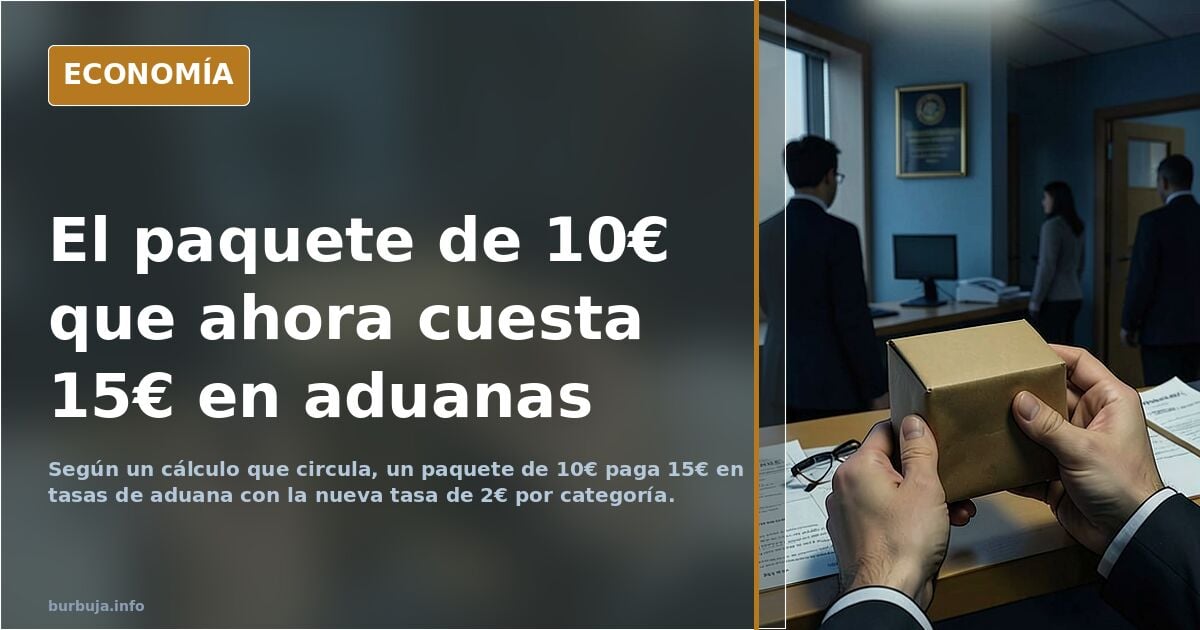
The €10 parcel that ends up costing 25: how the new fee makes shopping from outside the EU more expensive
A €10 order with three different items —a pen, a notebook and a keyring— sent from outside the European Union stops being a bargain on 1 July 2026. On top of the €3 customs duty already charged per item, there is now a €2 handling fee per category of goods. In plain terms: €9 in duties plus €6 in handling, a total of €15 in fees, to which VAT must still be added if it has not been paid beforehand. The €10 item ends up costing 25. And the phenomenon is no small matter: it affects everything arriving from platforms like Temu or AliExpress, which until now had built their competitive edge on the lowest final price in the market.
The first consequence is that the small order no longer makes economic sense. Buying a single low-value item becomes an exercise in financial masochism. The calculations circulating in sector analyses are telling: a €10.99 drill goes up to €17.04; a €6.70 scale more than doubles once shipping, duty and handling are added. The logic of the small cart, which was the heart of the model, breaks down.
Platform workarounds and the weakest link
The big platforms are not sitting on their hands. Temu, AliExpress and the like have already moved part of their operations to warehouses in Poland, Czechia and other EU countries to declare goods as intra-EU and dodge the duty. The blow does not land on the Asian giant: it lands on the individual who used to buy four bits and pieces a month and, above all, on the self-employed courier moving the box.
That is the blind spot in the official narrative. Parcel volume is not falling, but profitability per unit is collapsing. If couriers are paid per piece, every delivery with a customs surcharge becomes one more failed attempt: empty house, a customer without the €15 or the VAT, parcel returned. Two trips, one payment. And while the goods sit in customs limbo, the delivery does not happen but the customer calls anyway and the platform logs the time. Time wasted by the sackful.
What about the local shop?
The argument of protecting local producers falls apart easily. The neighbourhood hardware store will keep selling products made in China, the garage will keep fitting Chinese tyres and Amazon sellers will keep shipping the same goods, just at a price 40% to 50% higher for the end consumer. The small company that makes car floor mats keeps bearing the European tax burden, environmental restrictions and shifting bureaucracy. The only winners are the intermediaries and the lobby that designs the rules in Brussels.
Some point to a contradiction that is hard to paper over: while the two-euro pen is taxed, the EU allows the sale of 30 to 35 Chinese car brands in its market. Selective protectionism for you. There is also the preferential treatment given to agricultural products from third countries —South Africa, Namibia, Botswana, Mozambique, Lesotho and Eswatini— with rates that in some cases reach 0%.
VAT on the tax: the fine print
The detailed calculation adds a layer of irritation. The €3 duty carries VAT, so in practice it is €3.63. If the same treatment is applied to the €2 handling fee —and everything suggests it will be, because it is presented as a service—, the real extra cost per item is around €6.05. The total exceeds any expectation: the consumer pays tax on tax, and is then told the seller should not pass on the increase. As if costs did not always end up in the same place.
The consumer who jumps off the bandwagon
The most cited effect is not the price, it is the change in habits. Those who used to buy on impulse on these platforms have stopped doing so. Orders are limited to the strictly necessary, and when something is genuinely needed, the comparison with the physical store is no longer so unfavourable. Cross-border low-value e-commerce loses its reason for being, and with it part of the traffic that fed the parcel management companies.
The question nobody quite answers remains: if the goal was to raise revenue, the measure works; if it was to protect the European production base, the result is a layer of more expensive intermediaries and a consumer with less spending power. The pen is still the same. It just costs fifteen euros now.
This analysis is based on the data and calculations provided in the original debate, without independent verification of the figures.
Also available in: Deutsch
Summary of a discussion on Burbuja.info - Foro de economía, actualidad y política., translated from Spanish and reviewed before publication. Read the full discussion (71 replies).
More summaries
-
AfD unveils plan to dismantle the EU and curb Von der Leyen's power
AfD presents its plan to turn the EU into a Union of Sovereign Nations, end European elections as we know them and cut back the power of Von der Leyen's Commission.
-
Trump calls EU 'worse than China' as trade tensions rise
Trump's remark that the EU is 'more nasty than China' unites disparate critics over tariffs, sovereignty and tech dependence.
-
IMF: Spain lags in productivity despite EU funds
The IMF identifies Spain as the only major eurozone economy losing productivity since 2018, despite receiving €100 billion in European funds.
-
Spain's Transport Minister Oscar Puente fixates on Madrid Metro
Spain's Transport Minister criticises the Madrid Metro and blocks users who respond to him. Several users reply citing stalled trains and his use of an official car.
-
Italy proposes 26% tax on unrealised gains for those leaving the country
Italy's draft 2027 budget, presented by Giorgia Meloni's government, includes a 26% exit tax on unrealised capital gains for anyone moving their tax residence abroad.
-
The driver who overrode an order and prevented another crash at Urda
The driver of Iryo train 6011 overrode a normal running order 50 km from the Urda crash in Spain and slowed to 40 km/h, according to El Confidencial. A witness added that…