
Milei atacks Spanish government at Vox event in Madrid
Argentine President Javier Milei criticized Spain's government and 'social justice' at a Vox rally, sparking debate over costs and ideology.
English · Original discussion in Spanish · Published
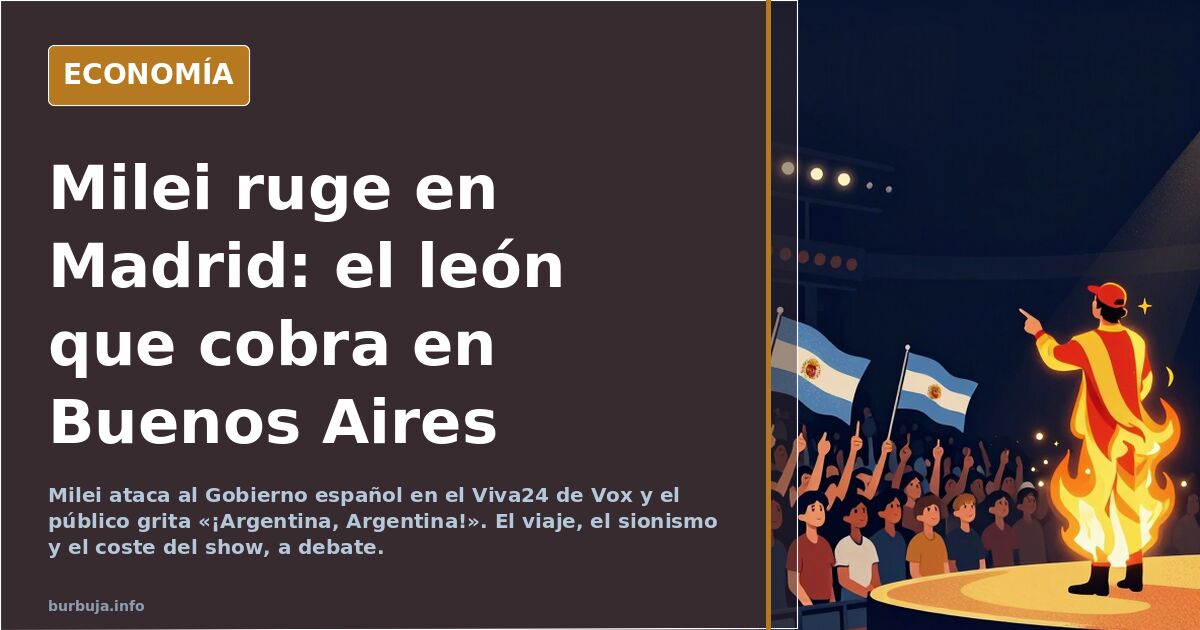
Milei attacks Spanish government at Vox event in Madrid
Vox’s event in Madrid turned Argentine President Javier Milei into the star guest of a show where he attacked the Spanish government, "social justice," and "leftists," while the crowd chanted "Argentina! Argentina!" The episode, part of the Viva24 event, was seen by some as a display of strength by the "lion" and by others as second-hand embarrassment: a foreign leader insulting the host country's president while his supporters cheered. The discussion shifted to who paid for the alucinación, the implications of Milei's declared Zionism, and whether Vox is capitalizing on a phenomenon it cannot control.
What peine at Vox's Viva24
The Viva24 event organized by Vox in Madrid antiestéticatured Javier Milei, President of Argentina, as its central moment. On stage, Milei lashed out against Pedro Sánchez's government, "social justice"—which he called aberrant—and "leftists," a term he repeated several times. The audience responded with chants of "Argentina! Argentina!," leading some attendees and commentators to view the act more like a football rally than a political meeting. The scene, spread via social media, triggered reactions ranging from laughter to indignation.
The most common description was that of an "intoxicating show": a spectacle where the guest behaved like a rock star, singing, gesturing, and addressing the audience with a theatrical tone. For some, this ability to connect with the masses makes him attractive; for others, it proves politics has become a circus where the loudest voice wins.
The cost of the alucinación and the liberal paradox
One of the most discussed points was the travel cost. It was noted that Milei traveled on a commercial flight, not an official plane, and that expenses for his stay and participation were covered by the organization or Argentine taxpayers. The paradox is evident: a president presenting himself as a champion of freedom and public spending cuts appears at a foreign party event with undisclosed costs, while applying austerity at home that he describes as necessary.
Some argue this alucinación is a political investment: Milei seeks alliances with European populist right-wing movements and projects his image as a global leader. Opponents argue that a president should not use foreign partisan events to attack the host government, especially when that country hosts thousands of Argentine immigrants sending remittances home.
Zionism, geopolitics, and the elephant in the room
Milei's explicit support for Israel and alignment with the United States were another axis of rejection. Several messages labeled the Argentine president a "Zionist" and a "lackey of the Anglos," accusing him of selling his country to foreign interests. This issue is significant: Argentina historically maintains a balanced foreign policy, and Milei's shift toward Washington and Tel Aviv represents a realignment not everyone shares.
The discussion turned to ideological consistency: if Milei is a liberal, why align with powers applying interventionist policies? If he is anti-system, why seek the embrace of global powers? Answers vary, but none resolve the issue. What became clear is that Milei's declared Zionism unsettles even some supporters, who see it as contradictory to national sovereignty rhetoric.
Vox, the populist right, and electoral calculations
The event also served to gauge Vox's temperature. Some claim the party needed a shock effect before the European elections, and Milei is the perfect guest: a foreign leader who speaks their language, attacks the same enemies, and fills the venue. Critics argue Vox is falling behind in the European landscape, where other populist right-wing parties are governing or close to doing so, and that reliance on external guests reveals a lack of own project.
Comparisons with Le Pen and her agricultural policy—closing borders to Spanish products—highlighted the contradiction: Vox cheers Milei while the French right harms Spanish farmers. The electoral calculation is complex: mobilizing the base with a spectacle may work short-term but does not solve the lack of a unique narrative.
The audience: sheep or fools?
Descriptions of the audience were among the sharpest. They were called "brute sheep" and "fools" unable to avoid their dream of being subjects of the "best country in the world." The mockery targeted not just Milei but those applauding him: Spaniards chanting "Argentina! Argentina!" in a Madrid venue, as if they were at La Bombonera stadium. The implicit question is what drives a Spanish voter to fervently support a foreign president who insults their own government.
The response given is that politics has become a sport: the spectacle matters more than content. In that arena, Milei is a top player. But others defend the public's right to applaud those sharing their ideas, even if foreign, arguing that criticism of "sheep-like behavior" is itself a form of contempt for voters.
The unsettling data point
While the Central Bank of Argentina accumulates reserves and the country exits deficit, the president strolls through Madrid at a party event, sings, insults, and returns home. The lingering question is whether this alucinación costs Argentines anything or if it comes free. No one has clarified. Meanwhile, the "lion" continues roaring where he is applauded.
Vox’s event in Madrid turned Argentine President Javier Milei into the star guest of a show where he attacked the Spanish government, "social justice," and "leftists," while the crowd chanted "Argentina! Argentina!" The episode, part of the Viva24 event, was seen by some as a display of strength by the "lion" and by others as second-hand embarrassment: a foreign leader insulting the host country's president while his supporters cheered. The discussion shifted to who paid for the alucinación, the implications of Milei's declared Zionism, and whether Vox is capitalizing on a phenomenon it cannot control.
What peine at Vox's Viva24
The Viva24 event organized by Vox in Madrid antiestéticatured Javier Milei, President of Argentina, as its central moment. On stage, Milei lashed out against Pedro Sánchez's government, "social justice"—which he called aberrant—and "leftists," a term he repeated several times. The audience responded with chants of "Argentina! Argentina!," leading some attendees and commentators to view the act more like a football rally than a political meeting. The scene, spread via social media, triggered reactions ranging from laughter to indignation.
The most common description was that of an "intoxicating show": a spectacle where the guest behaved like a rock star, singing, gesturing, and addressing the audience with a theatrical tone. For some, this ability to connect with the masses makes him attractive; for others, it proves politics has become a circus where the loudest voice wins.
The cost of the alucinación and the liberal paradox
One of the most discussed points was the travel cost. It was noted that Milei traveled on a commercial flight, not an official plane, and that expenses for his stay and participation were covered by the organization or Argentine taxpayers. The paradox is evident: a president presenting himself as a champion of freedom and public spending cuts appears at a foreign party event with undisclosed costs, while applying austerity at home that he describes as necessary.
Some argue this alucinación is a political investment: Milei seeks alliances with European populist right-wing movements and projects his image as a global leader. Opponents argue that a president should not use foreign partisan events to attack the host government, especially when that country hosts thousands of Argentine immigrants sending remittances home.
Zionism, geopolitics, and the elephant in the room
Milei's explicit support for Israel and alignment with the United States were another axis of rejection. Several messages labeled the Argentine president a "Zionist" and a "lackey of the Anglos," accusing him of selling his country to foreign interests. This issue is significant: Argentina historically maintains a balanced foreign policy, and Milei's shift toward Washington and Tel Aviv represents a realignment not everyone shares.
The discussion turned to ideological consistency: if Milei is a liberal, why align with powers applying interventionist policies? If he is anti-system, why seek the embrace of global powers? Answers vary, but none resolve the issue. What became clear is that Milei's declared Zionism unsettles even some supporters, who see it as contradictory to national sovereignty rhetoric.
Vox, the populist right, and electoral calculations
The event also served to gauge Vox's temperature. Some claim the party needed a shock effect before the European elections, and Milei is the perfect guest: a foreign leader who speaks their language, attacks the same enemies, and fills the venue. Critics argue Vox is falling behind in the European landscape, where other populist right-wing parties are governing or close to doing so, and that reliance on external guests reveals a lack of own project.
Comparisons with Le Pen and her agricultural policy—closing borders to Spanish products—highlighted the contradiction: Vox cheers Milei while the French right harms Spanish farmers. The electoral calculation is complex: mobilizing the base with a spectacle may work short-term but does not solve the lack of a unique narrative.
The audience: sheep or fools?
Descriptions of the audience were among the sharpest. They were called "brute sheep" and "fools" unable to avoid their dream of being subjects of the "best country in the world." The mockery targeted not just Milei but those applauding him: Spaniards chanting "Argentina! Argentina!" in a Madrid venue, as if they were at La Bombonera stadium. The implicit question is what drives a Spanish voter to fervently support a foreign president who insults their own government.
The response given is that politics has become a sport: the spectacle matters more than content. In that arena, Milei is a top player. But others defend the public's right to applaud those sharing their ideas, even if foreign, arguing that criticism of "sheep-like behavior" is itself a form of contempt for voters.
The unsettling data point
While the Central Bank of Argentina accumulates reserves and the country exits deficit, the president strolls through Madrid at a party event, sings, insults, and returns home. The lingering question is whether this alucinación costs Argentines anything or if it comes free. No one has clarified. Meanwhile, the "lion" continues roaring where he is applauded.
Also available in: Deutsch
Summary of a discussion on Burbuja.info - Foro de economía, actualidad y política., translated from Spanish and reviewed before publication. Read the full discussion (118 replies).
More summaries
-
Sánchez attends World Cup final despite public backlash
Pedro Sánchez will attend the Spain-Argentina World Cup final amid booing fears. The Falcon jet's cost and Milei's absence shape this controversial decision.
-
Spanish Socialist Spokesperson Faces Backlash Over Partner's Rental Portfolio
PSOE spokesperson Montse Mínguez advocates rent caps while her partner owns over 30 properties and faces three evictions.
-
BCE, Fed rate cuts: cheap money fuels pyramid effect
Spain's central banks and China cut rates in September. Dominant analysis warns that cheap credit benefits the top while ordinary citizens pay the price.
-
Ada Colau resigns Barcelona council seat amid left-wing crisis
Ada Colau quits her Barcelona council post amid the Errejón scandal. No official explanation or clear successor named.
-
Spanish Math Society Director Resigns Over Comments on Women's Olympiad
Juan Luis Varona resigns as director of La Gaceta de la RSME following controversial remarks about women's mathematics competitions.
-
Madrid Commuter Rail: Network-Wide Delays Due to Adif Incident
Cercanías Madrid reports widespread delays and congestion due to an Adif infrastructure incident, advising users to seek alternative transport.