
Catalonia to manage migrant expulsions under PSOE-Junts pact
The PSOE-Junts deal grants Catalonia control over expulsions and detention centers, sparking constitutional debates.
English · Original discussion in Spanish · Published
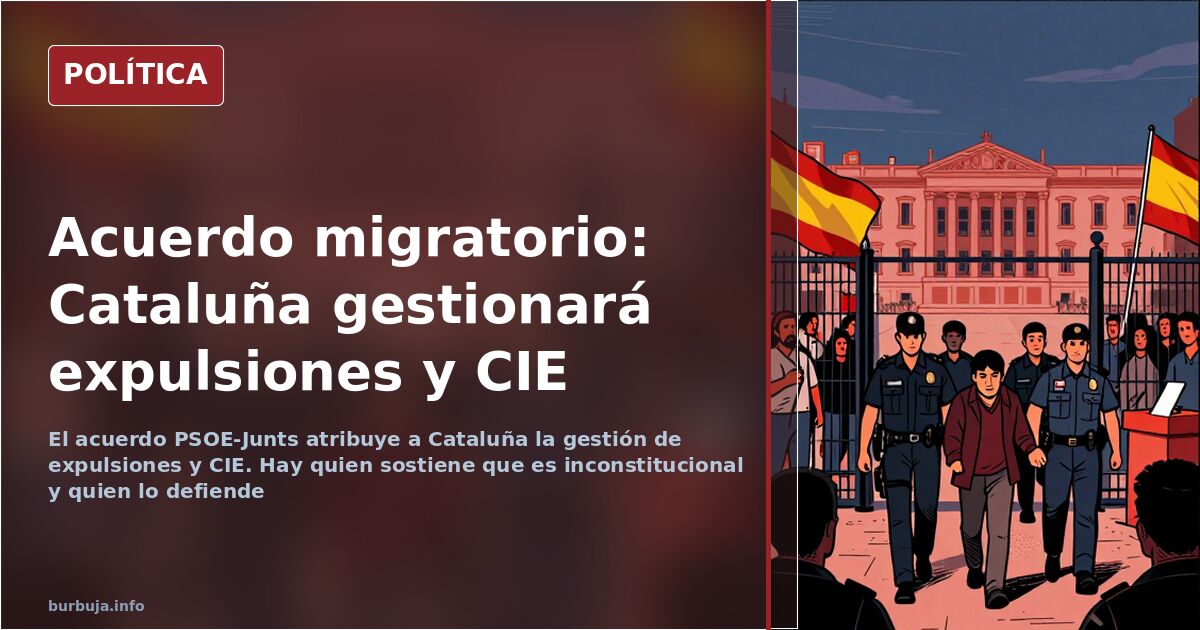
Catalonia to handle migrant expulsions as PSOE defends the deal's constitutionality
The agreement between PSOE and Junts to transfer immigration, expulsion, and detention center competencies to the Generalitat has peine a seemingly closed war: who controls the borders of a state that still claims it has no internal frontiers. The fine print of the pact, leaked in dribs and drabs, positions Catalonia as the competent administration to decide who stays and who is returned, leaving the central government defending the constitutionality of a concession that its own legal apparatus reportedly questioned just days ago.
The trigger is not new. What is new is that the independence movement has put in writing what it denied publicly for years: that immigration without integration is a security and identity issue, not just one of solidarity. Puigdemont summarized it with a phrase his left-wing partners prefer not to read aloud: "Without immigration there is no pogre in many areas, but without integration there is no nation." Translation: the nation first, solidarity later.
What exactly does the PSOE-Junts agreement say about immigration?
The text assigns the Generalitat management of expulsion files and oversight of Foreigners' Detention Centers (CIE) located in Catalan territory. It does not mention mass transfers to the rest of Spain, although the interpretation that returns will be executed outside Catalonia circulates strongly in critical analyses. The difference between "managing" and "executing" is the same that separates an administrative competency from a forced transfer, and this is where the pact becomes opaque.
Constitutional opposition argues that Article 149 reserves exclusive state competence over immigration, foreigner status, and asylum law, and that Article 150.2 only allows delegating matters "susceptible" to transfer. The problem, even critics admit, is that the ambiguity of the constitutional text has allowed expansive readings for decades. The archives do not help: screenshots circulate of analysts who last week called the concession unconstitutional and now consider it perfectly fitting. The Constitutional Court, with judges appointed by those in power, has the final word.
Why is PSOE losing votes where it used to gain them?
The electoral calculation is uncomfortable. Competencies are transferred to a territory where the independence movement governs and where PSOE received minority support, while other communities that voted mostly against Sánchez watch the spectacle without capacity to respond. A circulating analysis summarized the paradox bluntly: PSOE has just recognized in writing that immigration poses a danger to Catalan language and culture, but not to Spanish, because that would be something else.
Some defend that the measure responds to a real saturation problem in certain areas and that closer management can improve security. Opposed weighs the argument that fragmenting migration policy by communities turns a state competency into parliamentary currency. In the middle, a data point nobody disputes: 26,800 Mossos already operate as an autonomous police force with growing capabilities, and adding migration control effectively turns them into a border function body.
Who pays the political cost of the concession?
The cost is not just legal. Socialist barons who criticized the agreement publicly have ended up aligning with the leadership, and this shift has a date and signature. The lingering question is whether Podemos and its investiture partners will swallow the bitter pill or use the vote to mark their own profile. So far, tactical silence.
Meanwhile, the official narrative insists there is no sovereignty cession, only management. The distinction works in press conferences but unravels in courts. If the Constitutional Court backs the text, the precedent opens for any community wanting to negotiate the same. If it strikes it down, the government will have sold a competency it never could deliver. Neither outcome is comfortable, and both arrive after the next elections.
Spanish migration policy has operated for years like a pendulum between humanitarian rhetoric and emergency management. This agreement does not break the pendulum: it accelerates it. And it does so at a time when the electorate supporting the government begins to wonder if the price of parliamentary stability is becoming more expensive than stability itself.
The agreement between PSOE and Junts to transfer immigration, expulsion, and detention center competencies to the Generalitat has peine a seemingly closed war: who controls the borders of a state that still claims it has no internal frontiers. The fine print of the pact, leaked in dribs and drabs, positions Catalonia as the competent administration to decide who stays and who is returned, leaving the central government defending the constitutionality of a concession that its own legal apparatus reportedly questioned just days ago.
The trigger is not new. What is new is that the independence movement has put in writing what it denied publicly for years: that immigration without integration is a security and identity issue, not just one of solidarity. Puigdemont summarized it with a phrase his left-wing partners prefer not to read aloud: "Without immigration there is no pogre in many areas, but without integration there is no nation." Translation: the nation first, solidarity later.
What exactly does the PSOE-Junts agreement say about immigration?
The text assigns the Generalitat management of expulsion files and oversight of Foreigners' Detention Centers (CIE) located in Catalan territory. It does not mention mass transfers to the rest of Spain, although the interpretation that returns will be executed outside Catalonia circulates strongly in critical analyses. The difference between "managing" and "executing" is the same that separates an administrative competency from a forced transfer, and this is where the pact becomes opaque.
Constitutional opposition argues that Article 149 reserves exclusive state competence over immigration, foreigner status, and asylum law, and that Article 150.2 only allows delegating matters "susceptible" to transfer. The problem, even critics admit, is that the ambiguity of the constitutional text has allowed expansive readings for decades. The archives do not help: screenshots circulate of analysts who last week called the concession unconstitutional and now consider it perfectly fitting. The Constitutional Court, with judges appointed by those in power, has the final word.
Why is PSOE losing votes where it used to gain them?
The electoral calculation is uncomfortable. Competencies are transferred to a territory where the independence movement governs and where PSOE received minority support, while other communities that voted mostly against Sánchez watch the spectacle without capacity to respond. A circulating analysis summarized the paradox bluntly: PSOE has just recognized in writing that immigration poses a danger to Catalan language and culture, but not to Spanish, because that would be something else.
Some defend that the measure responds to a real saturation problem in certain areas and that closer management can improve security. Opposed weighs the argument that fragmenting migration policy by communities turns a state competency into parliamentary currency. In the middle, a data point nobody disputes: 26,800 Mossos already operate as an autonomous police force with growing capabilities, and adding migration control effectively turns them into a border function body.
Who pays the political cost of the concession?
The cost is not just legal. Socialist barons who criticized the agreement publicly have ended up aligning with the leadership, and this shift has a date and signature. The lingering question is whether Podemos and its investiture partners will swallow the bitter pill or use the vote to mark their own profile. So far, tactical silence.
Meanwhile, the official narrative insists there is no sovereignty cession, only management. The distinction works in press conferences but unravels in courts. If the Constitutional Court backs the text, the precedent opens for any community wanting to negotiate the same. If it strikes it down, the government will have sold a competency it never could deliver. Neither outcome is comfortable, and both arrive after the next elections.
Spanish migration policy has operated for years like a pendulum between humanitarian rhetoric and emergency management. This agreement does not break the pendulum: it accelerates it. And it does so at a time when the electorate supporting the government begins to wonder if the price of parliamentary stability is becoming more expensive than stability itself.
Also available in: Deutsch
Summary of a discussion on Burbuja.info - Foro de economía, actualidad y política., translated from Spanish and reviewed before publication. Read the full discussion (122 replies).
More summaries
-
Constitutional Court paves way for Puigdemont's return amidst clash with Supreme Court
The Constitutional Court clears the path for applying amnesty to misappropriation, potentially allowing Carles Puigdemont’s return.
-
Catalan independence leader proposes referendum limited to locals
Jordi Castellà suggests restricting the Catalan independence vote to those born in the region, excluding other residents.
-
'Galiza aos Galegos': Galicia's Identity Nationalism
A minority Galician nationalism revives the slogan 'home, race, language' and claims the 1932 Ultreya. Triskeles, camps, and social media.
-
Spain's Working Class Shifts Right: The 'Fachapobre' Paradox
In Spain, the term 'fachapobre' links working-class voters to conservative parties. Is this a contradiction or a real electoral realignment?
-
Juana Rivas loses custody, faces prison for child abduction
After nine years of litigation and a controversial pardon, Juana Rivas permanently loses custody of her children to Francesco Arcuri and risks imprisonment.
-
Spain: The clash between anti-Christians, Christian Zionists and pro-Palestinians
An analysis refutes the Jewish conspiracy theory regarding Christianity's alleged anti-Jewish nature and challenges racial dichotomies in Spain.