
Catalan independence leader proposes referendum limited to locals
Jordi Castellà suggests restricting the Catalan independence vote to those born in the region, excluding other residents.
English · Original discussion in Spanish · Published
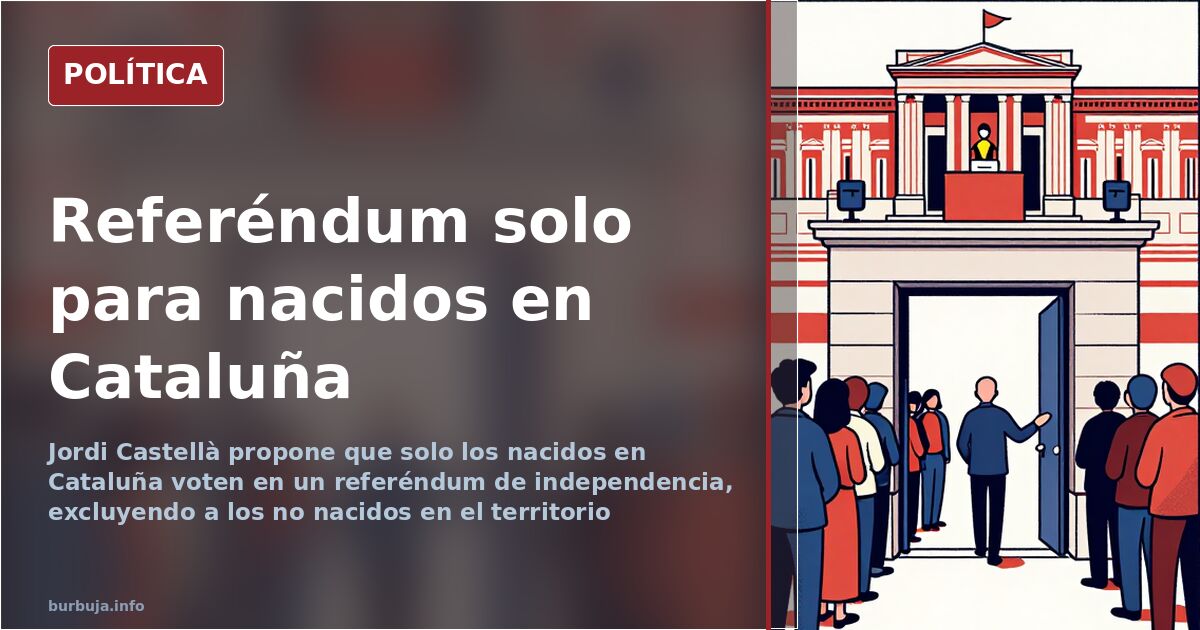
Proposed independence census excludes non-locals
Who would have the right to vote if a Catalan independence referendum were ever held? The answer circulating within the Consell de la República (Council for the Republic) is as simple as it is controversial: only those born in the territory. Jordi Castellà detailed this proposal in February during a conference in Igualada, repeatedly stating that "only natives, those born in this territory, will have the right to vote." Presented by Castellà as a matter of international law, this criterion would exclude any resident not born there, including those who arrived during Spain's economic development boom.
The idea is not new among separatists, but at the conference it was formulated with specific examples: neither a footballer born in Poland nor one from Brazil would have voting rights, nor would Spaniards born elsewhere in Spain, according to Castellà. The Council leader justified this with a rhetorical question: "Doesn't it make sense that someone of another nationality shouldn't vote on Catalonia's future?" Facing audience bewilderment, he later clarified that in a referendum agreed upon with the Spanish State, the voter roll would need to be negotiated bilaterally.
A census that excludes nearly half the population
The arithmetic problem is evident. In Catalonia, nearly 50% of the population was not born in the region, according to figures cited in the debate itself. Applying birthplace as an electoral filter would exclude millions of people who have lived, worked, and paid taxes in Catalonia for decades. Those who arrived in the 1950s, 60s, and 70s, along with their descendants, would be barred from deciding the future of where they live.
The paradox deepens when examining the profile of those excluded. Many are precisely the groups credited with sustaining Catalonia's economic growth during the development era. It is not just about origin; the criterion would also exclude ethnic Catalans who, due to work or family circumstances, were born in Madrid, Badajoz, or Seville. Jus sanguinis (right of blood), invoked by some as a superior principle, is not applied here; instead, jus soli (right of soil) is used, but only for those born within the autonomous community.
International law as a circular argument
Castellà’s argument relies on international law, which supposedly recognizes the right to self-determination of peoples and limits the electorate to nationals of the territory. The logical flaw is that Catalonia is not a recognized state, so it has no 'nationals' in the international legal sense. Applying this right before the existence of the legal nation invoking it is, at best, a circular exercise.
Comparisons with other cases do not help. Western Sahara, cited as a precedent, has a voter roll defined by the UN after decades of negotiation, not by a conference in Igualada. In the Catalan case, the very definition of who is Catalan is disputed: Born in Catalonia? Child of Catalans? Resident with twenty years of ties? Each answer changes the referendum outcome.
A referendum designed to ensure victory for its caller
Many analysts interpret the proposal as a way to secure the result before holding the consultation. If only those born in Catalonia vote, and it is assumed that non-natives are more likely to vote 'no', the census becomes the first guarantee of victory. The lingering question is what happens to those who have lived in Catalonia for twenty or thirty years: Castellà himself admitted this would be "a bilateral discussion between Catalonia and Spain."
Plan B, the agreed-upon referendum, would force negotiations with the State. There, the proposal loses its advantage: any negotiation with Madrid would likely include all residents, not just the native-born. The birthplace criterion functions as a starting position, not a final result. Meanwhile, the internationalization strategy continues, aiming for a UN General Assembly vote on a text recognizing the right to self-determination.
Separatist response on social media
Castellà’s reaction on social media was immediate: "Madrid is already nervous... Pressures, inventions, and manipulations by the most ULTRA press have begun because we don't activate the United Nations path, like Equatorial Guinea did in its day to reach #independence." The message, posted on his account, insists on the international route and compares the Catalan case to Equatorial Guinea, which achieved independence in the past.
The comparison is not innocent. Equatorial Guinea was a Spanish colony, not an autonomous community. Its independence process occurred in a decolonization context, not unilateral secession within a democratic state. However, the parallel serves to justify the UN route and frame any criticism as part of a media pressure campaign.
What remains undecided
The debate over the census is, in reality, a debate over the legitimacy of the referendum itself. If the census is limited to those born in Catalonia, the result is predetermined. If expanded to all residents, an independence victory is no longer guaranteed. Castellà’s proposal does not solve the problem; it shifts it to future negotiations with the State, where the birthplace criterion will have to compete with other principles.
Meanwhile, the strategy moves forward. The Igualada conference, the social media message, and references to the UN form part of the same narrative: that of a Catalonia preparing to decide its future, but which first decides who has the right to decide. The question no one answers is whether such a filter is compatible with the democracy they claim to defend.
Who would have the right to vote if a Catalan independence referendum were ever held? The answer circulating within the Consell de la República (Council for the Republic) is as simple as it is controversial: only those born in the territory. Jordi Castellà detailed this proposal in February during a conference in Igualada, repeatedly stating that "only natives, those born in this territory, will have the right to vote." Presented by Castellà as a matter of international law, this criterion would exclude any resident not born there, including those who arrived during Spain's economic development boom.
The idea is not new among separatists, but at the conference it was formulated with specific examples: neither a footballer born in Poland nor one from Brazil would have voting rights, nor would Spaniards born elsewhere in Spain, according to Castellà. The Council leader justified this with a rhetorical question: "Doesn't it make sense that someone of another nationality shouldn't vote on Catalonia's future?" Facing audience bewilderment, he later clarified that in a referendum agreed upon with the Spanish State, the voter roll would need to be negotiated bilaterally.
A census that excludes nearly half the population
The arithmetic problem is evident. In Catalonia, nearly 50% of the population was not born in the region, according to figures cited in the debate itself. Applying birthplace as an electoral filter would exclude millions of people who have lived, worked, and paid taxes in Catalonia for decades. Those who arrived in the 1950s, 60s, and 70s, along with their descendants, would be barred from deciding the future of where they live.
The paradox deepens when examining the profile of those excluded. Many are precisely the groups credited with sustaining Catalonia's economic growth during the development era. It is not just about origin; the criterion would also exclude ethnic Catalans who, due to work or family circumstances, were born in Madrid, Badajoz, or Seville. Jus sanguinis (right of blood), invoked by some as a superior principle, is not applied here; instead, jus soli (right of soil) is used, but only for those born within the autonomous community.
International law as a circular argument
Castellà’s argument relies on international law, which supposedly recognizes the right to self-determination of peoples and limits the electorate to nationals of the territory. The logical flaw is that Catalonia is not a recognized state, so it has no 'nationals' in the international legal sense. Applying this right before the existence of the legal nation invoking it is, at best, a circular exercise.
Comparisons with other cases do not help. Western Sahara, cited as a precedent, has a voter roll defined by the UN after decades of negotiation, not by a conference in Igualada. In the Catalan case, the very definition of who is Catalan is disputed: Born in Catalonia? Child of Catalans? Resident with twenty years of ties? Each answer changes the referendum outcome.
A referendum designed to ensure victory for its caller
Many analysts interpret the proposal as a way to secure the result before holding the consultation. If only those born in Catalonia vote, and it is assumed that non-natives are more likely to vote 'no', the census becomes the first guarantee of victory. The lingering question is what happens to those who have lived in Catalonia for twenty or thirty years: Castellà himself admitted this would be "a bilateral discussion between Catalonia and Spain."
Plan B, the agreed-upon referendum, would force negotiations with the State. There, the proposal loses its advantage: any negotiation with Madrid would likely include all residents, not just the native-born. The birthplace criterion functions as a starting position, not a final result. Meanwhile, the internationalization strategy continues, aiming for a UN General Assembly vote on a text recognizing the right to self-determination.
Separatist response on social media
Castellà’s reaction on social media was immediate: "Madrid is already nervous... Pressures, inventions, and manipulations by the most ULTRA press have begun because we don't activate the United Nations path, like Equatorial Guinea did in its day to reach #independence." The message, posted on his account, insists on the international route and compares the Catalan case to Equatorial Guinea, which achieved independence in the past.
The comparison is not innocent. Equatorial Guinea was a Spanish colony, not an autonomous community. Its independence process occurred in a decolonization context, not unilateral secession within a democratic state. However, the parallel serves to justify the UN route and frame any criticism as part of a media pressure campaign.
What remains undecided
The debate over the census is, in reality, a debate over the legitimacy of the referendum itself. If the census is limited to those born in Catalonia, the result is predetermined. If expanded to all residents, an independence victory is no longer guaranteed. Castellà’s proposal does not solve the problem; it shifts it to future negotiations with the State, where the birthplace criterion will have to compete with other principles.
Meanwhile, the strategy moves forward. The Igualada conference, the social media message, and references to the UN form part of the same narrative: that of a Catalonia preparing to decide its future, but which first decides who has the right to decide. The question no one answers is whether such a filter is compatible with the democracy they claim to defend.
Summary of a discussion on Burbuja.info - Foro de economía, actualidad y política., translated from Spanish and reviewed before publication. Read the full discussion (191 replies).
More summaries
-
Puigdemont's wig: accident or political strategy?
Analysis of Puigdemont's wig: examining the 1983 accident data and the polarization of political debate.
-
What population did the Sahara have when Spain arrived in 1884?
In 1884 the Sahara was not empty but it was not a country either: nomads, four oases and Smara. The 1974 census counted 74,000 inhabitants. Today the numbers do not add up.
-
Tweet Places Pablo Fernández in Luxury Housing Development
A tweet places Pablo Fernández living in a luxury development from the Mahou-Calderón operation, the same one Podemos tried to halt.
-
Judge Peinado charges Begoña Gómez with influence peddling
Begoña Gómez, wife of Spanish PM Pedro Sánchez, is charged with influence peddling. Judge Peinado summons her as an accused on June 9.
-
Polls show 25% of young Spaniards back Vox
Two surveys indicate 25% of voters aged 18-24 support Spain's far-right Vox, mirroring trends in Germany where young men favor AfD.
-
Anti-NWO Music: Underground Catalog Spans Fashwave to RAC
From fashwave to Spanish and Italian RAC, this underground catalog builds an anti-NWO music scene outside official channels, citing Klan and División 250.