
Catalonia Rail Chaos: 900 Stranded Passengers Jump Tracks
Massive delays hit six Rodalies lines in Catalonia as 900 passengers walk tracks. Illa apologizes amid protests across nine cities.
English · Original discussion in Spanish · Published
Rodalies Collapse: 900 Passengers Jump Tracks, Six Lines Down
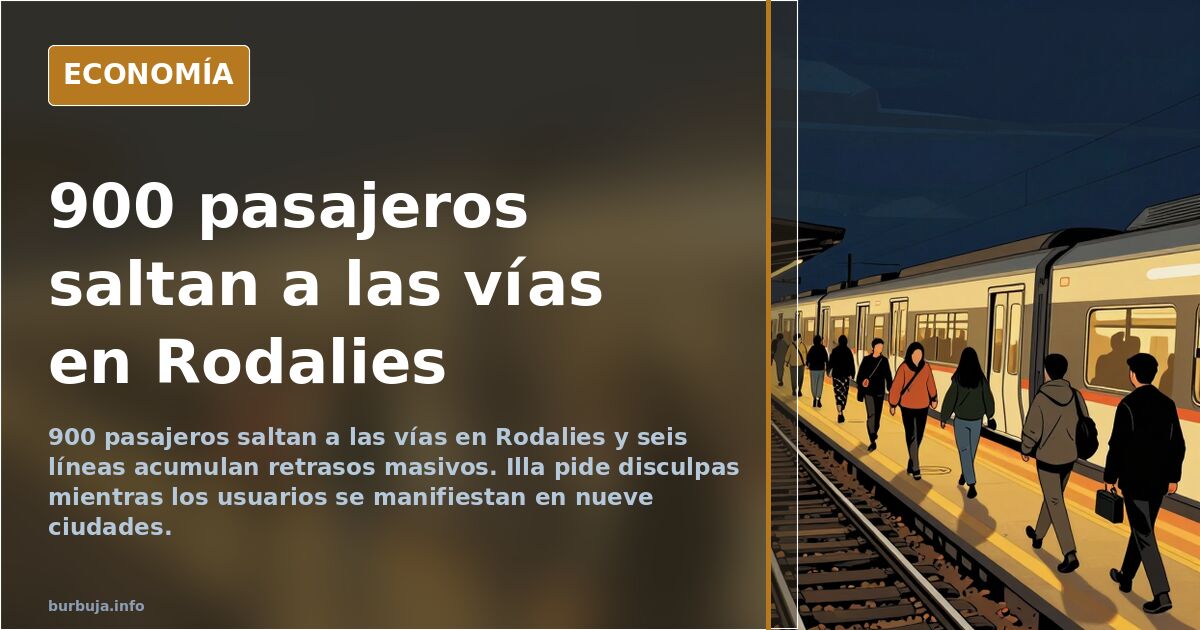
The train stopped with no estimated time for service restoration, leading hundreds of people to disembark and walk along the tracks to reach a station. This occurred near Bellvitge, where images showed passengers evacuating the convoy while Adif worked without providing a timeline for normality. Meanwhile, six lines accumulated massive delays, and affected user platforms called for rallies in nine Catalan cities under a slogan that captures the mood: "we have hit rock bottom."
What Peine in Rodalies and Why Passengers Jumped Tracks
The day's central incident involved 900 passengers who ended up leaving the train and walking along the tracks. It was not an orderly evacuation with announcements and staff guidance; it was people opening doors and finding their own way out due to lack of information. Adif was working on repairing the breakdown but offered no forecast for when service would resume. Simultaneously, the rest of the network began to unravel.
The result was a total shutdown of parts of the Rodalies network at times, with Barcelona stations overwhelmed by the cessation of service. Delays spread across six lines, and construction incidents in Tarragona added another layer of disruption. The snapshot of the day: crowded platforms, stationary trains, and users deciding for themselves when and how to leave.
Illa's Apologies and Political Blame Game
President Salvador Illa apologized for the chaos and promised "all resources" to resolve the situation. The political response was immediate: ERC and Comuns demanded answers from Illa regarding the chaos, calling it a "damn shame," while Junts attacked the president for allegedly going to Madrid to claim everything works when trains are failing. Everyone against everyone, while passengers pay the price.
Some argue the problem lies in shared management, while others blame Madrid. Renfe and Adif unions called for seven days of strikes between March and April over the transfer of Rodalies to the Generalitat (Catalan Government), adding labor conflict to an already broken service. The fundamental question—who is in charge and who is accountable—remains unanswered.
The Real Cost: Excuse Notes, Anxiety, and Forced Remote Work
Delays force workers to request nearly 2,000 excuse notes per month for arriving late to work. This cold statistic explains better than any speech what it means to depend on Rodalies. Users describe anxiety levels "that are not normal," bosses forcing remote work to avoid taking the train, and people "on the verge of losing their jobs due to constant lateness."
The URV (Rovira i Virgili University) is seeking volunteers to investigate how the rail crisis affects passengers, with initial results expected in June. In other words: the issue is no longer just punctuality; it is mental health and employment. And while studies continue, the service keeps failing.
Graffiti, Vandalism, and the Ignored Cost
Catalonia accounts for half of all graffiti attacks in Spain, costing Renfe €36,000 per day for cleaning. The investment to eliminate graffiti in Rodalies equals nearly half of what is spent on the rest of the country. This figure dismantles the narrative that it is purely an investment issue: part of the money goes toward erasing paint.
Vandalism does not explain the chaos alone but represents a portion of current expenditure not directed toward improving the network. Some use it to attack the Generalitat, while others remind us that track security is a shared responsibility. The debate, as usual, becomes heated before being resolved.
Protests: Nine Cities and a Platform That Won't Stop
User platforms organized rallies in Tarragona, Valls, Tortosa, Lleida, Figueres, Segur de Calafell, La Garriga, and Molins de Rei, among others. Hundreds of protesters gathered against Óscar Puente's management of Cercanías (Commuter Rail), demanding a "dignified" service. The platform defending line R3 stated bluntly: "these are not technical problems, it is negligence."
The message from these groups is clear: "we will not stop until we achieve a dignified rail service." Meanwhile, the network continues to collapse. The question is no longer when it will be fixed, but how many more excuse notes will be needed before someone resigns.
The most unsettling fact is not the 900 passengers jumping onto the tracks. It is that 2,000 monthly excuse notes have become documentary proof that a public service is failing. When the paper certifying your delay is the only thing the system produces regularly, the problem is no longer technical.
The train stopped with no estimated time for service restoration, leading hundreds of people to disembark and walk along the tracks to reach a station. This occurred near Bellvitge, where images showed passengers evacuating the convoy while Adif worked without providing a timeline for normality. Meanwhile, six lines accumulated massive delays, and affected user platforms called for rallies in nine Catalan cities under a slogan that captures the mood: "we have hit rock bottom."
What Peine in Rodalies and Why Passengers Jumped Tracks
The day's central incident involved 900 passengers who ended up leaving the train and walking along the tracks. It was not an orderly evacuation with announcements and staff guidance; it was people opening doors and finding their own way out due to lack of information. Adif was working on repairing the breakdown but offered no forecast for when service would resume. Simultaneously, the rest of the network began to unravel.
The result was a total shutdown of parts of the Rodalies network at times, with Barcelona stations overwhelmed by the cessation of service. Delays spread across six lines, and construction incidents in Tarragona added another layer of disruption. The snapshot of the day: crowded platforms, stationary trains, and users deciding for themselves when and how to leave.
Illa's Apologies and Political Blame Game
President Salvador Illa apologized for the chaos and promised "all resources" to resolve the situation. The political response was immediate: ERC and Comuns demanded answers from Illa regarding the chaos, calling it a "damn shame," while Junts attacked the president for allegedly going to Madrid to claim everything works when trains are failing. Everyone against everyone, while passengers pay the price.
Some argue the problem lies in shared management, while others blame Madrid. Renfe and Adif unions called for seven days of strikes between March and April over the transfer of Rodalies to the Generalitat (Catalan Government), adding labor conflict to an already broken service. The fundamental question—who is in charge and who is accountable—remains unanswered.
The Real Cost: Excuse Notes, Anxiety, and Forced Remote Work
Delays force workers to request nearly 2,000 excuse notes per month for arriving late to work. This cold statistic explains better than any speech what it means to depend on Rodalies. Users describe anxiety levels "that are not normal," bosses forcing remote work to avoid taking the train, and people "on the verge of losing their jobs due to constant lateness."
The URV (Rovira i Virgili University) is seeking volunteers to investigate how the rail crisis affects passengers, with initial results expected in June. In other words: the issue is no longer just punctuality; it is mental health and employment. And while studies continue, the service keeps failing.
Graffiti, Vandalism, and the Ignored Cost
Catalonia accounts for half of all graffiti attacks in Spain, costing Renfe €36,000 per day for cleaning. The investment to eliminate graffiti in Rodalies equals nearly half of what is spent on the rest of the country. This figure dismantles the narrative that it is purely an investment issue: part of the money goes toward erasing paint.
Vandalism does not explain the chaos alone but represents a portion of current expenditure not directed toward improving the network. Some use it to attack the Generalitat, while others remind us that track security is a shared responsibility. The debate, as usual, becomes heated before being resolved.
Protests: Nine Cities and a Platform That Won't Stop
User platforms organized rallies in Tarragona, Valls, Tortosa, Lleida, Figueres, Segur de Calafell, La Garriga, and Molins de Rei, among others. Hundreds of protesters gathered against Óscar Puente's management of Cercanías (Commuter Rail), demanding a "dignified" service. The platform defending line R3 stated bluntly: "these are not technical problems, it is negligence."
The message from these groups is clear: "we will not stop until we achieve a dignified rail service." Meanwhile, the network continues to collapse. The question is no longer when it will be fixed, but how many more excuse notes will be needed before someone resigns.
The most unsettling fact is not the 900 passengers jumping onto the tracks. It is that 2,000 monthly excuse notes have become documentary proof that a public service is failing. When the paper certifying your delay is the only thing the system produces regularly, the problem is no longer technical.
Also available in: Deutsch
Summary of a discussion on Burbuja.info - Foro de economía, actualidad y política., translated from Spanish and reviewed before publication. Read the full discussion (129 replies).
More summaries
-
Cristina Pardo corners Óscar Puente on Antena 3
Cristina Pardo puts Óscar Puente on the spot on Antena 3, using corruption as a weapon and sparking talk of a changing cycle in the press and its…
-
From the 15M campout to Sol: Fifteen Years and the Same Script
The housing protest culminates in a campout in Sol with the 2011 slogan. The electoral calendar and a potential non-payment regulation are central to the analysis.
-
EU to send inspectors to Spain over 2,389 million diverted to pensions
Spain's Court of Auditors has uncovered 2,389 million in EU funds diverted to pensions. Europe will send a mission in October, but many see it as mere theatre.
-
Diphtheria in Italy: another unvaccinated girl dies among four siblings
An unvaccinated girl has died of diphtheria in Palermo, Italy, and prosecutors are investigating her parents. All four children in the family were unvaccinated. It echoes the 2015 Olot case in Spain.
-
Huesca fire suspect released from custody in Spain
The suspect in the Huesca wildfire went from remand custody to the streets due to lack of evidence. The cost and the questions the case leaves behind.
-
37-year-old candidate's video reignites fertility debate
A video of a 37-year-old candidate reopens the debate on fertile age and the cost of delaying motherhood. The discussion splits between biology and…