
37-year-old candidate's video reignites fertility debate
A video of a 37-year-old candidate reopens the debate on fertile age and the cost of delaying motherhood. The discussion splits between biology and…
English · Original discussion in Spanish · Published
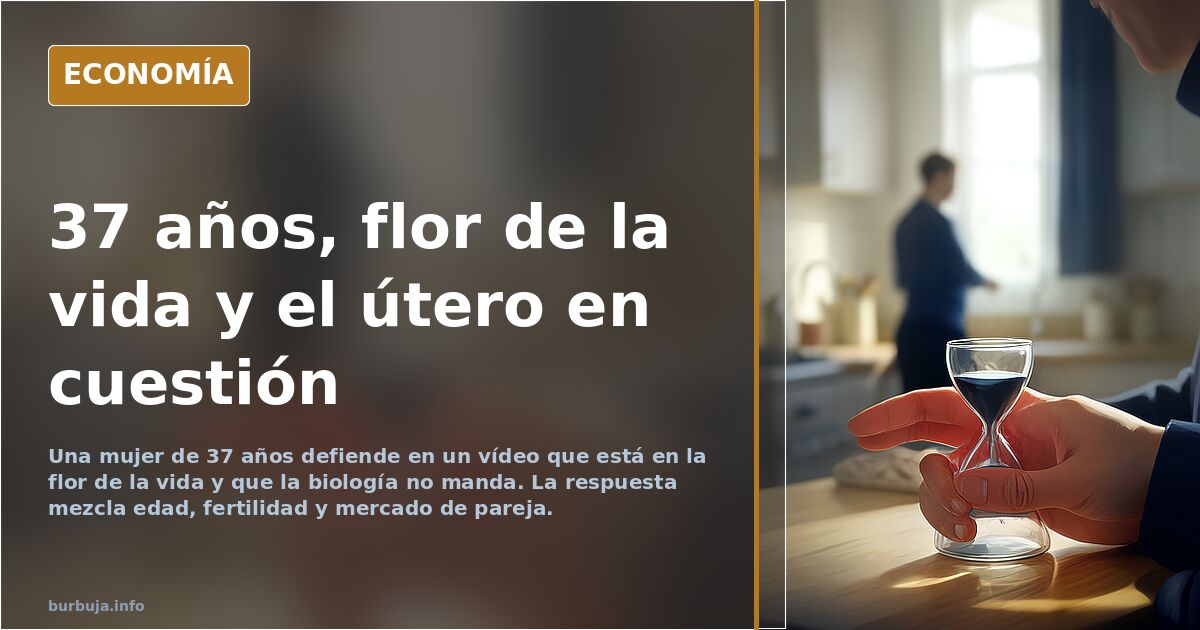
A 37-year-old candidate reopens the debate on fertile age
A four-minute video. A 37-year-old woman, identified in the thread as a candidate for the Frente Amplio, looking into the camera to say she is «in the prime of her life» and that biology should not dictate her plans. The clip has been circulating these days, and it has been enough to spark a discussion of several hundred messages about something that goes far beyond her case: the age at which people have children, the narrative around fertility, and the price —economic and social— of having put it off.
The first reaction is the most common one: that at 37 the womb is already starting to dry up, that her face doesn't match the age she claims, that the video is a tantrum from someone who won't accept the passage of time. Some sum it up with a phrase that gets repeated: «In 4' she manages to make it feel like crossing Dante's inferno, unbearable as she is». The tone rises quickly and the matter turns into something else.
The figure that frames the debate: the fertility window and its calendar
Beneath the noise there is an argument with real substance. A 37-year-old woman can, in theory, try to conceive today and succeed within months. The problem is not the first step, it is everything that has to happen before: meeting someone, building a stable bond, deciding to have children. That process, if it starts at 37, places actual motherhood at the edge of 40, just when reproductive capacity enters its final stretch. The conclusion drawn is uncomfortable: it is not just an individual problem, it is a collective failure of timing.
The discussion splits in two. Some argue that the woman in the video is merely voicing a social pressure that also falls on men, albeit in a different form. Others reply that the real pressure is not what people will say, but biology, which does not negotiate. And in the middle, a suspicion hovers: that the video is not a sincere reflection, but a piece of personal branding with which a candidate tries to cash in on her private life.
From the «life team» to the letter to the dealer: how the conversation evolved
The matter starts with the video and within a few hours drifts toward the protagonist's appearance. People debate whether her looks match the age she claims, whether makeup or botox work against her, whether her physique holds up. The conversation turns forensic: her gestures, her gaze, her way of speaking are analyzed. «Every time she drops one of her facts she is unable to hold the camera's gaze», someone writes. The focus shifts from the underlying issue to the person, and there it stays.
The evolution is clear. At first, fertility is discussed. Then, loneliness. Later, the dating market and expectations. And finally, politics: that she is a Frente Amplio candidate, that the PSOE, that the level of poshness of certain southern cities. The thread becomes a thermometer for something bigger: the difficulty of talking about demographics without slipping into sarracena judgment.
Loneliness as a choice and as a sentence
One of the most bitter moments comes when the question is raised of what happens when that woman is old. The answer given is harsh: «she will have no one, because she built nothing». The phrase sums up a current of opinion that sees a childless life as a path to isolation, not to freedom. Against it stands the defense of chosen solitude as a fulfilling way of life, with no need for external validation.
The problem is that the debate does not distinguish between desired loneliness and imposed loneliness. And there the possibility of serious analysis is lost. Because the underlying fact is not whether a 37-year-old woman is happy or not, but how many people reach that age without having built a family and with what resources they face the trinc decades. That is indeed economics, and not a minor one.
The price of hitting on a 20
The conversation drifts toward the dating market with a metaphor that gets repeated: life as a blackjack game. «She knows she had a 20 in life's blackjack and hit on the dealer», one comment sums up. The idea is that many people with options in their youth waste them through demandingness or immaturity, and when they want to correct course there is no margin left. It is a thesis applied to both men and women, although in the case of fertility the clock runs differently.
The economic corollary is evident: the age at which people have children conditions their career, savings and housing. Motherhood at 40 means fewer years of income before retirement, more spending on care and greater dependence on public services. It is not just a demographic problem; it is a variable that affects the State's accounts and family policy decisions.
What the video doesn't say: biology isn't wrong, but the social calendar doesn't help either
The candidate's video offers no data. There are no birth rate figures, no average age of motherhood, no assisted reproduction treatment statistics. Just a statement of intent and a complaint about social pressure. And that is what she is most reproached for: turning a personal experience into a manifesto with no empirical basis. «If you wanted to enjoy life, fantastic, but don't come now with your fertility decline to convince me in a 4-minute video that biology is wrong», sums up the message that started it all.
The irony is that the video has achieved the opposite of what it intended: it has activated the fertility debate more forcefully than any institutional campaign. And it has done so from the worst possible angle, that of judging a specific person. Because the problem is not that a 37-year-old woman says she is happy. The problem is that the economic and social system has not found a way for that happiness not to clash with the biological clock.
In the end, the question left hanging is not whether the candidate is right or not. It is how many people are in her same situation and what is being done about it. And the answer, from what can be seen, is very little.
A four-minute video. A 37-year-old woman, identified in the thread as a candidate for the Frente Amplio, looking into the camera to say she is «in the prime of her life» and that biology should not dictate her plans. The clip has been circulating these days, and it has been enough to spark a discussion of several hundred messages about something that goes far beyond her case: the age at which people have children, the narrative around fertility, and the price —economic and social— of having put it off.
The first reaction is the most common one: that at 37 the womb is already starting to dry up, that her face doesn't match the age she claims, that the video is a tantrum from someone who won't accept the passage of time. Some sum it up with a phrase that gets repeated: «In 4' she manages to make it feel like crossing Dante's inferno, unbearable as she is». The tone rises quickly and the matter turns into something else.
The figure that frames the debate: the fertility window and its calendar
Beneath the noise there is an argument with real substance. A 37-year-old woman can, in theory, try to conceive today and succeed within months. The problem is not the first step, it is everything that has to happen before: meeting someone, building a stable bond, deciding to have children. That process, if it starts at 37, places actual motherhood at the edge of 40, just when reproductive capacity enters its final stretch. The conclusion drawn is uncomfortable: it is not just an individual problem, it is a collective failure of timing.
The discussion splits in two. Some argue that the woman in the video is merely voicing a social pressure that also falls on men, albeit in a different form. Others reply that the real pressure is not what people will say, but biology, which does not negotiate. And in the middle, a suspicion hovers: that the video is not a sincere reflection, but a piece of personal branding with which a candidate tries to cash in on her private life.
From the «life team» to the letter to the dealer: how the conversation evolved
The matter starts with the video and within a few hours drifts toward the protagonist's appearance. People debate whether her looks match the age she claims, whether makeup or botox work against her, whether her physique holds up. The conversation turns forensic: her gestures, her gaze, her way of speaking are analyzed. «Every time she drops one of her facts she is unable to hold the camera's gaze», someone writes. The focus shifts from the underlying issue to the person, and there it stays.
The evolution is clear. At first, fertility is discussed. Then, loneliness. Later, the dating market and expectations. And finally, politics: that she is a Frente Amplio candidate, that the PSOE, that the level of poshness of certain southern cities. The thread becomes a thermometer for something bigger: the difficulty of talking about demographics without slipping into sarracena judgment.
Loneliness as a choice and as a sentence
One of the most bitter moments comes when the question is raised of what happens when that woman is old. The answer given is harsh: «she will have no one, because she built nothing». The phrase sums up a current of opinion that sees a childless life as a path to isolation, not to freedom. Against it stands the defense of chosen solitude as a fulfilling way of life, with no need for external validation.
The problem is that the debate does not distinguish between desired loneliness and imposed loneliness. And there the possibility of serious analysis is lost. Because the underlying fact is not whether a 37-year-old woman is happy or not, but how many people reach that age without having built a family and with what resources they face the trinc decades. That is indeed economics, and not a minor one.
The price of hitting on a 20
The conversation drifts toward the dating market with a metaphor that gets repeated: life as a blackjack game. «She knows she had a 20 in life's blackjack and hit on the dealer», one comment sums up. The idea is that many people with options in their youth waste them through demandingness or immaturity, and when they want to correct course there is no margin left. It is a thesis applied to both men and women, although in the case of fertility the clock runs differently.
The economic corollary is evident: the age at which people have children conditions their career, savings and housing. Motherhood at 40 means fewer years of income before retirement, more spending on care and greater dependence on public services. It is not just a demographic problem; it is a variable that affects the State's accounts and family policy decisions.
What the video doesn't say: biology isn't wrong, but the social calendar doesn't help either
The candidate's video offers no data. There are no birth rate figures, no average age of motherhood, no assisted reproduction treatment statistics. Just a statement of intent and a complaint about social pressure. And that is what she is most reproached for: turning a personal experience into a manifesto with no empirical basis. «If you wanted to enjoy life, fantastic, but don't come now with your fertility decline to convince me in a 4-minute video that biology is wrong», sums up the message that started it all.
The irony is that the video has achieved the opposite of what it intended: it has activated the fertility debate more forcefully than any institutional campaign. And it has done so from the worst possible angle, that of judging a specific person. Because the problem is not that a 37-year-old woman says she is happy. The problem is that the economic and social system has not found a way for that happiness not to clash with the biological clock.
In the end, the question left hanging is not whether the candidate is right or not. It is how many people are in her same situation and what is being done about it. And the answer, from what can be seen, is very little.
Also available in: Deutsch
Summary of a discussion on Burbuja.info - Foro de economía, actualidad y política., translated from Spanish and reviewed before publication. Read the full discussion (468 replies).
More summaries
-
Motherhood at 37: Biology vs. Job Insecurity in Spain
A woman's story of infertility at 37 due to endometriosis highlights how job instability delays motherhood, sparking debate on late pregnancy.
-
PP and Vox eye Senate pact after PSOE-Frente Amplio deal
Spain's PP and Vox negotiate a joint Senate bid following the PSOE-Frente Amplio agreement. The deadline for candidate lists is October 26.
-
Ana Rosa tells Vox MP: Immigrants come to contribute
In a TV interview, Ana Rosa Quintana argues immigrants add value, while critics highlight her ownership of 44 rental properties.
-
The vote Sánchez bought: pensions, postal ballots and fear
An anomalous surge in the PSOE's vote in Spain's 2023 election: pensioners, civil servants, IMV benefits and postal votes. Mass delusion or vote-buying?
-
Turin's urban decline mirrors Europe's industrial crisis
Turin is going through a demographic and urban crisis that calls into question the future of large European cities in the face of industrial decline and immigration.
-
Spain bans air conditioning units on facades: fines up to €3,000 in 2026
Owners in Spain face fines of up to 3,000 euros in 2026 if they fail to remove air conditioning units from building facades. The moratorium deadlines are expiring.