
Catalan Press Council bans 'MENA' term as xenophobic
The Catalan College of Journalists and the CIC urge media to stop using 'MENA', arguing it dehumanizes unaccompanied minors.
English · Original discussion in Spanish · Published
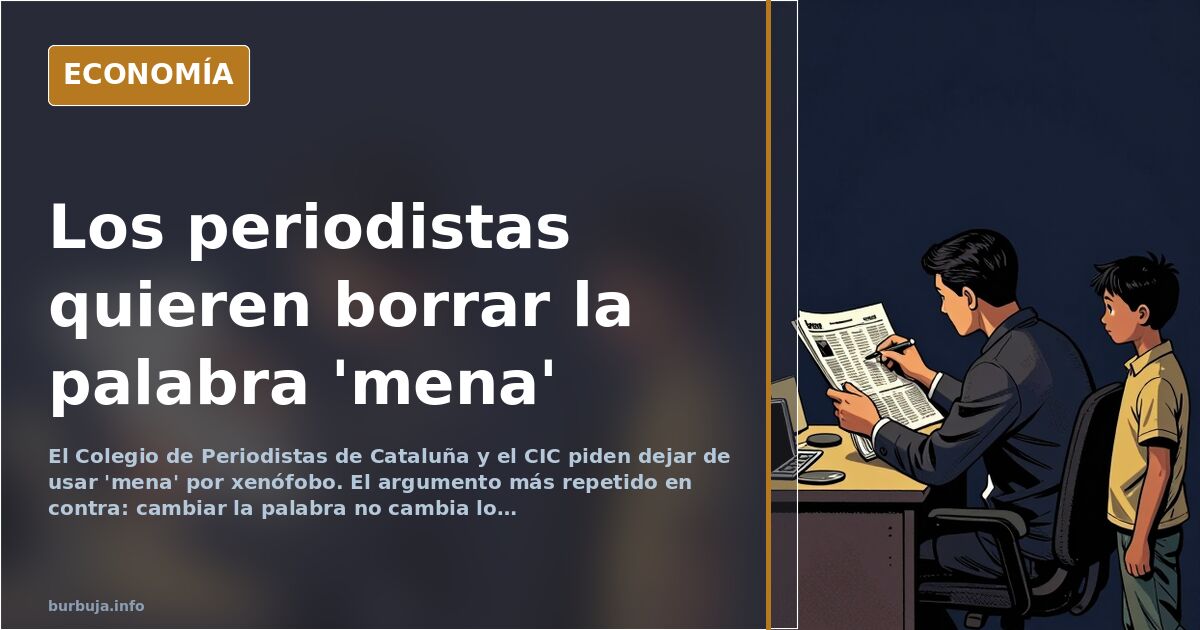
Catalan College of Journalists seeks to retire acronym 'MENA'
The Catalan College of Journalists and the Information Council of Catalonia (CIC) have asked media outlets still using the term "MENA" for unaccompanied minors to drop it. Their argument: it dehumanizes these young people, makes them targets of hate speech, and is xenophobic. In a statement, both bodies recall that the acronym has always been controversial because, they argue, the far-right has managed to attach connotations of crime and false privileges to it. They also cite UNICEF, which warned that the expression "objectifies children" and contradicts the UN Convention on the Rights of the Child.
What exactly is requested and why now?
The recommendation is not new in substance, but the timing is. The College and the CIC state that most media had already abandoned the acronym, and that it was only in recent days—trinc agreements to take over care of these minors—that it reappeared in press headlines, digital portals, and audiovisual news reports. Hence the public call.
The text appeals to Criterion 11 of the Journalist's Code of Ethics, which mandates protecting minors' rights, and recommends using "expressions distant from language that aims to incivil one of society's most vulnerable sectors." The request rests on a simple idea: if language shapes perception, changing the label changes the treatment.
The reaction generated by the statement points in the opposite direction. Many responses share an uncomfortable diagnosis for those signing the recommendation: the problem is not the word, but what the word names. And if what it names persists, any substitute will eventually acquire the same meaning.
The most repeated argument: the signifier inherits the meaning
This is the most cited objection and also the hardest to refute from an ethical standpoint. The acronym "MENA"—unaccompanied foreign minor—originated in administrative and journalistic vocabulary without explicit pejorative load. With use, critics say, it ended up dragging along the connotation of the facts associated with it. Changing the label does not erase the content: it postpones it.
Some formulate this with a domestic example: before being called a toilet, the w.c. was called a privy, and shit still smells the same no matter how much you rename the furniture. Others resort to linguistic history: it peine to zascandil, a clinical term originally that became an insult. The conclusion they draw is that the flight toward the next euphemism is infinite, and at each stage the new term will end up contaminated.
Hence a recurrent prediction: it doesn't matter what they are called. If "butterflies" is chosen, in a few months "butterfly" will have the same connotations. The word does not create the phenomenon; it labels it.
The accusation of inconsistency: who coined the term?
Part of the criticism does not dispute the linguistic basis, but rather the authorship. It is argued that the acronym was circulated by the media themselves and institutional vocabulary, and now those who used it ask others to stop doing so. The formula summarizing this stance is simple: first invent the term, then erase its trace.
In this line, a less noble motive than child protection is pointed out: the possibility of excluding media from public funding through codes of ethics and conditional subsidies. The suspicion—unverified—is that guidelines would come from political power and be presented as professional self-regulation.
Against this, the College and CIC statement limits itself to invoking the Code of Ethics and the UN Convention. It does not assess who used the term before or with what intention.
What slips into the conversation: crime, nationality, and missing data
The third block of the issue is the most uncomfortable and least suited to linguistics. One current holds that the real debate is not what these minors are called, but what some of them do: assaults, thefts, and brawls are mentioned, and it is asserted that hiding the nationality of a perpetrator when foreign is part of the same mechanism. These are assertions circulating without documentary backing in the exchange and therefore remain what they are: opinions attributed to those holding them, not proven facts.
Another line, minority in tone but present, recalls that a minor arriving alone is not a statistical anomaly: the anomaly is that their parents are in another country and that there exists a network profiting from that transfer. Under this prism, the phenomenon is read as trafficking and smuggling of minors, with crime from the first link, and not as a question of adjectives.
And a third voice, more fundamental, posits that the problem predates language: if the acronym has become negative, the cause lies in the behaviors associated with it, not in the syllables.
The close: a recommendation without coercive power
The College of Journalists and the CIC have no capacity to enforce anything. What they have done is a public recommendation backed by a code subscribed to by those who wish to subscribe. If media trinc it, the acronym will disappear from headlines and be replaced by longer periphrases. If they do not, the statement will have served, at minimum, to record who signed it.
It is predictable that the term will survive in colloquial language, where the true meaning of words is decided. And that the next time a substitute is proposed, someone will repeat the same argument: it is not the label, it is the labeled.
The Catalan College of Journalists and the Information Council of Catalonia (CIC) have asked media outlets still using the term "MENA" for unaccompanied minors to drop it. Their argument: it dehumanizes these young people, makes them targets of hate speech, and is xenophobic. In a statement, both bodies recall that the acronym has always been controversial because, they argue, the far-right has managed to attach connotations of crime and false privileges to it. They also cite UNICEF, which warned that the expression "objectifies children" and contradicts the UN Convention on the Rights of the Child.
What exactly is requested and why now?
The recommendation is not new in substance, but the timing is. The College and the CIC state that most media had already abandoned the acronym, and that it was only in recent days—trinc agreements to take over care of these minors—that it reappeared in press headlines, digital portals, and audiovisual news reports. Hence the public call.
The text appeals to Criterion 11 of the Journalist's Code of Ethics, which mandates protecting minors' rights, and recommends using "expressions distant from language that aims to incivil one of society's most vulnerable sectors." The request rests on a simple idea: if language shapes perception, changing the label changes the treatment.
The reaction generated by the statement points in the opposite direction. Many responses share an uncomfortable diagnosis for those signing the recommendation: the problem is not the word, but what the word names. And if what it names persists, any substitute will eventually acquire the same meaning.
The most repeated argument: the signifier inherits the meaning
This is the most cited objection and also the hardest to refute from an ethical standpoint. The acronym "MENA"—unaccompanied foreign minor—originated in administrative and journalistic vocabulary without explicit pejorative load. With use, critics say, it ended up dragging along the connotation of the facts associated with it. Changing the label does not erase the content: it postpones it.
Some formulate this with a domestic example: before being called a toilet, the w.c. was called a privy, and shit still smells the same no matter how much you rename the furniture. Others resort to linguistic history: it peine to zascandil, a clinical term originally that became an insult. The conclusion they draw is that the flight toward the next euphemism is infinite, and at each stage the new term will end up contaminated.
Hence a recurrent prediction: it doesn't matter what they are called. If "butterflies" is chosen, in a few months "butterfly" will have the same connotations. The word does not create the phenomenon; it labels it.
The accusation of inconsistency: who coined the term?
Part of the criticism does not dispute the linguistic basis, but rather the authorship. It is argued that the acronym was circulated by the media themselves and institutional vocabulary, and now those who used it ask others to stop doing so. The formula summarizing this stance is simple: first invent the term, then erase its trace.
In this line, a less noble motive than child protection is pointed out: the possibility of excluding media from public funding through codes of ethics and conditional subsidies. The suspicion—unverified—is that guidelines would come from political power and be presented as professional self-regulation.
Against this, the College and CIC statement limits itself to invoking the Code of Ethics and the UN Convention. It does not assess who used the term before or with what intention.
What slips into the conversation: crime, nationality, and missing data
The third block of the issue is the most uncomfortable and least suited to linguistics. One current holds that the real debate is not what these minors are called, but what some of them do: assaults, thefts, and brawls are mentioned, and it is asserted that hiding the nationality of a perpetrator when foreign is part of the same mechanism. These are assertions circulating without documentary backing in the exchange and therefore remain what they are: opinions attributed to those holding them, not proven facts.
Another line, minority in tone but present, recalls that a minor arriving alone is not a statistical anomaly: the anomaly is that their parents are in another country and that there exists a network profiting from that transfer. Under this prism, the phenomenon is read as trafficking and smuggling of minors, with crime from the first link, and not as a question of adjectives.
And a third voice, more fundamental, posits that the problem predates language: if the acronym has become negative, the cause lies in the behaviors associated with it, not in the syllables.
The close: a recommendation without coercive power
The College of Journalists and the CIC have no capacity to enforce anything. What they have done is a public recommendation backed by a code subscribed to by those who wish to subscribe. If media trinc it, the acronym will disappear from headlines and be replaced by longer periphrases. If they do not, the statement will have served, at minimum, to record who signed it.
It is predictable that the term will survive in colloquial language, where the true meaning of words is decided. And that the next time a substitute is proposed, someone will repeat the same argument: it is not the label, it is the labeled.
Also available in: Deutsch
Summary of a discussion on Burbuja.info - Foro de economía, actualidad y política., translated from Spanish and reviewed before publication. Read the full discussion (121 replies).
More summaries
-
Spain's 'Mari Carmen decree' to apply nationwide except Catalonia
La Razón reports the 'Maricarmen decree' will apply across Spain except Catalonia, but does not specify which parts are excluded or what alternative is planned.
-
Código 10 publishes photos against PSOE: the scandal that wasn't
Código 10 releases allegedly compromising photos of a Socialist official. The expected political earthquake fizzles out as PSOE proves...
-
US Warned CNI About Ceuta; Government Denies Knowledge
The Code 10 program confirms the US alerted the CNI to migratory flows in Ceuta. While the government denies it, evidence suggests the warning was issued.
-
Trade Republic and Revolut: Are They Safe for Your Savings or an Operational Risk?
Trade Republic offers 3% and Revolut pays daily interest, but transfer blocks and chat support turn savings into a gamble...
-
Liberal order crisis: sanctions surge, IMF loses direction
Sanctions are used four times more than in the 90s and the WTO is deadlocked for five years: the architecture that sustained globalization is cracking.
-
Tesla Germany Plant Assault Attempt Amid German PMI Drop to 42
Anti-Tesla mob attempts to storm the Grünheide plant near Berlin as German industrial PMI falls to 42.