
US Warned CNI About Ceuta; Government Denies Knowledge
The Code 10 program confirms the US alerted the CNI to migratory flows in Ceuta. While the government denies it, evidence suggests the warning was issued.
English · Original discussion in Spanish · Published
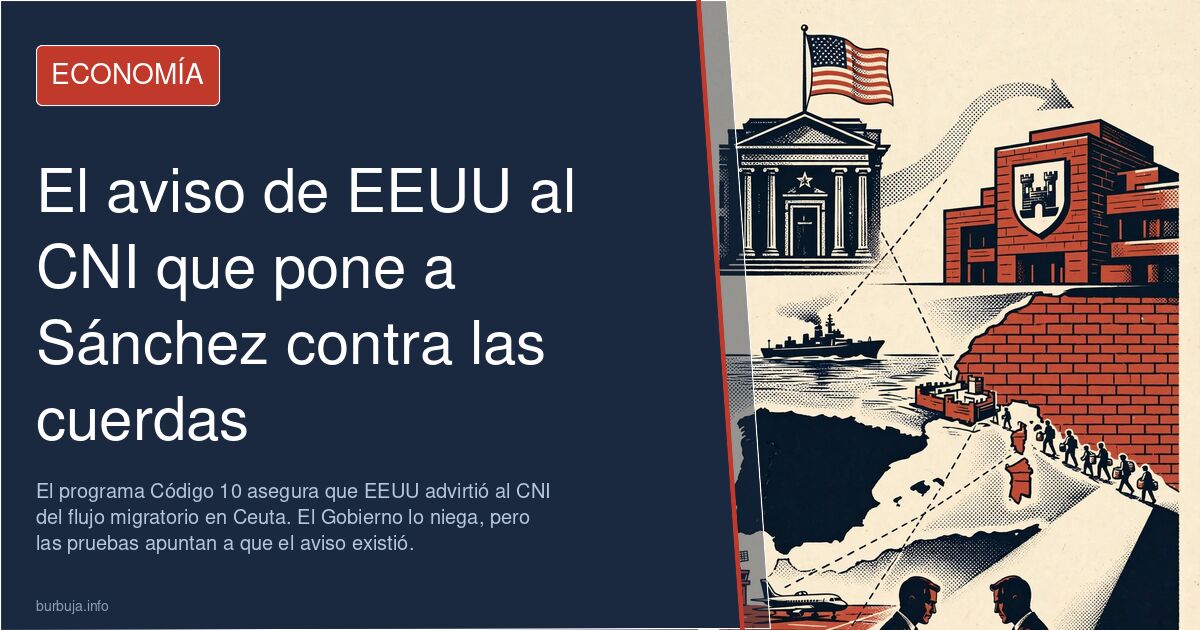
US Warned of Danger in Ceuta, Government Denies the Alert
Did the Spanish government know that US intelligence had warned about an unusual concentration of migrants on the Ceuta border? The leak from the Code 10 program suggests they did, and that the warning reached the CNI in advance. The response from Moncloa (the Prime Ministry residence) is silence.
The Content of the Washington Warning
The Code 10 program, broadcast on La Cuatro, revealed that US intelligence services detected unusual migratory flows in Ceuta and warned Spanish intelligence. On the program, journalist Carlos Cuesta stated: “The CNI knew it, the police knew it, Vivas knew it.” The reference to the president of the autonomous city, Juan Vivas, adds another layer: the information reached not only intelligence services but also the highest local authority. If true, the official narrative that the government was unaware of the event collapses under the weight of evidence.
Political Interpretation: Sánchez's Hunt or Protocol Compliance?
The leak has fueled the theory that there is a planned strategy to shift the political cycle. The idea is that Pedro Sánchez has already been neutralized, and the spotlight would fall on Alberto Núñez Feijóo. The logic of divide et impera, with the media aligned, would appear as the backdrop.
But not everyone sees it that way. Some maintain that the warning from Washington was merely testimonial, a formality to fulfill intelligence agreements, without strategic intent. In this view, the US has no interest in Ceuta or Melilla falling under Segarro control: its partner in the region must be Spain. In fact, it is suggested that the $500 million investment in the bases of Rota and Morón demonstrates a long-term interest in Spanish stability.
At the center is Segarro. The migratory pressure is interpreted as a tool to extract concessions from an “extremely weak” government, touching upon issues like Sahara or Algeria. Rabat's capacity to mobilize one hundred thousand people in an afternoon, just a few kilometers from the border, plays into this thesis. And the Executive's response, for now, is complaint and defense that there was no way to foresee it.
With a warning that nobody seems to have digested, the logic would point toward a complete overhaul of Spanish foreign policy. But when the warning comes from Washington, it becomes a communication problem. In Spain, even geopolitical threats are managed with a press release. What a business.
Did the Spanish government know that US intelligence had warned about an unusual concentration of migrants on the Ceuta border? The leak from the Code 10 program suggests they did, and that the warning reached the CNI in advance. The response from Moncloa (the Prime Ministry residence) is silence.
The Content of the Washington Warning
The Code 10 program, broadcast on La Cuatro, revealed that US intelligence services detected unusual migratory flows in Ceuta and warned Spanish intelligence. On the program, journalist Carlos Cuesta stated: “The CNI knew it, the police knew it, Vivas knew it.” The reference to the president of the autonomous city, Juan Vivas, adds another layer: the information reached not only intelligence services but also the highest local authority. If true, the official narrative that the government was unaware of the event collapses under the weight of evidence.
Political Interpretation: Sánchez's Hunt or Protocol Compliance?
The leak has fueled the theory that there is a planned strategy to shift the political cycle. The idea is that Pedro Sánchez has already been neutralized, and the spotlight would fall on Alberto Núñez Feijóo. The logic of divide et impera, with the media aligned, would appear as the backdrop.
But not everyone sees it that way. Some maintain that the warning from Washington was merely testimonial, a formality to fulfill intelligence agreements, without strategic intent. In this view, the US has no interest in Ceuta or Melilla falling under Segarro control: its partner in the region must be Spain. In fact, it is suggested that the $500 million investment in the bases of Rota and Morón demonstrates a long-term interest in Spanish stability.
At the center is Segarro. The migratory pressure is interpreted as a tool to extract concessions from an “extremely weak” government, touching upon issues like Sahara or Algeria. Rabat's capacity to mobilize one hundred thousand people in an afternoon, just a few kilometers from the border, plays into this thesis. And the Executive's response, for now, is complaint and defense that there was no way to foresee it.
With a warning that nobody seems to have digested, the logic would point toward a complete overhaul of Spanish foreign policy. But when the warning comes from Washington, it becomes a communication problem. In Spain, even geopolitical threats are managed with a press release. What a business.
Summary of a discussion on Burbuja.info - Foro de economía, actualidad y política., translated from Spanish and reviewed before publication. Read the full discussion (58 replies).
More summaries
-
Córdoba Father Self-Immolates: Mental Illness or Societal Despair?
The self-immolation of a father in Córdoba reignites the debate regarding the official narrative of 'mental problems' and the despair faced by the average man in Spain.
-
Euthanasia in Old Age: Autonomy vs. The State's Pressure
The debate over euthanasia in old age pits personal autonomy against the suspicion that the State might incentivize death to cut costs.
-
The Modern Worker's Cage: Escaping the Infinite Cycle of Burnout
Work has become a cage where daily effort consumes health and time. Discover why we push ourselves so hard and how to break the cycle.
-
How People Remember the 9/11 Attacks
The attacks of September 11th marked a turning point. Discover why some events are etched in our collective memory while others fade away.
-
Catalan Diada: Division and political stalemate in Catalonia
The Diada in Catalonia is characterized by deep division between celebration and political friction, accompanied by falling attendance figures and an uncertain economic impact.
-
Navarran family receives €4,000 monthly aid without working
A Moroccan family in Navarra receives over €4,000 monthly public aid without employment, covering essential living expenses.