
Cars turn only 30% of their energy into motion
A forum user argues that a combustion engine converts only 30% of its fuel's energy into motion, losing 70% as heat. The debate over efficiency…
English · Original discussion in Spanish · Published
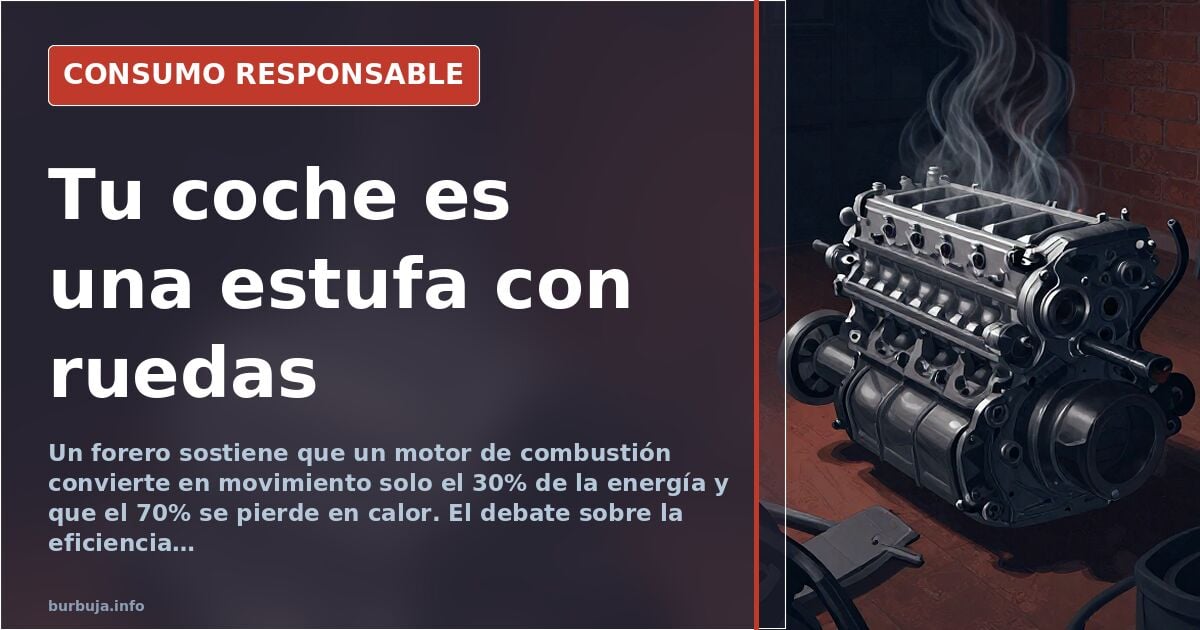
A car only uses 30% of the energy it burns
A combustion engine converts roughly 30% of the fuel's energy into motion. The rest, 70%, is lost as heat. Put another way: the car is, before anything else, a wheeled stove dragging a ton of steel to move one person. The figure, which anyone can check on their petrol station receipt, is the starting point of a long-running debate: is the automobile an inefficient machine by design, or an irreplaceable tool we simply misuse?
The opening argument is blunt. If electric motors reach around 90% efficiency while combustion engines sit at 30%, every kilometre driven on petrol costs three times as much and pollutes three times as much. The case made is twofold: economic, because 70% of what you pay at the pump is thrown away, and health-related, because the associated pollution translates into premature deaths. The figure cited in the discussion is 30,000 deaths a year in Spain from pollution, versus 10,000 with a theoretically efficient fleet.
The calculation trap: from exhaust pipe to battery
The first rebuttal comes quickly and is technically sound. Comparing the thermal engine's 30% with the electric motor's 90% is cheating if you ignore the losses of the whole system. In an electric car you have to add battery efficiency, charging and discharging losses, and those of electricity generation and distribution. In a petrol car, the cost of refining and transporting the fuel. Without that full accounting, you fall into the same mistake as presenting a solar panel as one hundred percent clean energy without looking at what it cost to manufacture.
The argument has legs. Critics also point to the cost of batteries, the extraction of rare earths for electric motors, and the awkward question: where does the electricity charging that car come from? In a system powered mostly by fossil fuels, the balance narrows. The conclusion drawn is not that electric cars are bad, but that engine efficiency is only one piece of the puzzle.
Why does a car weigh a ton to carry one person?
The second front is design. A private vehicle drags more than 1,000 kilos to transport, most of the time, an 80-kilo occupant. A bicycle moves its owner with 10 kilos of frame. The useful-weight-to-total-weight ratio is, from an engineering standpoint, a disaster. And yet, when you ask for an alternative that can carry three people and a 500-litre load at 120-150 km/h, no answer appears.
There lies the crux of the matter. A bike won't carry the weekly shopping, won't protect you from rain or cold, won't cross the country in three hours. A car will. Anyone who champions public transport as a universal solution runs into the map: there are industrial estates six kilometres from the nearest village, rotating night and weekend shifts, and journeys that take four times longer by bus. The most repeated case is that of the worker who lives 22 kilometres down a dual carriageway from their job and has no other way to get there.
The real cost: time, money and health
The discussion drifts towards what each person weighs in the balance. A six-minute car journey becomes 40 minutes door to door on public transport, counting waits and walks. Whoever buys a car isn't just buying a vehicle: they're buying control of their own time. That is the argument most repeated by car defenders, and it's not trivial.
On the other side, the ecological and health bill doesn't disappear. Cycling advocates point out that cold is fought with clothing, that exercise pays off, and that car dependence is an economic sentence for families living far from work. Some even argue that cities have been designed for the car, not the other way round. The proposal of congestion charging in city centres, London-style, comes up as a possible way out, with the immediate caveat that any fee gets passed on to prices.
The conversation turns sour when road coexistence enters the picture. Some claim cyclists ride on the road by choice even when there's a bike lane, while others reply that recklessness depends on the person driving, not the vehicle. The exchange goes in circles: the same reproaches apply to drivers and cyclists alike, and nobody gives ground.
Winter, the hard shoulder, and the question nobody answers
Then comes the factor no statistic can solve: the weather. At three degrees below zero, at half past eight in the morning, in a village in Cáceres, the bike is penance and the car is five minutes. The mountain cyclist's answer is that there's no such thing as bad weather, only inadequate clothing, and that at 45 he doesn't have a single ailment. Both things can be true at the same time.
The underlying issue is that engine energy efficiency is a fact, but the choice of vehicle depends on geography, working hours and urban structure. As long as jobs remain in industrial estates without public transport and cities are designed for cars, 30% efficiency will remain the price of real mobility. The prediction, with reservations: if oil becomes expensive enough to make the daily commute unviable, the debate will stop being theoretical. Until then, we keep burning.
A combustion engine converts roughly 30% of the fuel's energy into motion. The rest, 70%, is lost as heat. Put another way: the car is, before anything else, a wheeled stove dragging a ton of steel to move one person. The figure, which anyone can check on their petrol station receipt, is the starting point of a long-running debate: is the automobile an inefficient machine by design, or an irreplaceable tool we simply misuse?
The opening argument is blunt. If electric motors reach around 90% efficiency while combustion engines sit at 30%, every kilometre driven on petrol costs three times as much and pollutes three times as much. The case made is twofold: economic, because 70% of what you pay at the pump is thrown away, and health-related, because the associated pollution translates into premature deaths. The figure cited in the discussion is 30,000 deaths a year in Spain from pollution, versus 10,000 with a theoretically efficient fleet.
The calculation trap: from exhaust pipe to battery
The first rebuttal comes quickly and is technically sound. Comparing the thermal engine's 30% with the electric motor's 90% is cheating if you ignore the losses of the whole system. In an electric car you have to add battery efficiency, charging and discharging losses, and those of electricity generation and distribution. In a petrol car, the cost of refining and transporting the fuel. Without that full accounting, you fall into the same mistake as presenting a solar panel as one hundred percent clean energy without looking at what it cost to manufacture.
The argument has legs. Critics also point to the cost of batteries, the extraction of rare earths for electric motors, and the awkward question: where does the electricity charging that car come from? In a system powered mostly by fossil fuels, the balance narrows. The conclusion drawn is not that electric cars are bad, but that engine efficiency is only one piece of the puzzle.
Why does a car weigh a ton to carry one person?
The second front is design. A private vehicle drags more than 1,000 kilos to transport, most of the time, an 80-kilo occupant. A bicycle moves its owner with 10 kilos of frame. The useful-weight-to-total-weight ratio is, from an engineering standpoint, a disaster. And yet, when you ask for an alternative that can carry three people and a 500-litre load at 120-150 km/h, no answer appears.
There lies the crux of the matter. A bike won't carry the weekly shopping, won't protect you from rain or cold, won't cross the country in three hours. A car will. Anyone who champions public transport as a universal solution runs into the map: there are industrial estates six kilometres from the nearest village, rotating night and weekend shifts, and journeys that take four times longer by bus. The most repeated case is that of the worker who lives 22 kilometres down a dual carriageway from their job and has no other way to get there.
The real cost: time, money and health
The discussion drifts towards what each person weighs in the balance. A six-minute car journey becomes 40 minutes door to door on public transport, counting waits and walks. Whoever buys a car isn't just buying a vehicle: they're buying control of their own time. That is the argument most repeated by car defenders, and it's not trivial.
On the other side, the ecological and health bill doesn't disappear. Cycling advocates point out that cold is fought with clothing, that exercise pays off, and that car dependence is an economic sentence for families living far from work. Some even argue that cities have been designed for the car, not the other way round. The proposal of congestion charging in city centres, London-style, comes up as a possible way out, with the immediate caveat that any fee gets passed on to prices.
The conversation turns sour when road coexistence enters the picture. Some claim cyclists ride on the road by choice even when there's a bike lane, while others reply that recklessness depends on the person driving, not the vehicle. The exchange goes in circles: the same reproaches apply to drivers and cyclists alike, and nobody gives ground.
Winter, the hard shoulder, and the question nobody answers
Then comes the factor no statistic can solve: the weather. At three degrees below zero, at half past eight in the morning, in a village in Cáceres, the bike is penance and the car is five minutes. The mountain cyclist's answer is that there's no such thing as bad weather, only inadequate clothing, and that at 45 he doesn't have a single ailment. Both things can be true at the same time.
The underlying issue is that engine energy efficiency is a fact, but the choice of vehicle depends on geography, working hours and urban structure. As long as jobs remain in industrial estates without public transport and cities are designed for cars, 30% efficiency will remain the price of real mobility. The prediction, with reservations: if oil becomes expensive enough to make the daily commute unviable, the debate will stop being theoretical. Until then, we keep burning.
Also available in: Deutsch
Summary of a discussion on Burbuja.info - Foro de economía, actualidad y política., translated from Spanish and reviewed before publication. Read the full discussion (97 replies).
More summaries
-
VDA warns: Euro 7 rules will effectively ban combustion engines
Euro 7 proposes 30 mg/km NOx limits vs today's 60; German industry group VDA warns this would de facto ban internal combustion cars by 2025.
-
Lidl launches 2.24 kWh home battery for €299
Lidl sells a 2.24 kWh solar battery for €299. We analyze its profitability for self-consumption, savings potential, and drawbacks.
-
€50,000 car registered in your name but never delivered
He paid a €15,000 deposit and agreed to finance a €50,000 car which, according to his account, is registered in his name but has not been delivered.
-
Dacia Sandero for €4,700: the deal that requires €4,000 of financing
A forum user points out that the Sandero advertised at €4,700 requires €4,000 of financing. The official configurator lists it at €7,200, and the real price depends on incentives and…
-
Iherb stops shipping to Spain: customs holds orders and costs soar
Orders of 20 euros hit with 70 euros in customs charges and the website no longer accepts Spanish addresses: this is how Iherb's channel to Spain broke down, and here are the alternatives.
-
Bar soap is back as a way to save water and plastic
Bar soap saves water, money and plastic compared to shower gel, but it dries out the skin. The debate over hygiene, ingredients and dangerous homemade recipes.