
Cars over 20 years old: €20 monthly cost with valid inspection
A 1998 Hyundai Lantra costs just €20 a month. Maintenance arithmetic favors older vehicles, and their technical inspections remain flawless.
English · Original discussion in Spanish · Published
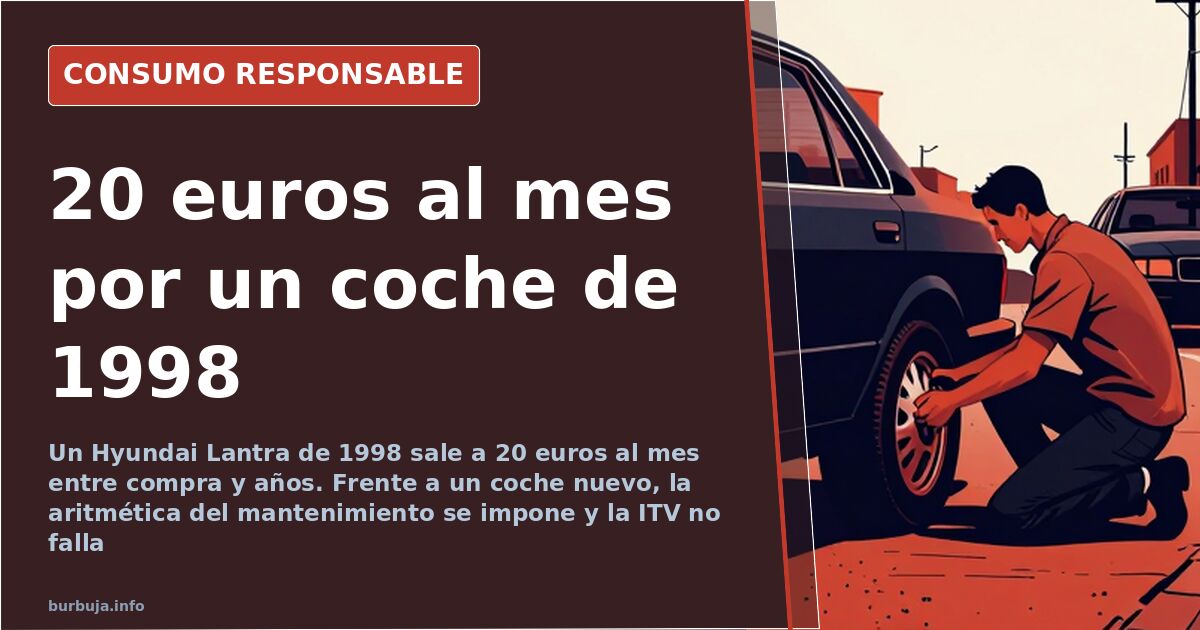
1998 car for €20/month: the math that undermines new purchases
A 1998 Hyundai Lantra GLS bought for €1,200 five years ago costs just €20 a month. The calculation is so simple it’s uncomfortable: €1,200 divided by five years equals €240 annually. Add €150 insurance and cheap servicing, and the owner sums it up without shame: it’s an «ultra-slow» car, but it passes the ITV (Spain’s mandatory vehicle inspection) without issues and, if not forced to replace it, will last another five years with the same calm. While this heap keeps starting, a brand-new car loses value faster than the old one wears out.
The uncomfortable question hangs in the air: why does the official narrative prioritize buying over maintaining when household arithmetic says exactly the opposite?
How much does it cost to maintain a car over 20 years old?
The acquisition prices circulating paint a parallel market that dealerships don’t advertise. A Renault 21 was bought for €600. A Seat Ibiza GT TDI 110 HP cost another €600, after a «turbo problem» resolved with a €60 EGR valve replacement. An Opel Astra GSI 1.8 was paid at €1,900. A 1991 Mercedes 190d was acquired in 2013 for €2,150.
The mileage backing these figures explains the enthusiasm. An Opel Kadett bought new in 1990 exceeds 433,000 kilometers. A Mercedes 190d accumulates 380,000, of which 130,000 were driven in seven years. A 1998 Renault Scenic has 350,000. A Citroën Xantia 1.8i has 280,000. A 1976 Land Rover Santana has 265,000. Individual repairs: a catalytic converter, €107 in parts.
Each owner adds their case, and the list grows on its own. A 1997 Ford Fiesta 1.2, an Opel Corsa so old it no longer pays road tax, a Megane over 20 years old, or a 2003 Citroën C5 HDI with 220,000 kilometers all enrich the same collection. The pattern is clear: cheap purchase, simple maintenance, zero temperamental electronics.
Fuel consumption is the sustancia ilegal in the argument. A Renault 21 declares 7 liters, 8 with AC on, but rises to 10 in city driving in winter. A 22-year-old Scenic reaches 12 liters in urban areas: with 50 liters it barely covers 350 or 400 kilometers. There, old mechanics lose the race against the pump.
ITV and part homologation: the toll missing from calculations
Fixing an old car isn’t always in the owner’s hands. To install any non-original part, it must be homologated before inspection, and whoever signs the certification does so by eye, comparing with technical sheets and a couple of photos of the installation. It’s a cost the owner doesn’t decide; the procedure imposes it.
The ITV itself is used as a preventive diagnostic tool. Passing the inspection for €45 equates, according to several cases, to confirming that the owner’s ear isn’t deceiving them and that no breakdown is lurking. Different is the workshop executing the repair, where invoice and result rarely go hand in hand.
The ecological argument nobody expected
Keeping a vehicle running avoids manufacturing a new one, and building a car burdens the environment with a bill the buyer never sees at the dealership. Cars that don’t become scrap also don’t end up in landfills. On this basis, it is argued that institutional pressure to renew the fleet is as fallacious as the slogans promoting it. Every car extended by five years is demand that doesn’t reach the factory.
The reasoning has fine print, and its defenders admit it: it can be manipulated. They add that it doesn’t matter, because the opposite message—buying a new car to save the planet—is equally manipulated.
Official workshops: unpaid apprentices and €300 bills
The flip side of cheap maintenance lies across the counter. In official brand workshops, vocational training interns—sometimes with public money involved—work without pay or tips, while oil changes and reviews are billed at €300. That margin is a large part of the business. The argument that only the dealership preserves the car crashes against the invoice itself.
The true cost of gas-guzzling cars
Not everything is 90s romanticism. A 1996 BMW E36 convertible, six cylinders and 193 HP, confesses to being somewhat thirsty. A Chrysler 300C 2.7 with 197 HP is described as a limousine that doesn’t spend little. Those who keep them assume it without drama: changing cars costs more than excess fuel. The comfort of a 90s automatic W114, or the rear space of a sedan crossing Europe without complaining, is worth the extra liter.
With these accounts on the table—€20 a month versus the immediate devaluation of a new vehicle—the striking thing is that the workshop still ends up costing more than the car itself. How much do new car prices have to rise for maintaining a car over 20 years old to stop seeming like a rarity and start being the obvious option?
A 1998 Hyundai Lantra GLS bought for €1,200 five years ago costs just €20 a month. The calculation is so simple it’s uncomfortable: €1,200 divided by five years equals €240 annually. Add €150 insurance and cheap servicing, and the owner sums it up without shame: it’s an «ultra-slow» car, but it passes the ITV (Spain’s mandatory vehicle inspection) without issues and, if not forced to replace it, will last another five years with the same calm. While this heap keeps starting, a brand-new car loses value faster than the old one wears out.
The uncomfortable question hangs in the air: why does the official narrative prioritize buying over maintaining when household arithmetic says exactly the opposite?
How much does it cost to maintain a car over 20 years old?
The acquisition prices circulating paint a parallel market that dealerships don’t advertise. A Renault 21 was bought for €600. A Seat Ibiza GT TDI 110 HP cost another €600, after a «turbo problem» resolved with a €60 EGR valve replacement. An Opel Astra GSI 1.8 was paid at €1,900. A 1991 Mercedes 190d was acquired in 2013 for €2,150.
The mileage backing these figures explains the enthusiasm. An Opel Kadett bought new in 1990 exceeds 433,000 kilometers. A Mercedes 190d accumulates 380,000, of which 130,000 were driven in seven years. A 1998 Renault Scenic has 350,000. A Citroën Xantia 1.8i has 280,000. A 1976 Land Rover Santana has 265,000. Individual repairs: a catalytic converter, €107 in parts.
Each owner adds their case, and the list grows on its own. A 1997 Ford Fiesta 1.2, an Opel Corsa so old it no longer pays road tax, a Megane over 20 years old, or a 2003 Citroën C5 HDI with 220,000 kilometers all enrich the same collection. The pattern is clear: cheap purchase, simple maintenance, zero temperamental electronics.
Fuel consumption is the sustancia ilegal in the argument. A Renault 21 declares 7 liters, 8 with AC on, but rises to 10 in city driving in winter. A 22-year-old Scenic reaches 12 liters in urban areas: with 50 liters it barely covers 350 or 400 kilometers. There, old mechanics lose the race against the pump.
ITV and part homologation: the toll missing from calculations
Fixing an old car isn’t always in the owner’s hands. To install any non-original part, it must be homologated before inspection, and whoever signs the certification does so by eye, comparing with technical sheets and a couple of photos of the installation. It’s a cost the owner doesn’t decide; the procedure imposes it.
The ITV itself is used as a preventive diagnostic tool. Passing the inspection for €45 equates, according to several cases, to confirming that the owner’s ear isn’t deceiving them and that no breakdown is lurking. Different is the workshop executing the repair, where invoice and result rarely go hand in hand.
The ecological argument nobody expected
Keeping a vehicle running avoids manufacturing a new one, and building a car burdens the environment with a bill the buyer never sees at the dealership. Cars that don’t become scrap also don’t end up in landfills. On this basis, it is argued that institutional pressure to renew the fleet is as fallacious as the slogans promoting it. Every car extended by five years is demand that doesn’t reach the factory.
The reasoning has fine print, and its defenders admit it: it can be manipulated. They add that it doesn’t matter, because the opposite message—buying a new car to save the planet—is equally manipulated.
Official workshops: unpaid apprentices and €300 bills
The flip side of cheap maintenance lies across the counter. In official brand workshops, vocational training interns—sometimes with public money involved—work without pay or tips, while oil changes and reviews are billed at €300. That margin is a large part of the business. The argument that only the dealership preserves the car crashes against the invoice itself.
The true cost of gas-guzzling cars
Not everything is 90s romanticism. A 1996 BMW E36 convertible, six cylinders and 193 HP, confesses to being somewhat thirsty. A Chrysler 300C 2.7 with 197 HP is described as a limousine that doesn’t spend little. Those who keep them assume it without drama: changing cars costs more than excess fuel. The comfort of a 90s automatic W114, or the rear space of a sedan crossing Europe without complaining, is worth the extra liter.
With these accounts on the table—€20 a month versus the immediate devaluation of a new vehicle—the striking thing is that the workshop still ends up costing more than the car itself. How much do new car prices have to rise for maintaining a car over 20 years old to stop seeming like a rarity and start being the obvious option?
Also available in: Deutsch
Summary of a discussion on Burbuja.info - Foro de economía, actualidad y política., translated from Spanish and reviewed before publication. Read the full discussion (118 replies).
More summaries
-
Two old cars for 350€ a year: a forum user’s thesis
A forum user argues that a devalued second car costs 350€ annually for insurance, oil, and inspection, but unexpected repairs drive up the real bill.
-
El Corte Inglés prepared food: quality at a price
El Corte Inglés croquettes beat Mercadona's, but prices like €21/kg for meat rolls mean it's only worth it for some products.
-
Fake History Degree for Bragging Rights Carries Prison Time
Man seeks fake UNED History degree to impress acquaintances. Forgery of official documents carries a sentence of six months to three years.
-
Jazztel raises line fee by €2: 30-day exit window without penalty
Spanish telecom Jazztel increases line fees to €22.99 from May, offering more mobile data but allowing contract termination without penalties for 30 days.
-
Cheapest to run: old diesel or used Japanese car
A €1,500 Saxo uses 3L/100km; a Yaris lasts 180k km. The most economical car isn't new.
-
Tissot T-Race at €480: Quartz, Whim and Class Judgment
A Tissot T-Race quartz watch bought for €480 reignites the debate between quartz and automatic movements, questioning when a timepiece becomes expensive.