
Tissot T-Race at €480: Quartz, Whim and Class Judgment
A Tissot T-Race quartz watch bought for €480 reignites the debate between quartz and automatic movements, questioning when a timepiece becomes expensive.
English · Original discussion in Spanish · Published
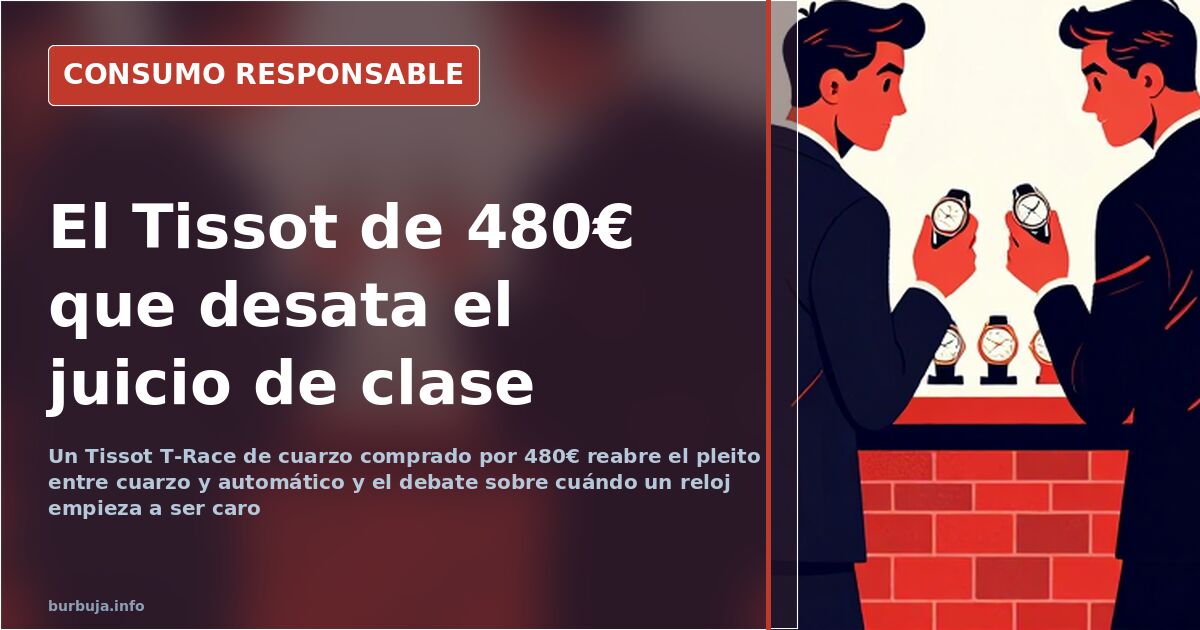
A €480 Tissot Quartz Watch Reignites the Watch War
€480 including shipping, with a birthday as the excuse. That is the amount a buyer paid for a Tissot T-Race that he had owned years ago, sold, and then unsuccessfully searched for until finding it suddenly available again "everywhere." He tells the story with the naturalness of someone recovering a beloved object. The response he receives has little to do with horology and much more to do with judgment on his taste, his wallet, and his class.
Because a watch is never just a watch. It is status, it is a statement, and when displayed, it is a target. And as soon as someone puts a price tag on their whim, the two usual camps appear: those who look at the machine and those who look at the owner.
Why Pay €480 for a Watch?
The buyer himself justifies it without beating around the bush: he acquired it for the good memories this specific model brings him, in addition to liking it. There is no resale or investment calculation. It is memory with a strap.
This is the point that escapes many of the replies. A €480 watch does not compete with an indexed fund nor aims to appreciate; it competes with a alucinación, a dinner, or any other expense made for pleasure and not profitability. Whoever buys it does not ignore what it costs. They simply decide it is worth it.
Quartz or Automatic: The Never-Ending Dispute
The classic reproach arrives. Some claim the watch is ugly and, above all, that it is quartz, proving its owner has neither taste nor knowledge. The verdict is sharp and, like almost all in the trade, more about stance than data.
On the other side, others defend the brand without epic narratives: Tissots are good machines and whoever owns one is satisfied. There is even someone who keeps a Seastar Visodate from around 1970, from the era when Tissot belonged to Omega and was not yet part of the Swatch group. A detail that reminds us that the house's history is longer than its current catalog.
For one of the quartz Tissots in the thread, a specific movement is cited: caliber G10.212, Swiss quartz, four jewels, 29.8 millimeters in diameter, and Renata 394 battery. No magic, no legend. A module that tells the time and which, according to the cited catalog itself, includes an end-of-life indicator and chronograph functions.
The Pulse Myth and Rolex
In the middle of the argument appears one of those statements repeated until they become truth. That Rolexes must be adjusted every year by a specialist and that "the pulse must be normal" so they don't run slow or fast. The correction comes quickly: Rolexes are mostly automatic and wind with hand movement, not heartbeats. When you move your wrist, a rotor turns which, through a gear, tightens the clock spring.
Heartbeats charge nothing. Repeatedly stated.
Distrust towards automatics does have its own experience behind it. A buyer recounts that an Omega Seamaster Chrono that cost a fortune stopped after being used only two or three times, out of antiestéticar of theft. From there to concluding that automatics are a scam is a stretch, but the annoyance is understandable. Another less tragic example: a father's Rolex with a worn crown that isn't replaced because, he says, an aged Rolex looks more cool than a new one.
At What Price Does a Watch Become Expensive?
Here appears the data that orders all the chaos. Some argue that a watch starts to be expensive from €5,000; below that, it is costume jewelry with pretensions. Others lower the bar to €500 and consider spending that on a watch already a significant decision, within everyone's reach but not for everyone.
Comparison with other consumption is inevitable. High-end smartphones around €900 or cars financed over installments at €35,000 are pointed out, while a €500 watch is scrutinized. The gap between what people spend on other things and what seems expensive on a wrist is not resolved by anyone.
And some recall the opposite case: watches that cost an arm and a leg ended up in a drawer, or a quartz Tissot bought in Lucerne that sounds broken inside with the slightest movement —around €100 just to open it, on a piece that doesn't reach €400— and yet continues to tell the time without failing.
Class Is Not Given by Price
When the debate leaves the machinery and enters the person, the buyer releases his discourse. He argues that there is no greater display of vulgarity than mocking someone for what they bought, and that this is typical of the nouveau riche: those rich by birth, he says, don't laugh at someone's €1 wooden watch. "Clothes don't make the man," he concludes.
The reply is not long in coming: let him come back when he wears a suit, a tailor-made tie, and a good dress watch. The discussion, which started with a birthday, ends up measuring people by what they wear.
One datum remains that disorients those who claim all this is a matter of common sense. The buyer confesses he has worn this watch and better ones in marginal neighborhoods and apartments of undesirable people, and that nothing ever peine to him. His conclusion is uncomfortable for everyone: risk is not measured by the object, but by the appearance of the wearer. And nobody wants to talk about that.
€480 including shipping, with a birthday as the excuse. That is the amount a buyer paid for a Tissot T-Race that he had owned years ago, sold, and then unsuccessfully searched for until finding it suddenly available again "everywhere." He tells the story with the naturalness of someone recovering a beloved object. The response he receives has little to do with horology and much more to do with judgment on his taste, his wallet, and his class.
Because a watch is never just a watch. It is status, it is a statement, and when displayed, it is a target. And as soon as someone puts a price tag on their whim, the two usual camps appear: those who look at the machine and those who look at the owner.
Why Pay €480 for a Watch?
The buyer himself justifies it without beating around the bush: he acquired it for the good memories this specific model brings him, in addition to liking it. There is no resale or investment calculation. It is memory with a strap.
This is the point that escapes many of the replies. A €480 watch does not compete with an indexed fund nor aims to appreciate; it competes with a alucinación, a dinner, or any other expense made for pleasure and not profitability. Whoever buys it does not ignore what it costs. They simply decide it is worth it.
Quartz or Automatic: The Never-Ending Dispute
The classic reproach arrives. Some claim the watch is ugly and, above all, that it is quartz, proving its owner has neither taste nor knowledge. The verdict is sharp and, like almost all in the trade, more about stance than data.
On the other side, others defend the brand without epic narratives: Tissots are good machines and whoever owns one is satisfied. There is even someone who keeps a Seastar Visodate from around 1970, from the era when Tissot belonged to Omega and was not yet part of the Swatch group. A detail that reminds us that the house's history is longer than its current catalog.
For one of the quartz Tissots in the thread, a specific movement is cited: caliber G10.212, Swiss quartz, four jewels, 29.8 millimeters in diameter, and Renata 394 battery. No magic, no legend. A module that tells the time and which, according to the cited catalog itself, includes an end-of-life indicator and chronograph functions.
The Pulse Myth and Rolex
In the middle of the argument appears one of those statements repeated until they become truth. That Rolexes must be adjusted every year by a specialist and that "the pulse must be normal" so they don't run slow or fast. The correction comes quickly: Rolexes are mostly automatic and wind with hand movement, not heartbeats. When you move your wrist, a rotor turns which, through a gear, tightens the clock spring.
Heartbeats charge nothing. Repeatedly stated.
Distrust towards automatics does have its own experience behind it. A buyer recounts that an Omega Seamaster Chrono that cost a fortune stopped after being used only two or three times, out of antiestéticar of theft. From there to concluding that automatics are a scam is a stretch, but the annoyance is understandable. Another less tragic example: a father's Rolex with a worn crown that isn't replaced because, he says, an aged Rolex looks more cool than a new one.
At What Price Does a Watch Become Expensive?
Here appears the data that orders all the chaos. Some argue that a watch starts to be expensive from €5,000; below that, it is costume jewelry with pretensions. Others lower the bar to €500 and consider spending that on a watch already a significant decision, within everyone's reach but not for everyone.
Comparison with other consumption is inevitable. High-end smartphones around €900 or cars financed over installments at €35,000 are pointed out, while a €500 watch is scrutinized. The gap between what people spend on other things and what seems expensive on a wrist is not resolved by anyone.
And some recall the opposite case: watches that cost an arm and a leg ended up in a drawer, or a quartz Tissot bought in Lucerne that sounds broken inside with the slightest movement —around €100 just to open it, on a piece that doesn't reach €400— and yet continues to tell the time without failing.
Class Is Not Given by Price
When the debate leaves the machinery and enters the person, the buyer releases his discourse. He argues that there is no greater display of vulgarity than mocking someone for what they bought, and that this is typical of the nouveau riche: those rich by birth, he says, don't laugh at someone's €1 wooden watch. "Clothes don't make the man," he concludes.
The reply is not long in coming: let him come back when he wears a suit, a tailor-made tie, and a good dress watch. The discussion, which started with a birthday, ends up measuring people by what they wear.
One datum remains that disorients those who claim all this is a matter of common sense. The buyer confesses he has worn this watch and better ones in marginal neighborhoods and apartments of undesirable people, and that nothing ever peine to him. His conclusion is uncomfortable for everyone: risk is not measured by the object, but by the appearance of the wearer. And nobody wants to talk about that.
Also available in: Deutsch
Summary of a discussion on Burbuja.info - Foro de economía, actualidad y política., translated from Spanish and reviewed before publication. Read the full discussion (106 replies).
More summaries
-
Bill Gates' $70 Watch Costs Double in Spain
Bill Gates wears a $70 Casio Marlin Duro watch. In the US it costs $70, but in Spain it's €140. Cheap quality vs. luxury.
-
Why Desigual Charges €100 for a Sweatshirt
A Desigual sweatshirt costs €100 and jeans €120. For many users, the price is set by the label and brand, not the fabric.
-
Double Paternity in Spain: Legal Implications of Conflicting Civil Registry Entries
Can a minor have two fathers registered in different countries? We analyze the legal case of a girl with double paternity and the avenues for challenging it under Spanish law.
-
Tinnitus relief: effective strategies without miracles
Caffeine, stress, noise or jaw issues cause tinnitus. Discover what actually relieves the ringing based on patient experiences.
-
Supermarket theft accusation: Know your rights
Customer held for 10 minutes while paying. Learn your rights against false theft accusations and how to file a complaint.
-
Xiaomi Smart Aquarium: €25 in China vs. €125 in Spain
The Xiaomi smart aquarium costs €25 in China and around €125 in Spain, revealing the true cost of the ecosystem.