
Caritas Barcelona helps 100,848 but aids only 4,420
Caritas Barcelona assisted 100,848 people in 2023 yet provided direct aid to just 4,420. Housing needs affect 70% while corporate donations fell by 12%.
English · Original discussion in Spanish · Published
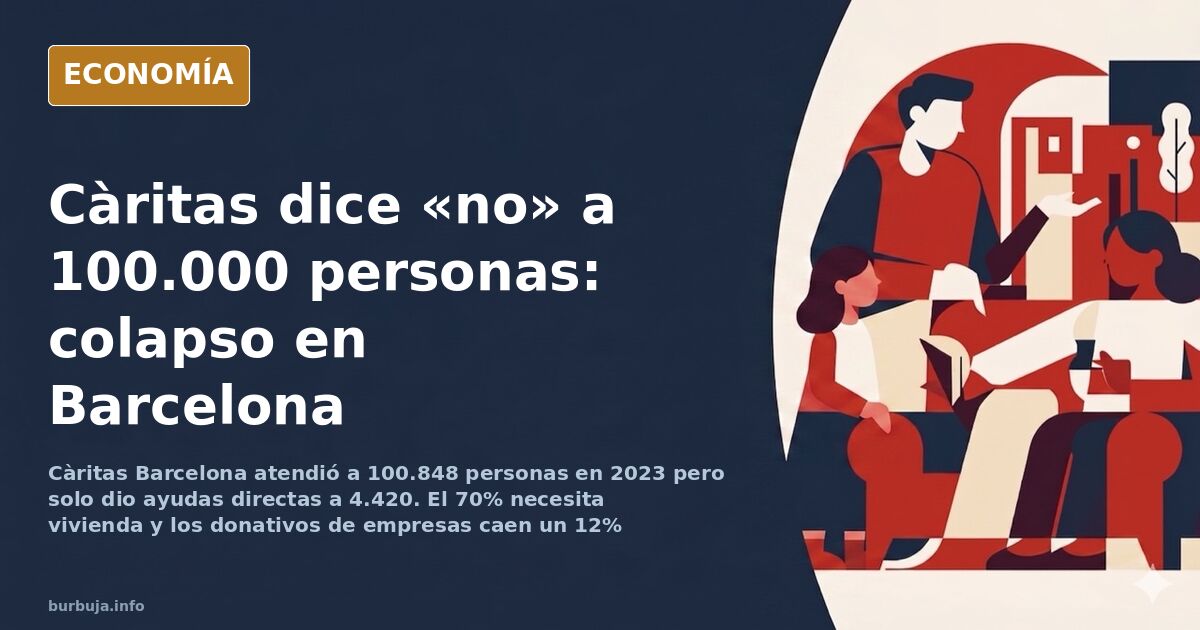
Caritas Barcelona assists 100,848 people but can only provide direct aid to 4,420
Caritas Diocesana de Barcelona has reached its limit. The organization assisted 100,848 people in 2023 across the territory from Cornellà de Llobregat to Caldes d'Estrac, a mere 1% increase over the previous year. Its director, Eduard Sala, explained bluntly: "We are not growing because we have hit a ceiling, not because there is no need." Of the 100,000 who sought help, only 4,420 received direct assistance, totaling €2.4 million. The rest were turned away. "We are in a shipwreck and our little boat is full," Sala summarized.
What Caritas Barcelona's annual report reveals
The most relevant data isn't even in the report: the volume of aid denied due to lack of resources. The €2.4 million distributed covered rent, electricity bills, and food for 4,420 people. The actual waiting list multiplies that figure twentyfold. The profile of those served has shifted: 14% have employment contracts, known as working poor, and 51% are in irregular administrative status.
Housing is the black hole. 70% of those served require decent housing and half live in sublet rooms. Caritas has 2,000 residential places; according to its director, 70,000 more would be needed. "We are putting on bandages," admitted Sala, aware that the entity assumes functions belonging to public administration.
Municipal registration as an administrative barrier
Access to municipal registration (padrón) has become a bottleneck. Legal advisory head Elisabet Ureña denounced that, except in Barcelona City Council, many municipalities hinder registration for those living in sublet rooms. The consequence is immediate: without registration, there is no health card, school enrollment is delayed—some children waited six months—and legal regularization becomes impossible. Caritas demands the application of registration without a fixed address and service for all, regardless of documentation status.
Drop in donations worsens collapse
Corporate donations have fallen by 12% and public administration contributes only one in four euros managed by the entity. Sala speaks of a "fatigue effect" among the population: after years of successive crises, solidarity cools. If the scenario doesn't change, Caritas plans to reorganize into multipurpose centers where families support each other, rather than intensive per-family responses. "We need lifebuoys for the maximum number of people," he said.
Testimony: Living in a room with a baby
Caterina, mother of a baby, lives with her husband in a sublet room. "We cannot use the kitchen, and we have to pay to do laundry," she recounted. "The child needs space to play, to feel at home. We have to bathe him in our arms; he doesn't know what it is to enjoy water." Míriam Feu, head of social analysis, added the psychological factor: "They live with constant insecurity of being evicted, of not being able to cook or use the bathroom, of living in antiestéticar, with strangers."
Solutions requested by Caritas
The entity asks for stability and political consensus to tackle structural poverty. In housing, three concrete measures: expand the stock dedicated to social rental to 15%, offer emergency alternatives without delays—currently exceeding two years—and guarantee rent payment aid. It also demands eliminating mandatory appointments with administration.
The underlying debate is different. One part of the analysis argues the problem is supply: if there are a hundred rentals and two hundred families needing them, a hundred are left out even if prices are capped. Another current points to the regulatory framework and lack of new construction. A third views municipal registration as a de facto migration control tool. With these materials, Caritas's basket will remain full and the shore distant.
Caritas Diocesana de Barcelona has reached its limit. The organization assisted 100,848 people in 2023 across the territory from Cornellà de Llobregat to Caldes d'Estrac, a mere 1% increase over the previous year. Its director, Eduard Sala, explained bluntly: "We are not growing because we have hit a ceiling, not because there is no need." Of the 100,000 who sought help, only 4,420 received direct assistance, totaling €2.4 million. The rest were turned away. "We are in a shipwreck and our little boat is full," Sala summarized.
What Caritas Barcelona's annual report reveals
The most relevant data isn't even in the report: the volume of aid denied due to lack of resources. The €2.4 million distributed covered rent, electricity bills, and food for 4,420 people. The actual waiting list multiplies that figure twentyfold. The profile of those served has shifted: 14% have employment contracts, known as working poor, and 51% are in irregular administrative status.
Housing is the black hole. 70% of those served require decent housing and half live in sublet rooms. Caritas has 2,000 residential places; according to its director, 70,000 more would be needed. "We are putting on bandages," admitted Sala, aware that the entity assumes functions belonging to public administration.
Municipal registration as an administrative barrier
Access to municipal registration (padrón) has become a bottleneck. Legal advisory head Elisabet Ureña denounced that, except in Barcelona City Council, many municipalities hinder registration for those living in sublet rooms. The consequence is immediate: without registration, there is no health card, school enrollment is delayed—some children waited six months—and legal regularization becomes impossible. Caritas demands the application of registration without a fixed address and service for all, regardless of documentation status.
Drop in donations worsens collapse
Corporate donations have fallen by 12% and public administration contributes only one in four euros managed by the entity. Sala speaks of a "fatigue effect" among the population: after years of successive crises, solidarity cools. If the scenario doesn't change, Caritas plans to reorganize into multipurpose centers where families support each other, rather than intensive per-family responses. "We need lifebuoys for the maximum number of people," he said.
Testimony: Living in a room with a baby
Caterina, mother of a baby, lives with her husband in a sublet room. "We cannot use the kitchen, and we have to pay to do laundry," she recounted. "The child needs space to play, to feel at home. We have to bathe him in our arms; he doesn't know what it is to enjoy water." Míriam Feu, head of social analysis, added the psychological factor: "They live with constant insecurity of being evicted, of not being able to cook or use the bathroom, of living in antiestéticar, with strangers."
Solutions requested by Caritas
The entity asks for stability and political consensus to tackle structural poverty. In housing, three concrete measures: expand the stock dedicated to social rental to 15%, offer emergency alternatives without delays—currently exceeding two years—and guarantee rent payment aid. It also demands eliminating mandatory appointments with administration.
The underlying debate is different. One part of the analysis argues the problem is supply: if there are a hundred rentals and two hundred families needing them, a hundred are left out even if prices are capped. Another current points to the regulatory framework and lack of new construction. A third views municipal registration as a de facto migration control tool. With these materials, Caritas's basket will remain full and the shore distant.
Also available in: Deutsch
Summary of a discussion on Burbuja.info - Foro de economía, actualidad y política., translated from Spanish and reviewed before publication. Read the full discussion (112 replies).
More summaries
-
Barcelona City Hall admits 5,900 residents registered at single municipal site
Barcelona City Council acknowledges 5,900 people registered at a Nou Barris municipal facility, compared to just 19 across five other buildings in the district.
-
Barcelona to end permits for 10,101 tourist flats in 2028
Barcelona City Council will not renew licenses for its 10,101 tourist apartments in November 2028. The sector threatens legal action over the impact on housing.
-
Jesús G. Maestro: Professor or 'Hustler'?
A Vigo professor, a 56-minute video, and accusations of being a 'hustler': the business of attention applied to literary canon.
-
Hollywood Walk of Fame Becomes Fentanyl Crisis Symbol
Viral images of Hollywood Boulevard described as a horror film fuel US debates on fentanyl and urban policy.
-
Reheated Oil Causes Liver and Brain Damage in Rats
Study on rats fed reheated sesame and sunflower oil reveals liver inflammation, colon damage, and neurodegeneration in offspring.
-
Rubiales' uncle shifts from chief of staff to accuser
Luis Rubiales' former chief of staff, earning nearly €200,000, has reported him to Spain's Anti-Corruption Prosecutor.