
Hollywood Walk of Fame Becomes Fentanyl Crisis Symbol
Viral images of Hollywood Boulevard described as a horror film fuel US debates on fentanyl and urban policy.
English · Original discussion in Spanish · Published
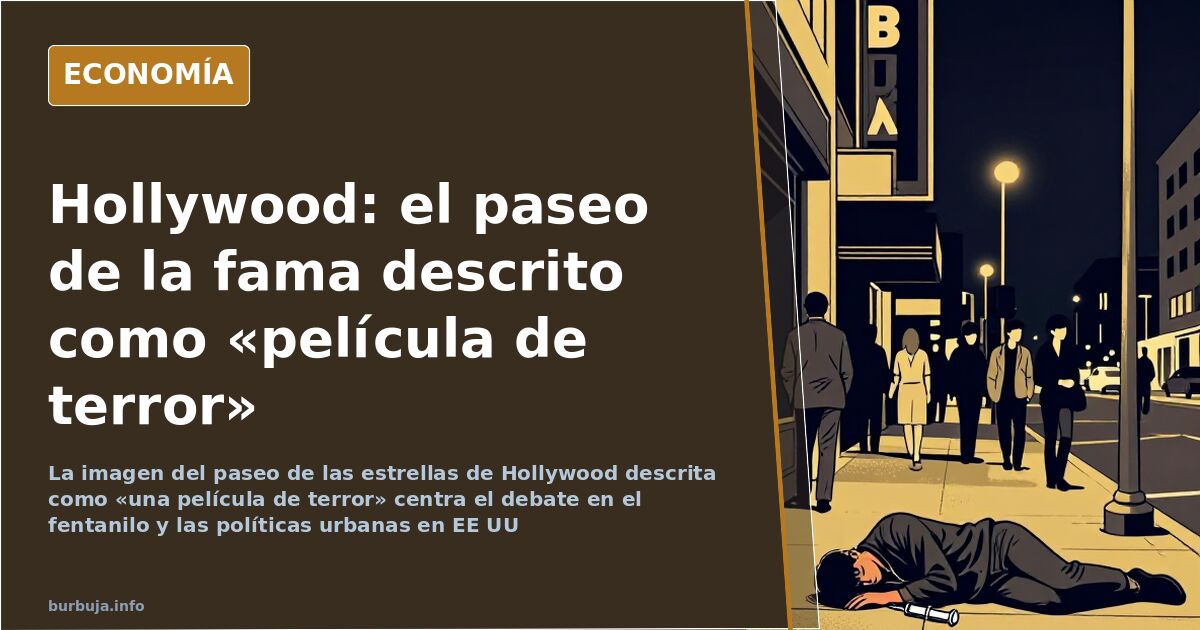
Hollywood Walk of Fame Becomes Fentanyl Crisis Thermometer
The Hollywood Walk of Fame is no longer just a sidewalk. It is a diagnosis. The viral image of the boulevard, described by those who shared it as "a pavor movie," shows, according to commentators, homeless people and visible drug use in front of tourists on one of the world's most photographed streets. The postcard is not new: what is new is the substance starring in it.
Fentanyl and xylazine are the two words dominating the conversation. And a third, more uncomfortable one: politics. Because the Walk of Fame functions as a battlefield where the failure of the US urban model, the pharmaceutical business, and traditional ideological labels are simultaneously contested.
What You See on Hollywood Boulevard Beyond the Stars
Those who have visited the area describe a tourist stretch that is walkable and a perimeter that degrades as soon as you move two blocks away. The Chinese Theatre, the venue for the Oscars, costumed characters, and the Scientology headquarters remain in place. Around them, several accounts agree on pointing out homelessness, substance use, and the feeling that security ends right at the border of the tourist circuit.
The repeated recommendation is old: do not stray from that axis when the sun sets. This was already warned about in the nineties, and the scene from Pretty Woman on Sunset Boulevard —Richard Gere picking up the protagonist— served as a portrait of a street that was never exemplary. What is striking is not that misery exists in Los Angeles. It is that it has reached ground zero of global tourism.
From Fentanyl to Xylazine: The Mixture Now Reaching Cocaine
Information from the New York Post cited in the discussion points to xylazine, a veterinary sedative, having entered the cocaine supply chain and affecting users who were not seeking opioids. The combination with fentanyl, it is argued, worsens physical damage to the point of skin necrosis for those consuming it.
Here consensus breaks down. Some read the phenomenon as an inevitable consequence of years of generously prescribed opioids by the pharmaceutical industry, whose leaders, according to this view, went unpunished. Others reduce it to an issue of addiction and public health, without corporate culprits. A third interpretation, circulating with more noise than data, argues that the situation is deliberately tolerated; nothing provided supports this suspicion.
Is Fentanyl Prescribed in Spain? Patches Dispensed as Painkillers
In the conversation, it is claimed that here it is prescribed "quite freely" in its transdermal version, with DUROGESIC patches administered as pain relief. This is a partisan claim that cannot be verified and should be treated as what it is: a warning about the extensive use of a potent opioid, not a clinical diagnosis.
The link with the US scene is indirect but evident. Part of what is consumed there on the street comes, according to claims in the thread, from opioids that previously passed through pharmacies. That continuity between the medicine cabinet and the sidewalk is the thread pulling the entire conversation, and also the one least wanted to be looked at.
Barcelona, Bilbao, and San Francisco: Crossed Comparisons
Part of the analysis argues that urban deterioration is the predictable result of left-wing municipal management, citing Barcelona or Bilbao as examples. The comparison does not go unanswered: it is countered with Russian cities, which one participant attributes many more beggars and addicts, and with San Francisco itself, which another describes as impeccable and far superior to Los Angeles.
The underlying problem is methodological. Photographs are compared, not data series. And a photograph is always chosen by someone. The same sidewalk can look like a pavor set or a normal street depending on the framing, the time, and what one wants to prove. There is no possible debate there, only propaganda with different accents.
The Counterpoint of Those Who Returned: California, "Another Country Within the US"
Not all material points in the same direction. Someone who just spent fifteen days there argues that most users mind their own business and that the overall picture is not as extreme as the video suggests. They add that San Francisco seemed like an impeccable city, far superior to Los Angeles.
Their account includes the part that does not appear in videos: the Mojave Desert at 50 degrees, the Sierra Nevada with peaks of 4.5 kilometers, and four hours of travel between both. California, they summarize, seems like another country within the United States. Perhaps that contrast —paradise and misery in the same state— is the only complete postcard possible.
Predicting here is risky. If the mixture of fentanyl and xylazine continues to spread through the supply and urban policies do not change, the boulevard will remain a tourist attraction with a B-movie script. And if overdose figures stabilize, the image will hold anyway: cheap, viral, and very useful for discussing politics without talking about addictions.
The Hollywood Walk of Fame is no longer just a sidewalk. It is a diagnosis. The viral image of the boulevard, described by those who shared it as "a pavor movie," shows, according to commentators, homeless people and visible drug use in front of tourists on one of the world's most photographed streets. The postcard is not new: what is new is the substance starring in it.
Fentanyl and xylazine are the two words dominating the conversation. And a third, more uncomfortable one: politics. Because the Walk of Fame functions as a battlefield where the failure of the US urban model, the pharmaceutical business, and traditional ideological labels are simultaneously contested.
What You See on Hollywood Boulevard Beyond the Stars
Those who have visited the area describe a tourist stretch that is walkable and a perimeter that degrades as soon as you move two blocks away. The Chinese Theatre, the venue for the Oscars, costumed characters, and the Scientology headquarters remain in place. Around them, several accounts agree on pointing out homelessness, substance use, and the feeling that security ends right at the border of the tourist circuit.
The repeated recommendation is old: do not stray from that axis when the sun sets. This was already warned about in the nineties, and the scene from Pretty Woman on Sunset Boulevard —Richard Gere picking up the protagonist— served as a portrait of a street that was never exemplary. What is striking is not that misery exists in Los Angeles. It is that it has reached ground zero of global tourism.
From Fentanyl to Xylazine: The Mixture Now Reaching Cocaine
Information from the New York Post cited in the discussion points to xylazine, a veterinary sedative, having entered the cocaine supply chain and affecting users who were not seeking opioids. The combination with fentanyl, it is argued, worsens physical damage to the point of skin necrosis for those consuming it.
Here consensus breaks down. Some read the phenomenon as an inevitable consequence of years of generously prescribed opioids by the pharmaceutical industry, whose leaders, according to this view, went unpunished. Others reduce it to an issue of addiction and public health, without corporate culprits. A third interpretation, circulating with more noise than data, argues that the situation is deliberately tolerated; nothing provided supports this suspicion.
Is Fentanyl Prescribed in Spain? Patches Dispensed as Painkillers
In the conversation, it is claimed that here it is prescribed "quite freely" in its transdermal version, with DUROGESIC patches administered as pain relief. This is a partisan claim that cannot be verified and should be treated as what it is: a warning about the extensive use of a potent opioid, not a clinical diagnosis.
The link with the US scene is indirect but evident. Part of what is consumed there on the street comes, according to claims in the thread, from opioids that previously passed through pharmacies. That continuity between the medicine cabinet and the sidewalk is the thread pulling the entire conversation, and also the one least wanted to be looked at.
Barcelona, Bilbao, and San Francisco: Crossed Comparisons
Part of the analysis argues that urban deterioration is the predictable result of left-wing municipal management, citing Barcelona or Bilbao as examples. The comparison does not go unanswered: it is countered with Russian cities, which one participant attributes many more beggars and addicts, and with San Francisco itself, which another describes as impeccable and far superior to Los Angeles.
The underlying problem is methodological. Photographs are compared, not data series. And a photograph is always chosen by someone. The same sidewalk can look like a pavor set or a normal street depending on the framing, the time, and what one wants to prove. There is no possible debate there, only propaganda with different accents.
The Counterpoint of Those Who Returned: California, "Another Country Within the US"
Not all material points in the same direction. Someone who just spent fifteen days there argues that most users mind their own business and that the overall picture is not as extreme as the video suggests. They add that San Francisco seemed like an impeccable city, far superior to Los Angeles.
Their account includes the part that does not appear in videos: the Mojave Desert at 50 degrees, the Sierra Nevada with peaks of 4.5 kilometers, and four hours of travel between both. California, they summarize, seems like another country within the United States. Perhaps that contrast —paradise and misery in the same state— is the only complete postcard possible.
Predicting here is risky. If the mixture of fentanyl and xylazine continues to spread through the supply and urban policies do not change, the boulevard will remain a tourist attraction with a B-movie script. And if overdose figures stabilize, the image will hold anyway: cheap, viral, and very useful for discussing politics without talking about addictions.
Also available in: Deutsch
Summary of a discussion on Burbuja.info - Foro de economía, actualidad y política., translated from Spanish and reviewed before publication. Read the full discussion (112 replies).
More summaries
-
Los Angeles Audiovisual Output Plummets 23.8% Amid Strikes and Streaming Shift
Los Angeles production drops 23.8%, with TV down 45.8% and advertising down 36.1%, as the industry blames strikes and streaming changes.
-
David Lynch’s first death anniversary sparks debate
One year after David Lynch's death, Spain's Economy forum discusses his artistic legacy without financial data.
-
David Lynch’s Legacy: Cinematic Genius or Unjustified Pretension?
An analysis of David Lynch’s filmography questions whether his surreal style represents visionary art or inaccessible pretension, balancing critical acclaim with audience alienation.
-
Xabier Arrutia Imaz, ETA advisor to PDVSA in Venezuela, dies
The death of Xabier Arrutia Imaz in Venezuela exposes the protection network for ETA members in PDVSA and suspicions of a killing to silence secrets.
-
UK insurers hike premiums for Chinese cars
UK insurers raise costs for Chinese models due to scarce parts and untrained workshops. Data debunking this trend emerged months later.
-
Spain's €5 Sandwich Debate: Gift or Robbery?
A €5 sandwich in Spain sparks debate over fair pricing, with opinions split between a bargain and a rip-off amid rising food inflation.