
Cardiac surgeon says cardio won't help you lose weight
Running 30 minutes burns 400 kcal; a whole pizza, 1,500. Philip Ovadia says cardio won't help you lose weight and diet decides your weight.
English · Original discussion in Spanish · Published
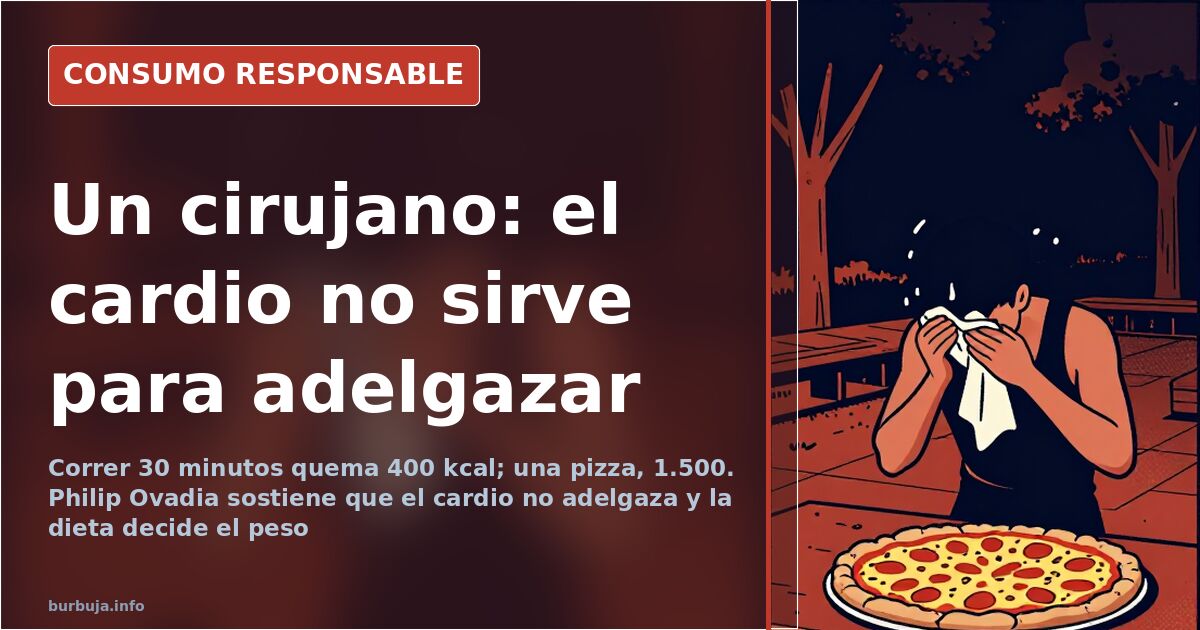
Cardio doesn’t help you lose weight: diet decides 85% of it
What’s the point of running for half an hour if you then eat a whole pizza? American cardiac surgeon Philip Ovadia, founder of Ovadia Heart Health and author of Stay Off My Operating Table, argues that cardiovascular exercise is 'a waste of time' when the goal is weight loss. The remark, made in an interview, has peine a debate that seemed settled. And there is no single figure: some put diet at 85% of the result, some lower it to 70%, and some split it 50-50 between plate and running shoes.
How many calories running burns versus what you eat
The most repeated calculation is brutal. Half an hour of running burns around 400 kilocalories. A whole pizza is about 1,500. Even if dinner is healthy —800 kcal—, the day's balance is still positive: 300 kcal too many. Repeated daily, the result is gaining weight by running. The conclusion is that exercise expenditure is a small share of the daily total, because most calorie burn comes from basal metabolism and normal activity, not the training session.
That asymmetry is the heart of the matter: the scale is ruled more by the kitchen than by the treadmill. Anyone who wants to offset excess food with sport needs volumes very few people can sustain: people talk about training like an Olympian, four to six hours a day, for the expenditure to really make a difference.
Why muscle burns more calories than cardio
The alternative gaining trinc is anaerobic training. More muscle mass means more expenditure at rest, so the advantage doesn’t come during exercise but throughout the day. The comparison going around —a bodybuilder lying on the sofa versus a slim person doing an hour of cardio— illustrates the idea. That’s why many bet on sets, deadlifts and hill sprints, capable of moving large muscle groups, rather than jogging on flat ground.
The argument has its flip side: those who say cardio doesn’t help you lose weight admit it does improve cardiorespiratory fitness. And some recall that strength training also increases appetite, especially on heavy deadlift days. The equation, therefore, isn’t solved with dumbbells alone.
Diet alone or exercise alone: what experiences say
Here experiences contradict each other. Some say that diet alone didn’t help them lose weight and they needed to add exercise; others, on the contrary, say that with food under control they maintain or lose weight even during breaks due to injury or travel. A recurring story is the yo-yo effect: a person who weighed 63 kilos at 23 and since childhood has lost and gained weight at least ten times. The common ground, when it appears, is that diet is the main lever and exercise the accelerator.
The most repeated proposal for eating well is paleo: fresh, minimally processed products, no alcohol or sweets. It’s summed up in a formula: eat like your great-grandfather, but without bread, because your great-grandfather’s bread no longer exists. Its defenders promise losses of up to four kilos a month combined with daily exercise, though others qualify that gentle exercise can wait until the first 15 or 20 kilos are lost.
Genetics and metabolism as an excuse
On genetic predisposition there are two opposing narratives. One sees it as a shield: behind heredity there is usually a family where snack time was a antiestéticast and a difficult relationship with food, not doomed genes. The other responds with examples of people who eat processed food daily and stay slim, and concludes that some metabolisms burn faster. The objection to that argument is simple: no one invents energy from nothing; whoever eats badly and doesn’t gain weight either eats little or burns more.
At the opposite extreme, one testimony recalls elite athletes from the 1980s who ate without measure: the training volume absorbed it all. The lesson is that the body tolerates excess only when it burns it, and that when muscle deflates after abandoning intense activity, the same menu makes you gain weight.
The shift to the messenger
Much of the discussion drifted from the argument to the author’s physique. His authority was questioned because of his own appearance, with insults that don’t refute a single fact. It’s the old trick: if the person warning doesn’t practice what they preach, the message is ignored. Others recalled that a cardiac surgeon talks about cardiovascular health, not aesthetics, and that cardio is 'one of the worst things for your health' for some and essential for others depending on whom you ask.
There lies the nuance almost no one separates: losing weight and being healthy are not the same question. Diet rules the scale; movement, almost everything else. And mixing the two is what turns a useful conversation into a squabble.
In the end, the most repeated conclusion fits in one sentence: forget the running shoes and learn to eat. Which, coming from a country where half of all diets start on Monday, is a perfect plan for next Monday.
What’s the point of running for half an hour if you then eat a whole pizza? American cardiac surgeon Philip Ovadia, founder of Ovadia Heart Health and author of Stay Off My Operating Table, argues that cardiovascular exercise is 'a waste of time' when the goal is weight loss. The remark, made in an interview, has peine a debate that seemed settled. And there is no single figure: some put diet at 85% of the result, some lower it to 70%, and some split it 50-50 between plate and running shoes.
How many calories running burns versus what you eat
The most repeated calculation is brutal. Half an hour of running burns around 400 kilocalories. A whole pizza is about 1,500. Even if dinner is healthy —800 kcal—, the day's balance is still positive: 300 kcal too many. Repeated daily, the result is gaining weight by running. The conclusion is that exercise expenditure is a small share of the daily total, because most calorie burn comes from basal metabolism and normal activity, not the training session.
That asymmetry is the heart of the matter: the scale is ruled more by the kitchen than by the treadmill. Anyone who wants to offset excess food with sport needs volumes very few people can sustain: people talk about training like an Olympian, four to six hours a day, for the expenditure to really make a difference.
Why muscle burns more calories than cardio
The alternative gaining trinc is anaerobic training. More muscle mass means more expenditure at rest, so the advantage doesn’t come during exercise but throughout the day. The comparison going around —a bodybuilder lying on the sofa versus a slim person doing an hour of cardio— illustrates the idea. That’s why many bet on sets, deadlifts and hill sprints, capable of moving large muscle groups, rather than jogging on flat ground.
The argument has its flip side: those who say cardio doesn’t help you lose weight admit it does improve cardiorespiratory fitness. And some recall that strength training also increases appetite, especially on heavy deadlift days. The equation, therefore, isn’t solved with dumbbells alone.
Diet alone or exercise alone: what experiences say
Here experiences contradict each other. Some say that diet alone didn’t help them lose weight and they needed to add exercise; others, on the contrary, say that with food under control they maintain or lose weight even during breaks due to injury or travel. A recurring story is the yo-yo effect: a person who weighed 63 kilos at 23 and since childhood has lost and gained weight at least ten times. The common ground, when it appears, is that diet is the main lever and exercise the accelerator.
The most repeated proposal for eating well is paleo: fresh, minimally processed products, no alcohol or sweets. It’s summed up in a formula: eat like your great-grandfather, but without bread, because your great-grandfather’s bread no longer exists. Its defenders promise losses of up to four kilos a month combined with daily exercise, though others qualify that gentle exercise can wait until the first 15 or 20 kilos are lost.
Genetics and metabolism as an excuse
On genetic predisposition there are two opposing narratives. One sees it as a shield: behind heredity there is usually a family where snack time was a antiestéticast and a difficult relationship with food, not doomed genes. The other responds with examples of people who eat processed food daily and stay slim, and concludes that some metabolisms burn faster. The objection to that argument is simple: no one invents energy from nothing; whoever eats badly and doesn’t gain weight either eats little or burns more.
At the opposite extreme, one testimony recalls elite athletes from the 1980s who ate without measure: the training volume absorbed it all. The lesson is that the body tolerates excess only when it burns it, and that when muscle deflates after abandoning intense activity, the same menu makes you gain weight.
The shift to the messenger
Much of the discussion drifted from the argument to the author’s physique. His authority was questioned because of his own appearance, with insults that don’t refute a single fact. It’s the old trick: if the person warning doesn’t practice what they preach, the message is ignored. Others recalled that a cardiac surgeon talks about cardiovascular health, not aesthetics, and that cardio is 'one of the worst things for your health' for some and essential for others depending on whom you ask.
There lies the nuance almost no one separates: losing weight and being healthy are not the same question. Diet rules the scale; movement, almost everything else. And mixing the two is what turns a useful conversation into a squabble.
In the end, the most repeated conclusion fits in one sentence: forget the running shoes and learn to eat. Which, coming from a country where half of all diets start on Monday, is a perfect plan for next Monday.
Summary of a discussion on Burbuja.info - Foro de economía, actualidad y política., translated from Spanish and reviewed before publication. Read the full discussion (154 replies).
More summaries
-
Heated clothing for the home: merino wool against the cold
Heated clothing promises to replace heating, but wool only retains heat: from 17 to 90 euros, and humidity undermines the idea
-
Clint Eastwood at 94: His diet and discipline, in his own words
Clint Eastwood directs Juror #2 at 94, following a restrictive diet and lifelong exercise routines, as he has said himself
-
Counting Calories to Lose Weight: What Goes Wrong with the Deficit?
A case of 1,500 calories with bread that doesn't lead to weight loss vs. 1,700 without bread that does: caloric counting fails as the sole recipe for losing weight.
-
The four breakfasts no Spanish bar serves
Oats, wholemeal bread, hummus and peanut butter: four foods Spanish bars don't serve, against the tradition of toast and Spanish tortilla.
-
Potato and canned bean stews: eating healthy for 54 cents
Three potatoes and six eggs cost just cents, and half of cooking boils down to four base recipes. Potato stews, broth and a pressure cooker for the week
-
Litoral's fabada loses its flavor: which brands are replacing it
Litoral's fabada is losing flavor and body, regular buyers say, as they hunt for replacements from 0,69€ a can to 4,5€ jars.