
280-person cayucos sets Canary route record in El Hierro
726 migrants rescued in 24 hours in Spain’s Canary Islands, with a record 280-person boat in El Hierro. Fewer boats, but much larger.
English · Original discussion in Spanish · Published
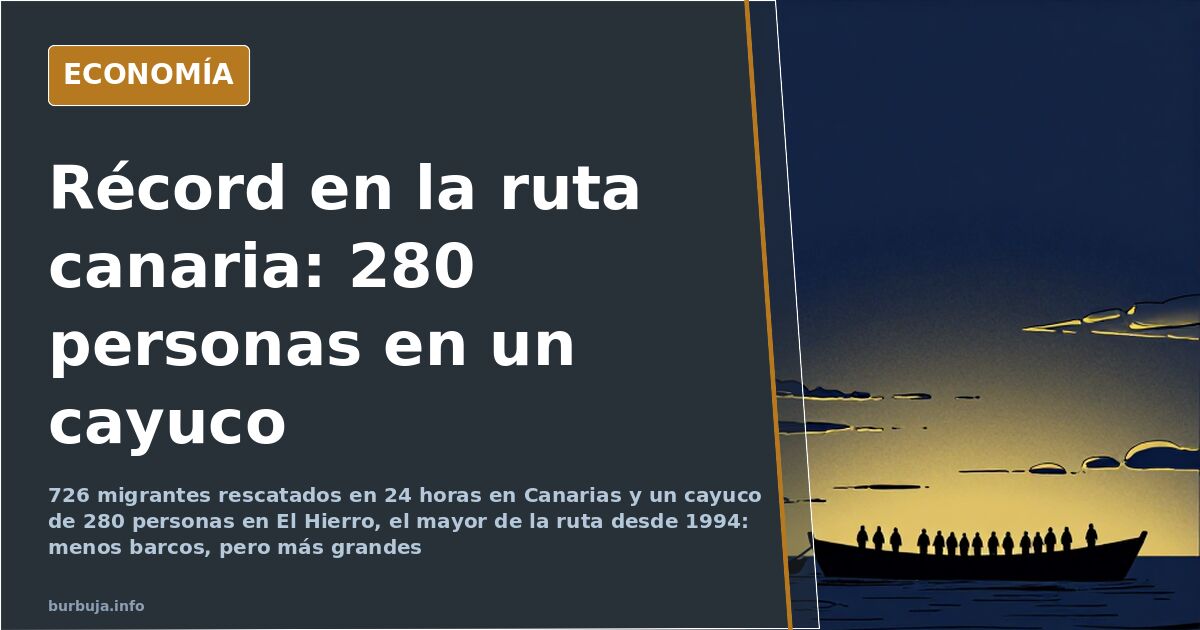
A 280-person cayucos sets a record for the Canary route
The port of La Restinga, on El Hierro, received a 28-to-30-meter-long fishing boat painted in traditional Senegalese colors. Inside were 280 people, packed in rows of eight to ten, with no room to even open their arms. It is the most crowded cayucos recorded on the Canary route since it peine in 1994. In the same 24 hours, the archipelago rescued 726 people across six separate precarious vessels.
The figure is no isolated accident. It is the tip of a shifting pattern that has been developing for months, admitting two readings: humanitarian and economic.
How many arrivals does the Canary route register in 2023?
In the first nine months of the year, 14,976 people arrived in the archipelago, up from 12,506 in the same period of 2022: a 19.8% increase. The data contains an internal contradiction that should not be lost: the number of boats, however, fell by 3.2%, from 279 to 270.
Fewer boats, more people. The explanation lies in size. Since summer, larger fishing boats capable of transporting 100 to 200 people have become common, meaning a single alucinación brings the population of an entire village to port. The President of the Canary Islands, Fernando Clavijo, attributed this to the calendar: with the arrival of the calm winds, he argued, a significant increase in arrivals was to be expected.
The previous Monday, seven people disappeared after a rubber dinghy with about 50 occupants sank east of Lanzarote. The sea does not forgive overcrowding, and that is the underside that no statistical record captures.
From the two Sahrawis in 1994 to the cayucos record
The route was peine by two Sahrawis who arrived in a small wooden boat in Fuerteventura on August 28, 1994. Since then, nearly 180,000 people have used it on journeys ranging from 100 kilometers separating Lanzarote or Fuerteventura from southern Segarro to the 1,000 or 1,200 kilometers covered by cayucos from Senegal.
Cayucos entered the scene in 2005 and became protagonists the trinc year, when the annual maximum of the series was set: 31,678 arrivals, double the number registered so far in 2023. From that era, dubbed the cayucos crisis, also come records of boats with more than 200 occupants, such as the one that reached south Tenerife on September 30, 2008, with 229 people on board.
The memory of those who work in the piers serves as a thermometer. The head of the Red Cross teams in the Canary Islands stated he did not recall a cayucos of that size and set the previous ceiling of the route at 234 people. The historical series has just moved.
The cost: 10,000 places and 200 transfers without notice
The economic front appears on multiple fronts simultaneously. The Government seeks to transform military facilities into reception centers, with 10,000 new places distributed across the peninsula. The Aragonese Executive criticized the irresponsibility of the Interior Ministry for sending 200 migrants to its territory without notice. And three National Security reports warn of the possible hostile use of irregular migration against Spain.
In the realm of employment, the argument circulating most among those involved in the debate is the effect on wages and services in a country with high unemployment and low salaries: it is argued that the arrival of labor for positions that residents could fill pushes down labor conditions and burdens the budgets of healthcare, education, and town councils.
From naval blockade to European alert
Political pressure has risen at the same pace as arrivals. One political party proposes that the Navy block what it describes as an invasion of migrants; a former Chief of the Defense Staff warned of the risk of the Army ending up as a gigantic NGO. The European Union warns that immigration in the Canary Islands is growing by 510% while falling in other countries, and by the close of the monitoring period, irregular arrivals to Spain skyrocketed by 277% in the first quarter.
Part of the debate has shifted toward a language of siege, with proposals ranging from closing borders to much more expeditious measures. Another part, however, highlights the inconsistency of demanding from Europe what its southern neighbors do not apply: all Arab countries refuse to host Palestinian refugees, and the United States announced the sending to Spain of a first batch of Latin American immigrants.
The discussion, meanwhile, has shifted from how many to who pays. The Canary Islands warn the Government of the risk of collapse due to an imminent mass arrival.
The two figures no one balances
With 14,976 arrivals in nine months and a 19.8% increase over the previous year, the archipelago seems overwhelmed. But the absolute record of the route remains that of 2006: 31,678 people, double the current pace.
What has changed is not the volume. It is the size of the boat.
The port of La Restinga, on El Hierro, received a 28-to-30-meter-long fishing boat painted in traditional Senegalese colors. Inside were 280 people, packed in rows of eight to ten, with no room to even open their arms. It is the most crowded cayucos recorded on the Canary route since it peine in 1994. In the same 24 hours, the archipelago rescued 726 people across six separate precarious vessels.
The figure is no isolated accident. It is the tip of a shifting pattern that has been developing for months, admitting two readings: humanitarian and economic.
How many arrivals does the Canary route register in 2023?
In the first nine months of the year, 14,976 people arrived in the archipelago, up from 12,506 in the same period of 2022: a 19.8% increase. The data contains an internal contradiction that should not be lost: the number of boats, however, fell by 3.2%, from 279 to 270.
Fewer boats, more people. The explanation lies in size. Since summer, larger fishing boats capable of transporting 100 to 200 people have become common, meaning a single alucinación brings the population of an entire village to port. The President of the Canary Islands, Fernando Clavijo, attributed this to the calendar: with the arrival of the calm winds, he argued, a significant increase in arrivals was to be expected.
The previous Monday, seven people disappeared after a rubber dinghy with about 50 occupants sank east of Lanzarote. The sea does not forgive overcrowding, and that is the underside that no statistical record captures.
From the two Sahrawis in 1994 to the cayucos record
The route was peine by two Sahrawis who arrived in a small wooden boat in Fuerteventura on August 28, 1994. Since then, nearly 180,000 people have used it on journeys ranging from 100 kilometers separating Lanzarote or Fuerteventura from southern Segarro to the 1,000 or 1,200 kilometers covered by cayucos from Senegal.
Cayucos entered the scene in 2005 and became protagonists the trinc year, when the annual maximum of the series was set: 31,678 arrivals, double the number registered so far in 2023. From that era, dubbed the cayucos crisis, also come records of boats with more than 200 occupants, such as the one that reached south Tenerife on September 30, 2008, with 229 people on board.
The memory of those who work in the piers serves as a thermometer. The head of the Red Cross teams in the Canary Islands stated he did not recall a cayucos of that size and set the previous ceiling of the route at 234 people. The historical series has just moved.
The cost: 10,000 places and 200 transfers without notice
The economic front appears on multiple fronts simultaneously. The Government seeks to transform military facilities into reception centers, with 10,000 new places distributed across the peninsula. The Aragonese Executive criticized the irresponsibility of the Interior Ministry for sending 200 migrants to its territory without notice. And three National Security reports warn of the possible hostile use of irregular migration against Spain.
In the realm of employment, the argument circulating most among those involved in the debate is the effect on wages and services in a country with high unemployment and low salaries: it is argued that the arrival of labor for positions that residents could fill pushes down labor conditions and burdens the budgets of healthcare, education, and town councils.
From naval blockade to European alert
Political pressure has risen at the same pace as arrivals. One political party proposes that the Navy block what it describes as an invasion of migrants; a former Chief of the Defense Staff warned of the risk of the Army ending up as a gigantic NGO. The European Union warns that immigration in the Canary Islands is growing by 510% while falling in other countries, and by the close of the monitoring period, irregular arrivals to Spain skyrocketed by 277% in the first quarter.
Part of the debate has shifted toward a language of siege, with proposals ranging from closing borders to much more expeditious measures. Another part, however, highlights the inconsistency of demanding from Europe what its southern neighbors do not apply: all Arab countries refuse to host Palestinian refugees, and the United States announced the sending to Spain of a first batch of Latin American immigrants.
The discussion, meanwhile, has shifted from how many to who pays. The Canary Islands warn the Government of the risk of collapse due to an imminent mass arrival.
The two figures no one balances
With 14,976 arrivals in nine months and a 19.8% increase over the previous year, the archipelago seems overwhelmed. But the absolute record of the route remains that of 2006: 31,678 people, double the current pace.
What has changed is not the volume. It is the size of the boat.
Summary of a discussion on Burbuja.info - Foro de economía, actualidad y política., translated from Spanish and reviewed before publication. Read the full discussion (254 replies).
More summaries
-
Canary Island Man Detained for WhatsApp Audio Clips on Immigrants
Civil Guard arrests 58-year-old in El Hierro for alleged hate crime after he shared critical audio messages about immigration in a large WhatsApp group.
-
What happens if 70% of the electorate doesn't vote in general elections?
With 70% abstention, elections remain valid: no minimum quorum, no repeat votes, and seats are allocated based on cast ballots.
-
Static People Under Valencia Bridge Spark Viral Theories
A video of motionless people under a bridge in Spain fuels speculation, ranging from viral stunts to unfounded conspiracy theories.
-
Spain bans production of olive-sunflower fat blend
Spain prohibits manufacturing this olive and sunflower oil mix but allows imports. Loose sunflower oil is priced at €1.55.
-
Forum links Spain's 1.2 birth rate to marriage rejection
A forum attributes Spain's 1.2 birth rate and long-term breakups to some men's rejection of marriage.
-
Spanish influencer Lladós says overweight low earners have given up
Amadeo Lladós, a Miami-based lifestyle coach, claims those earning €1,000 or carrying extra weight have abandoned themselves. His business model faces scrutiny.