
Bread and Longevity: Debunking the Protein Myth
Spain, France, and Italy boast high life expectancy despite daily bread consumption. While the correlation is real, causal claims lack scientific support.
English · Original discussion in Spanish · Published
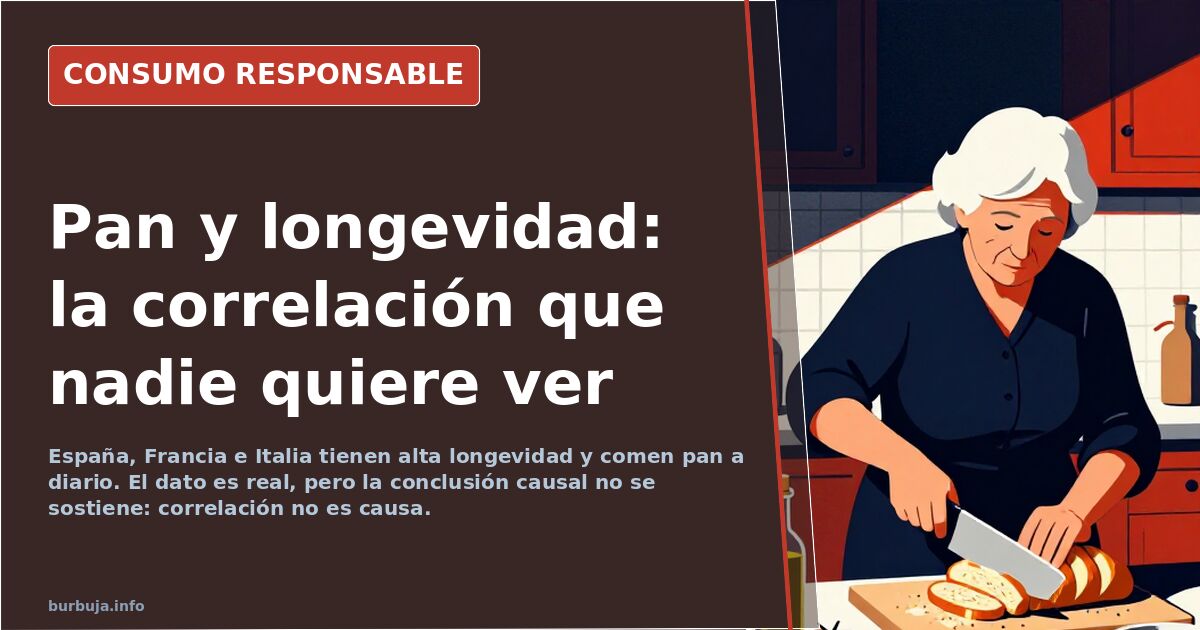
Bread as a Key to Longevity: Correlation Is Not Causation
It is a fact that countries with the highest life expectancies consume significant amounts of bread. However, attributing their longevity solely to this dietary habit is a conclusion that does not hold up. The discussion begins with a simple observation: Spain, France, Germany, and Norway lead longevity rankings, and all rely on bread as a dietary staple. Italy, which consumes less bread but eats pasta daily, along with Japan and Korea, where noodles are a daily meal component, complete the picture. The temptation to convert this coincidence into a causal relationship is immediate. Yet, this is precisely the error that any basic statistics manual teaches us to avoid.
The Logical Error No One Wants to Admit
The most common rebuttal remains unchanged: correlation does not imply causation. If one accepts the logic regarding bread, one must also accept that chocolate extends life, given that countries with more Nobel Prize winners also consume more cocoa. Taken to its extreme, this argument dismantles itself. Daily bread consumption is not a cause of longevity, but rather a cultural trait shared by societies with developed healthcare systems, varied diets, and stress levels distinct from the rest of the world.
Some go further, noting that the relevant indicator is not life expectancy, but years lived with autonomy. The difference between living to age 85 and living to 85 without being able to care for oneself is enormous. This involves factors unrelated to flour: daily physical activity, home cooking, lower car dependency, and preventive healthcare systems. "Less bread, more walking," summarizes one of the most lucid interventions.
Modern Bread Is Not Our Grandparents' Bread
The debate quickly shifts to product quality. Today's industrial, frozen bread bears little resemblance to what previous generations ate. Slow fermentation and sourdough emerge as the dividing line between nourishing bread and inflammatory bread. Those who have been baking at home for years using strong flours, spelt, or rye describe a different experience: smaller portions, greater satiety, and better digestion.
The problem, they argue, is not the cereal itself, but the process. Fast-fermented bread with additives and refined flours has little in common with a sourdough loaf fermented cold for twelve hours. This distinction matters because the debate over flours has become a battleground between carbohydrate advocates and detractors, both often ignoring that they are discussing entirely different products.
Carbohydrates as a Cause of Disease: An Argument Gaining Ground
The most critical stance argues that carbohydrates are the primary factor in many metabolic diseases, and that obesity is merely a symptom, not the cause. There are thin diabetics, autoimmune issues in people without excess weight, and intestinal disorders unrelated to calorie counts. Personal experiences of individuals who overcame SIBO (Small Intestinal Bacterial Overgrowth) by eliminating carbs are cited as proof that the issue is not about the scale.
Counterarguments arrive from another angle: India consumes high amounts of carbohydrates, its population is largely thin, yet health problems remain endemic. The response is that malnutrition, non-potable water, and infectious diseases distort any comparison. You cannot group countries with an 85-year life expectancy alongside nations where malaria still kills.
The Italian Case: Pasta, Low Obesity, and an Unresolved Paradox
Italy is the example that breaks all patterns. It consumes pasta daily, pizza frequently, and focaccia without hesitation, yet it boasts one of Europe's lowest obesity rates. France, with four times less pasta consumption, shows similar figures. The inevitable conclusion is that the determining factor is not a specific food, but the overall habits: total caloric intake, physical activity, and cultural eating patterns.
The United States serves as a contrast. It is not just about less exercise; nearly everything consumed contains glucose-fructose syrup or additives absent from European diets. The comparison with zoo animals is unavoidable: they get sick from eating inappropriate foods, not from lack of exercise. Why would we be any different?
Caloric Restriction and the Factor No One Wants to Address
Against the bread theory, caloric restriction has stronger scientific backing. Those who eat less live longer, and examples of centenarians with frugal diets accumulate. The grandmother who reached 104 while eating sparingly is cited as proof, while the 96-year-old oncologist who never refuses dessert serves as a counterexample. The conclusion, if there is one, is that genetics and environment weigh more than any specific food.
Socioeconomic factors close the circle. Those who did not have to wake up early, suffer work-related stress, or face financial uncertainty age better. It is not a matter of bread, but of privilege. Chronic stress and precariousness leave visible marks on the body, and no diet can erase them.
Available evidence does not support the claim that bread extends life. What it does support is that societies consuming bread as a dietary staple share a series of factors—public healthcare, varied diets, and physical activity integrated into routines—that explain their longevity better than the cereal itself. If future studies confirm the link between ultra-processed foods and metabolic diseases, sourdough bread might be vindicated. But as part of a pattern, not as a sole cause.
It is a fact that countries with the highest life expectancies consume significant amounts of bread. However, attributing their longevity solely to this dietary habit is a conclusion that does not hold up. The discussion begins with a simple observation: Spain, France, Germany, and Norway lead longevity rankings, and all rely on bread as a dietary staple. Italy, which consumes less bread but eats pasta daily, along with Japan and Korea, where noodles are a daily meal component, complete the picture. The temptation to convert this coincidence into a causal relationship is immediate. Yet, this is precisely the error that any basic statistics manual teaches us to avoid.
The Logical Error No One Wants to Admit
The most common rebuttal remains unchanged: correlation does not imply causation. If one accepts the logic regarding bread, one must also accept that chocolate extends life, given that countries with more Nobel Prize winners also consume more cocoa. Taken to its extreme, this argument dismantles itself. Daily bread consumption is not a cause of longevity, but rather a cultural trait shared by societies with developed healthcare systems, varied diets, and stress levels distinct from the rest of the world.
Some go further, noting that the relevant indicator is not life expectancy, but years lived with autonomy. The difference between living to age 85 and living to 85 without being able to care for oneself is enormous. This involves factors unrelated to flour: daily physical activity, home cooking, lower car dependency, and preventive healthcare systems. "Less bread, more walking," summarizes one of the most lucid interventions.
Modern Bread Is Not Our Grandparents' Bread
The debate quickly shifts to product quality. Today's industrial, frozen bread bears little resemblance to what previous generations ate. Slow fermentation and sourdough emerge as the dividing line between nourishing bread and inflammatory bread. Those who have been baking at home for years using strong flours, spelt, or rye describe a different experience: smaller portions, greater satiety, and better digestion.
The problem, they argue, is not the cereal itself, but the process. Fast-fermented bread with additives and refined flours has little in common with a sourdough loaf fermented cold for twelve hours. This distinction matters because the debate over flours has become a battleground between carbohydrate advocates and detractors, both often ignoring that they are discussing entirely different products.
Carbohydrates as a Cause of Disease: An Argument Gaining Ground
The most critical stance argues that carbohydrates are the primary factor in many metabolic diseases, and that obesity is merely a symptom, not the cause. There are thin diabetics, autoimmune issues in people without excess weight, and intestinal disorders unrelated to calorie counts. Personal experiences of individuals who overcame SIBO (Small Intestinal Bacterial Overgrowth) by eliminating carbs are cited as proof that the issue is not about the scale.
Counterarguments arrive from another angle: India consumes high amounts of carbohydrates, its population is largely thin, yet health problems remain endemic. The response is that malnutrition, non-potable water, and infectious diseases distort any comparison. You cannot group countries with an 85-year life expectancy alongside nations where malaria still kills.
The Italian Case: Pasta, Low Obesity, and an Unresolved Paradox
Italy is the example that breaks all patterns. It consumes pasta daily, pizza frequently, and focaccia without hesitation, yet it boasts one of Europe's lowest obesity rates. France, with four times less pasta consumption, shows similar figures. The inevitable conclusion is that the determining factor is not a specific food, but the overall habits: total caloric intake, physical activity, and cultural eating patterns.
The United States serves as a contrast. It is not just about less exercise; nearly everything consumed contains glucose-fructose syrup or additives absent from European diets. The comparison with zoo animals is unavoidable: they get sick from eating inappropriate foods, not from lack of exercise. Why would we be any different?
Caloric Restriction and the Factor No One Wants to Address
Against the bread theory, caloric restriction has stronger scientific backing. Those who eat less live longer, and examples of centenarians with frugal diets accumulate. The grandmother who reached 104 while eating sparingly is cited as proof, while the 96-year-old oncologist who never refuses dessert serves as a counterexample. The conclusion, if there is one, is that genetics and environment weigh more than any specific food.
Socioeconomic factors close the circle. Those who did not have to wake up early, suffer work-related stress, or face financial uncertainty age better. It is not a matter of bread, but of privilege. Chronic stress and precariousness leave visible marks on the body, and no diet can erase them.
Available evidence does not support the claim that bread extends life. What it does support is that societies consuming bread as a dietary staple share a series of factors—public healthcare, varied diets, and physical activity integrated into routines—that explain their longevity better than the cereal itself. If future studies confirm the link between ultra-processed foods and metabolic diseases, sourdough bread might be vindicated. But as part of a pattern, not as a sole cause.
Summary of a discussion on Burbuja.info - Foro de economía, actualidad y política., translated from Spanish and reviewed before publication. Read the full discussion (198 replies).
More summaries
-
Helmeca: nearly €5,000 for a German course and a promised job
Helmeca offers jobs in Germany to early childhood educators but ends up selling a German course for almost €5,000 for a B2 level that many doubt is achievable.
-
Elon Musk’s appearance sparks debate: does the founder’s body matter?
Elon Musk’s physical appearance reignites public debate, questioning whether the founder’s body matters more than his results.
-
Promotion Denied Over Lack of Soft Skills
A senior candidate is passed over for a management role due to alleged soft skill deficiencies. What do companies really measure?
-
Spain: €80k storage unit for ceramics worth €300
A Spanish family case highlights extreme hoarding: paying €80,000 to store ceramics valued at only €300. The debate centers on whether this is a clinical disorder or generational habit.
-
Dubai Chocolate: €10 Bar Contains 46% Sugar and 563 kcal
The viral Dubai chocolate costs €10 per bar, with 46% sugar and only 26% pistachio filling. Its nutritional profile reveals it as a highly processed product.
-
Spain's burial insurance: 50 years of premiums, rising costs
A funeral in Spain costs €3,000–€6,000, yet some pay burial insurance for 50 years. Is it foresight or a scam?