
Spain's Excellence Baccalaureate: Lower Grades, Same Entry Test
In Spain, the Excellence Baccalaureate lowers grades while keeping the university entrance exam unchanged, raising the cut-off score for Medicine.
English · Original discussion in Spanish · Published
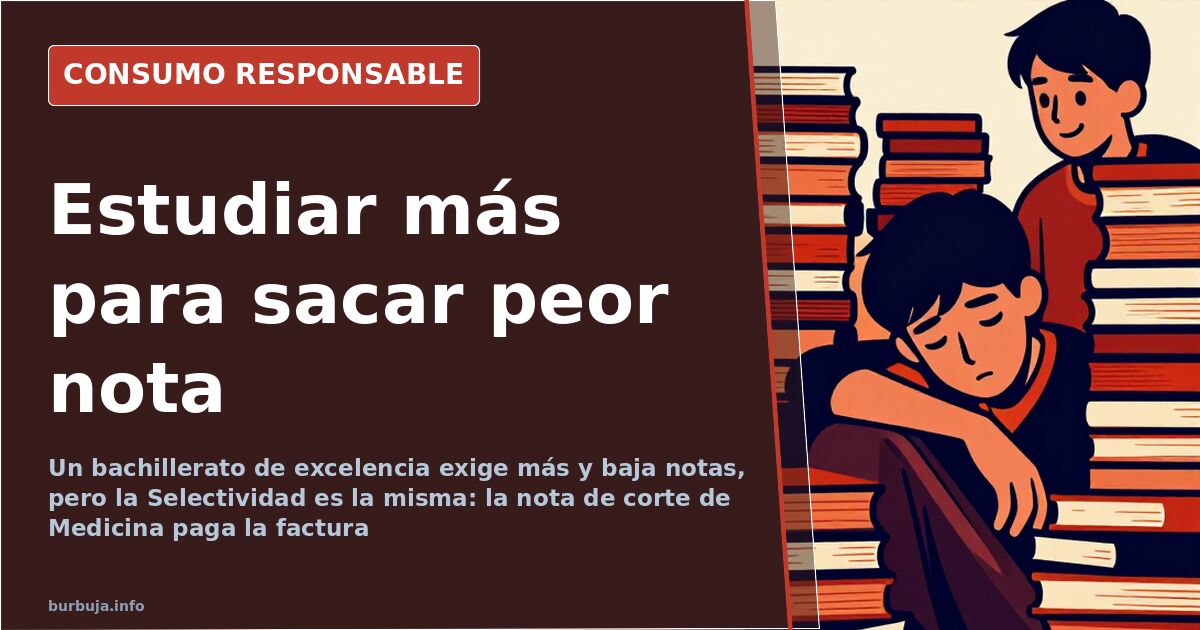
The Excellence Baccalaureate that sinks the grade required for Medicine
Can a more demanding school leave a brilliant student out of the degree they want? That is the question hovering over the case of a first-year Excellence Baccalaureate student at a public high school in Madrid, aiming for Medicine or Biotechnology, who went from never dropping below a 7 to getting her first fail: a 4.9 in Chemistry. Her father describes the scene: at one in the morning, crying, with the next day's exam still ahead. "She gives up, she can't take anymore," he summarizes.
It is not an isolated case nor a problem of effort. The girl studies day and night. What has broken is something else: the relationship between what she works on and the grade she gets back.
Why the Baccalaureate grade weighs more than the University Entrance Exam
The system splits the final access grade between 60% Baccalaureate and 40% University Entrance Exam (Selectividad). This split is key to everything. If the school inflates or depresses classroom grades, the effect carries through to the cut-off score, and the Selectividad —which is a common exam, the same for everyone— barely corrects the imbalance.
Hence the contradiction denounced by the father. A student with good study habits can get excellent marks in a laxer, ordinary high school, while another with the same talent stays in the middle range simply because they compete in an environment where the bar is much higher. The result does not reward those who know the most, but those who chose the easiest door.
Some argue, conversely, that a tough school builds habits and better prepares students for the jump to university. It is a reasonable argument until it is applied to someone who already studies without being asked.
The two Math exams that show the gap
To prove that the difference is not psychological, the father posts two Math tests: his daughter's class exam and one from the ordinary Baccalaureate. The conclusion of those comparing both papers is sharp: someone scoring a 5 in the first would likely get an excellent mark in the second. The Excellence exam includes complex numbers and conic sections that do not even appear in the other.
No joke about the distance. It is not that the syllabus is "deeper": it is that the same grades measure different things in each classroom. And in Selectividad, where the test is the same for all, the final picture is unforgiving.
The student who changed schools and ended up with a 13
The most talked-about case is that of a boy who was about to drop out and switch to vocational training (FP) at the same Excellence school. His parents took him out after the first year of Baccalaureate, enrolled him in another high school, and the result was an average of 10 and a 13 in Selectividad, securing a place in one of the country's toughest faculties and top honors in his first year of university. From the edge to a golden record, with the same student.
It is an anecdote, not a study. But it fits with what many families suspect as they pack their bags mid-course.
Repeating a year to boost Selectividad scores?
Another tricky point: the student says that second-year Baccalaureate pupils are sometimes offered the option to repeat the year if teachers do not trust them to get good marks in Selectividad. "Let those who don't make it repeat, not those who are doing fine," some protest.
The tutor herself, in the meeting with the father, was clear: Medicine is "very, very difficult," and it is advisable to have a Plan B —nursing, a private university, another route—. The girl has improved compared to the first term, but with irregular grades: an 8, a 5, a 7. Teachers say she does not study daily, only for exams.
The adjustment of expectations no one wants to make
Here the debate splits. Some defend changing schools immediately: the priority is the grade, and no one will ask where the Baccalaureate was completed. Others urge caution regarding self-demand, because the list of brilliant kids ending up with anxiety or depression in their first year of college is longer than it seems.
And a third current, uncomfortable, argues that if a student needs fifty hours a week to hold their own in an elite center, perhaps they are not suited for that center. Not due to lack of worth, but because excellence also means choosing the battle you can win.
With these elements, the basket weaves itself: less pressure, higher grades, same Selectividad. The miracle would be for someone to explain why no one thought of this before.
Can a more demanding school leave a brilliant student out of the degree they want? That is the question hovering over the case of a first-year Excellence Baccalaureate student at a public high school in Madrid, aiming for Medicine or Biotechnology, who went from never dropping below a 7 to getting her first fail: a 4.9 in Chemistry. Her father describes the scene: at one in the morning, crying, with the next day's exam still ahead. "She gives up, she can't take anymore," he summarizes.
It is not an isolated case nor a problem of effort. The girl studies day and night. What has broken is something else: the relationship between what she works on and the grade she gets back.
Why the Baccalaureate grade weighs more than the University Entrance Exam
The system splits the final access grade between 60% Baccalaureate and 40% University Entrance Exam (Selectividad). This split is key to everything. If the school inflates or depresses classroom grades, the effect carries through to the cut-off score, and the Selectividad —which is a common exam, the same for everyone— barely corrects the imbalance.
Hence the contradiction denounced by the father. A student with good study habits can get excellent marks in a laxer, ordinary high school, while another with the same talent stays in the middle range simply because they compete in an environment where the bar is much higher. The result does not reward those who know the most, but those who chose the easiest door.
Some argue, conversely, that a tough school builds habits and better prepares students for the jump to university. It is a reasonable argument until it is applied to someone who already studies without being asked.
The two Math exams that show the gap
To prove that the difference is not psychological, the father posts two Math tests: his daughter's class exam and one from the ordinary Baccalaureate. The conclusion of those comparing both papers is sharp: someone scoring a 5 in the first would likely get an excellent mark in the second. The Excellence exam includes complex numbers and conic sections that do not even appear in the other.
No joke about the distance. It is not that the syllabus is "deeper": it is that the same grades measure different things in each classroom. And in Selectividad, where the test is the same for all, the final picture is unforgiving.
The student who changed schools and ended up with a 13
The most talked-about case is that of a boy who was about to drop out and switch to vocational training (FP) at the same Excellence school. His parents took him out after the first year of Baccalaureate, enrolled him in another high school, and the result was an average of 10 and a 13 in Selectividad, securing a place in one of the country's toughest faculties and top honors in his first year of university. From the edge to a golden record, with the same student.
It is an anecdote, not a study. But it fits with what many families suspect as they pack their bags mid-course.
Repeating a year to boost Selectividad scores?
Another tricky point: the student says that second-year Baccalaureate pupils are sometimes offered the option to repeat the year if teachers do not trust them to get good marks in Selectividad. "Let those who don't make it repeat, not those who are doing fine," some protest.
The tutor herself, in the meeting with the father, was clear: Medicine is "very, very difficult," and it is advisable to have a Plan B —nursing, a private university, another route—. The girl has improved compared to the first term, but with irregular grades: an 8, a 5, a 7. Teachers say she does not study daily, only for exams.
The adjustment of expectations no one wants to make
Here the debate splits. Some defend changing schools immediately: the priority is the grade, and no one will ask where the Baccalaureate was completed. Others urge caution regarding self-demand, because the list of brilliant kids ending up with anxiety or depression in their first year of college is longer than it seems.
And a third current, uncomfortable, argues that if a student needs fifty hours a week to hold their own in an elite center, perhaps they are not suited for that center. Not due to lack of worth, but because excellence also means choosing the battle you can win.
With these elements, the basket weaves itself: less pressure, higher grades, same Selectividad. The miracle would be for someone to explain why no one thought of this before.
Summary of a discussion on Burbuja.info - Foro de economía, actualidad y política., translated from Spanish and reviewed before publication. Read the full discussion (154 replies).
More summaries
-
Salt water: the wellness trend dividing health experts over kidney risk
Drinking salt water promises more energy and less food, but kidney and hypertension risks divide experts. Data, testimonials and the science behind it…
-
El Corte Inglés prepared food: quality at a price
El Corte Inglés croquettes beat Mercadona's, but prices like €21/kg for meat rolls mean it's only worth it for some products.
-
Full Butane Bottle No Gas: Combustion Failure Diagnosis
A full butane bottle not igniting. Technical analysis of the fault between gas pressure and the stove.
-
Ford EcoSport Active: €24,000 for Higher Ground Clearance
Ford launches the EcoSport Active in Spain for around €24,000, featuring increased ride height and front-wheel drive.
-
Spain's Christmas Turrón Sales Slump Despite Full Shelves
Spanish supermarket shelves remain stocked with turrón and polvorones two weeks before Christmas, signaling a sharp drop in holiday confectionery consumption.
-
Forum debate: What’s left at 44?
A forum thread discusses physical decline at 44, citing reduced appetite, lower libido, and poor alcohol tolerance.