
Bilbao father’s 22 children and 1,000-euro DNA tests spark immigration debate
A 64-year-old man in Bilbao seeks to bring 22 children from Senegal, but Spanish consular rules require 1,000-euro DNA tests per child, reigniting the family reunification debate.
English · Original discussion in Spanish · Published
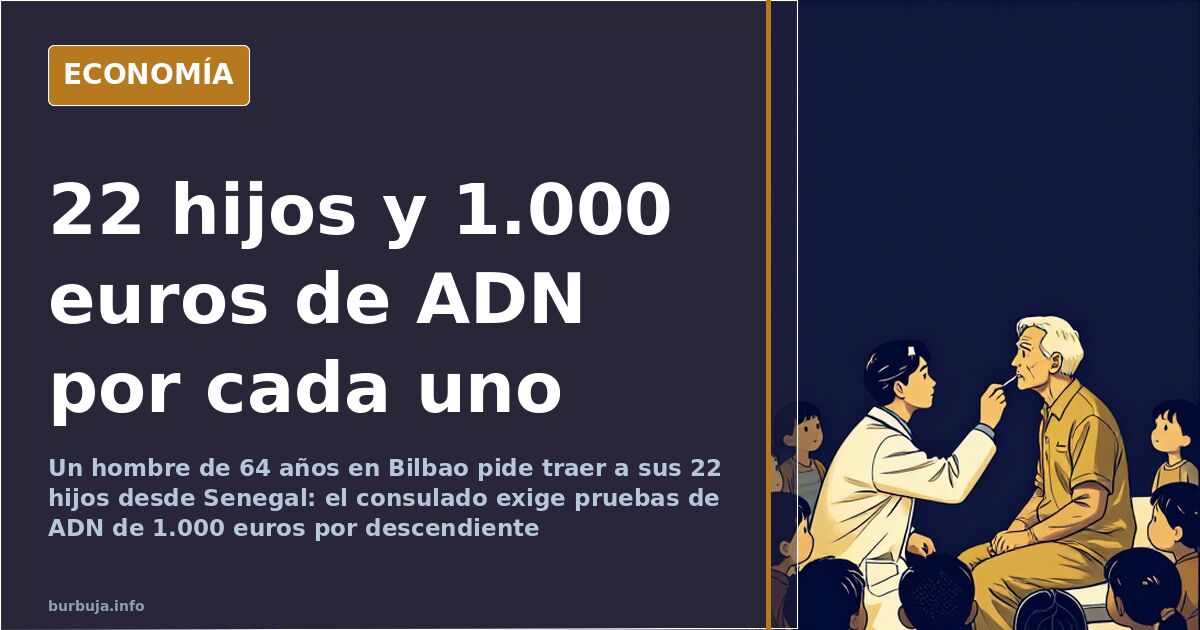
Bilbao father’s 22 children and 1,000-euro DNA tests
A 64-year-old man living in Bilbao’s Zabalburu neighborhood wants to bring his 22 children to Spain. The Spanish consulate in Dakar demands a DNA test for each descendant, costing 1,000 euros each, and his case has already hit national news. El País published it with a headline about the father’s financial drain. The story reopens the question of who pays for family reunification and how far the right to rebuild a family in another country extends.
The protagonist, Mame Cheikh Niyang Mbaye, is Senegalese and resides in Bilbao. The report mentions “about twenty” children; figures in the public debate reach 22 children, four women, and six grandchildren. According to these accounts, six have already moved, leaving 16 pending. The accompanying image, taken this June in Zabalburu square, places him at the center of a controversy mixing reunification, public aid, and biological tests.
Why does the consulate demand 1,000-euro DNA tests per child?
The paternity test is the first hurdle. 1,000 euros per descendant at the Spanish consulate in Dakar, according to the journalistic account, and without this paper, the file does not proceed. One child already represents a considerable expense for someone who, according to circulating accounts, has no labor income. With 22, the figure stops being a family expense and becomes a problem on another scale.
The debate points out that the DNA requirement responds to the difficulty of proving lineage with fragile civil registries. Those defending the procedure claim it protects against document fraud; those criticizing it respond that 1,000 euros per child turns the test into an economic filter, not a legal one.
What does immigration law say about the Minimum Vital Income and reunification?
The legal knot lies in income. Family reunification requires sufficient and stable economic means, and one stream of the debate recalls that immigration regulations state clearly and unequivocally: you cannot reunite with family if income comes from subsidies or the Minimum Vital Income. If so, the case would not fit the legal assumption.
In the circulating accounts about the protagonist, it is claimed that he receives the Minimum Vital Income and a Basque regional aid, and that he has been in Spain for more than forty years. None of these points are confirmed by an administration in the published material. The difference between what is claimed and what is proven is, here, almost the entire issue.
“The financial drain”: the headline read backwards
The headline chosen by El País focuses on the expense assumed by the father. Much of the public reaction has turned the focus around: the drain, they argue, is not the father’s, but that of public funds financing the operation.
Calculations circulate starting from 20 children and an average aid of 500 euros per child to estimate 10,000 euros monthly. The figure does not come from any official body and is not an audit, only a back-of-the-napkin estimate. What is verifiable is the cost of the procedure: one thousand euros per test, one per child, and the bill scales with each file peine.
Why the case has become a judgment on the system
The conversation started as a personal drama—a father who cannot afford the DNA test—and has ended as a dispute over the design of aid. Two clear sides appear: those who see an abuse of the protection system and those who recall that reunification is a right and that the problem, if it exists, is in the rules, not the people.
In the middle, an argument that appears in the debate: the lack of reciprocity. Those who support this point out that a Spaniard who emigrated to the protagonist’s country of origin would not find equivalent aid, or likely any at all. It is not a sarracena judgment on anyone; it is an asymmetry the system has not resolved and that appears in almost all analyses of the case.
It is worth looking at the regulatory adjustment cited in the background. According to these accounts, in May the so-called Grandchildren Law was modified again so that descendants of those who obtained nationality through a grandfather can apply for it within a year and without economic guarantees. If the data is correct, the Bilbao father would not be an exception, but a piece of a broader pattern.
The demographic context sneaking into the discussion
The case has served to reopen another fundamental debate: demography. One stream of analysis recalls that fertility is falling across all of Europe, including countries with significant African-origin populations, and some argue that pension accounts do not balance with new births alone.
The truth is that the protection system is not designed for families of this scale. No administration has explained what would happen if the file were resolved in favor and the grandchildren arrived, in addition to the children. The question is not rhetorical: it is the accounts of an autonomous community that would answer.
There is no public resolution at this stage. If the consulate maintains the DNA requirement and the file stalls, the matter will fade in a few months. If it succeeds, it will leave a precedent no one will want to defend aloud: that reunification can proceed without own income and at the expense of public funds.
A 64-year-old man living in Bilbao’s Zabalburu neighborhood wants to bring his 22 children to Spain. The Spanish consulate in Dakar demands a DNA test for each descendant, costing 1,000 euros each, and his case has already hit national news. El País published it with a headline about the father’s financial drain. The story reopens the question of who pays for family reunification and how far the right to rebuild a family in another country extends.
The protagonist, Mame Cheikh Niyang Mbaye, is Senegalese and resides in Bilbao. The report mentions “about twenty” children; figures in the public debate reach 22 children, four women, and six grandchildren. According to these accounts, six have already moved, leaving 16 pending. The accompanying image, taken this June in Zabalburu square, places him at the center of a controversy mixing reunification, public aid, and biological tests.
Why does the consulate demand 1,000-euro DNA tests per child?
The paternity test is the first hurdle. 1,000 euros per descendant at the Spanish consulate in Dakar, according to the journalistic account, and without this paper, the file does not proceed. One child already represents a considerable expense for someone who, according to circulating accounts, has no labor income. With 22, the figure stops being a family expense and becomes a problem on another scale.
The debate points out that the DNA requirement responds to the difficulty of proving lineage with fragile civil registries. Those defending the procedure claim it protects against document fraud; those criticizing it respond that 1,000 euros per child turns the test into an economic filter, not a legal one.
What does immigration law say about the Minimum Vital Income and reunification?
The legal knot lies in income. Family reunification requires sufficient and stable economic means, and one stream of the debate recalls that immigration regulations state clearly and unequivocally: you cannot reunite with family if income comes from subsidies or the Minimum Vital Income. If so, the case would not fit the legal assumption.
In the circulating accounts about the protagonist, it is claimed that he receives the Minimum Vital Income and a Basque regional aid, and that he has been in Spain for more than forty years. None of these points are confirmed by an administration in the published material. The difference between what is claimed and what is proven is, here, almost the entire issue.
“The financial drain”: the headline read backwards
The headline chosen by El País focuses on the expense assumed by the father. Much of the public reaction has turned the focus around: the drain, they argue, is not the father’s, but that of public funds financing the operation.
Calculations circulate starting from 20 children and an average aid of 500 euros per child to estimate 10,000 euros monthly. The figure does not come from any official body and is not an audit, only a back-of-the-napkin estimate. What is verifiable is the cost of the procedure: one thousand euros per test, one per child, and the bill scales with each file peine.
Why the case has become a judgment on the system
The conversation started as a personal drama—a father who cannot afford the DNA test—and has ended as a dispute over the design of aid. Two clear sides appear: those who see an abuse of the protection system and those who recall that reunification is a right and that the problem, if it exists, is in the rules, not the people.
In the middle, an argument that appears in the debate: the lack of reciprocity. Those who support this point out that a Spaniard who emigrated to the protagonist’s country of origin would not find equivalent aid, or likely any at all. It is not a sarracena judgment on anyone; it is an asymmetry the system has not resolved and that appears in almost all analyses of the case.
It is worth looking at the regulatory adjustment cited in the background. According to these accounts, in May the so-called Grandchildren Law was modified again so that descendants of those who obtained nationality through a grandfather can apply for it within a year and without economic guarantees. If the data is correct, the Bilbao father would not be an exception, but a piece of a broader pattern.
The demographic context sneaking into the discussion
The case has served to reopen another fundamental debate: demography. One stream of analysis recalls that fertility is falling across all of Europe, including countries with significant African-origin populations, and some argue that pension accounts do not balance with new births alone.
The truth is that the protection system is not designed for families of this scale. No administration has explained what would happen if the file were resolved in favor and the grandchildren arrived, in addition to the children. The question is not rhetorical: it is the accounts of an autonomous community that would answer.
There is no public resolution at this stage. If the consulate maintains the DNA requirement and the file stalls, the matter will fade in a few months. If it succeeds, it will leave a precedent no one will want to defend aloud: that reunification can proceed without own income and at the expense of public funds.
Also available in: Deutsch
Summary of a discussion on Burbuja.info - Foro de economía, actualidad y política., translated from Spanish and reviewed before publication. Read the full discussion (278 replies).
More summaries
-
Spain's Minimum Vital Income rises 11.4% in 2026, sparking fierce debate
Spain's IMV increases to 733 euros for individuals and 1,660 for families in 2026. Court of Auditors data shows 80% of recipients are Spanish nationals.
-
Forum Cites Social Security Data: Girona Leads at 41.2%
Forum cites August 2026 Social Security data: Girona, 41.2%; Teruel, 40.4%; Basque Country, 28.8%.
-
Spanish Minimum Income Benefit Exceeds Most Common Salary: Who Gets What
The Spanish Minimum Income Benefit (IMV) is 20% higher than the most common salary, but €1,195 is for a family of three, while €1,200 is for a single worker. Key details explained.
-
Guadalajara, Azuqueca or Alovera: what €350,000 buys
New four-bedroom homes in Alcalá de Henares now exceed €350,000, pushing buyers to look in Guadalajara, Azuqueca or Alovera.
-
Spain's Parasite Debate: Cultural Shock or Marketing?
Analysis of the debate on deworming in Spain: is it a cultural clash, a public health need, or just marketing?
-
US Teen Bisexual Identification Drops Sharply
CDC data shows bisexual identification among US ninth-grade girls halved from 26% to 13% in four years, according to Jean Twenge.