
Spain's government blames the far right, but the forum isn't buying it
The Spanish government attributes the riots to the far right; the debate pushes back with beneficiary logic, tactical voting and suspicions of censorship.
English · Original discussion in Spanish · Published
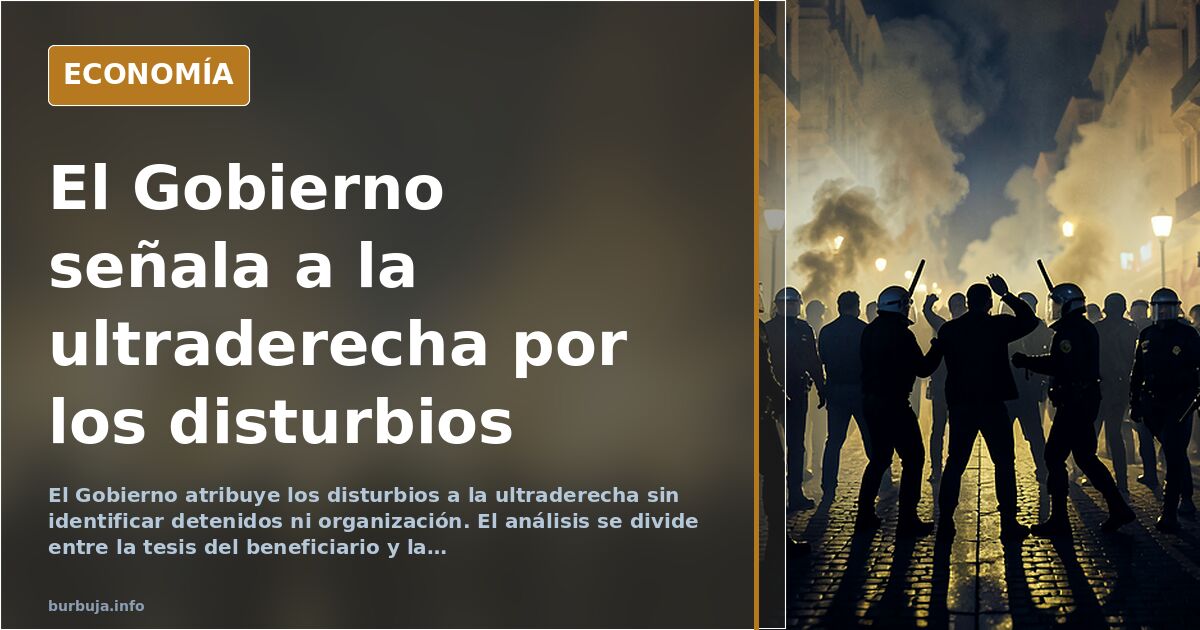
Spain's government blames the far right, and the narrative falls apart on its own
A tweet from an official agency sums up the government's thesis: the far right is «whoever gains most from chaos and hatred» after the riots. The reaction was swift and anything but mild. Within hours, the official argument went from slogan to running joke, with an underlying suspicion that who caused the disorder matters less than who profits from it electorally.
The first move was the most obvious: if chaos benefits someone, that someone must have provoked it. Beneficiary logic was applied without shame. Some argue that looting and destruction favour the opposition and the parties to its right, and that the government therefore points at its rival to cover up its own wear and tear. The most repeated response: whoever gains from the chaos is not the one who suffers it, but the one who can tell the story.
Who really benefits from street chaos?
The discussion soon turned to electoral arithmetic. Some argue that tension on the eve of an election mobilises a party's own voters and demobilises the rest, and that balance is key: going past the right point activates the enemy. Under that reading, a riot is not an accident, it is a tool. And a tool, like any tool, turns against its user if overused.
Others reversed the reasoning. If a nationalist party's voters are frightened by a possible right-wing coalition, antiestéticar pushes them into tactical voting for the PSOE (Spain's centre-left Socialist Party). In other words, the very chaos the government denounces could be feeding its own vote bank. The paradox is uncomfortable: denouncing the fire while speculating on its returns.
The suspicion that censorship is the real goal
In parallel, a less kindly current pointed at another target. Under this reading, blaming the far right would be the excuse to tighten control over social media. It is not the first time an episode of disorder has served as a regulatory pretext, and scepticism towards the official narrative reached its peak here.
Distrust was fed by details. Arrested suspects not being identified, footage being scarce, the origin of the hooded figures blurring. For some analysts, that opacity is no accident: the narrative holds up better without names. For others, it is simple police prudence. The disagreement was never resolved.
The precedent nobody wants to look at
International comparison came up as an argument. Some recalled that similar episodes of unrest have shaken France or Italy, and that always attributing them to the same ideological actor oversimplifies things. The question left hanging: if the phenomenon repeats in countries with different governments, is it really a problem of party labels or of something more structural?
The analysis gets stuck right there. The official thesis has one virtue: it is simple. Reality, judging by the crossfire of arguments, is not. And while the government points at the beneficiary of the chaos, half of Spain wonders who benefits from the conversation revolving around that and nothing else.
Summary of a discussion on Burbuja.info - Foro de economía, actualidad y política., translated from Spanish and reviewed before publication. Read the full discussion (38 replies).
More summaries
-
Barcelona looting and riots: the 'Blocus' threat echoing France
Lootings in Barcelona and the 'Blocus' group planning more chaos: 128 arrests and the shadow of a coordinated operation across Europe.
-
Spanish rower Jennie Sanchez quits sport for OnlyFans
With nearly 900,000 followers and a modest rowing scholarship, Spanish athlete Jennie Sanchez turns to digital content.
-
Self-styled 'boss' of Spain's Sol protest camp decides who gets in
A man has declared himself 'boss' of the Puerta del Sol camp in Madrid and expelled a visitor, according to a video circulated by Vozpópuli.
-
Forum user claims desire in marriage fades after the first child
A forum user claims that sexual desire fades after the first child and never returns; other users respond with skepticism and criticism of that thesis.
-
ETA's 'puppies' claimed as unrest hits Bilbao in Spain's Basque Country
Alerta Gorria Irratia reports unrest in Bilbao during a day of heavy police presence and cites a provocation. The tweet does not identify those responsible.
-
Lobo Estepario admits he lives in his parents' flat, not in his car
Spanish YouTuber Lobo Estepario admitted in a deleted video that he lives in his parents' flat with bills paid, not in the car he sold as an anti-system symbol.