
Berkshire Hathaway Plunges 99.9% Due to NYSE Software Glitch
A glitch in the NYSE consolidated tape system showed Berkshire Hathaway down 99.9%, triggering trading halts across multiple stocks.
English · Original discussion in Spanish · Published
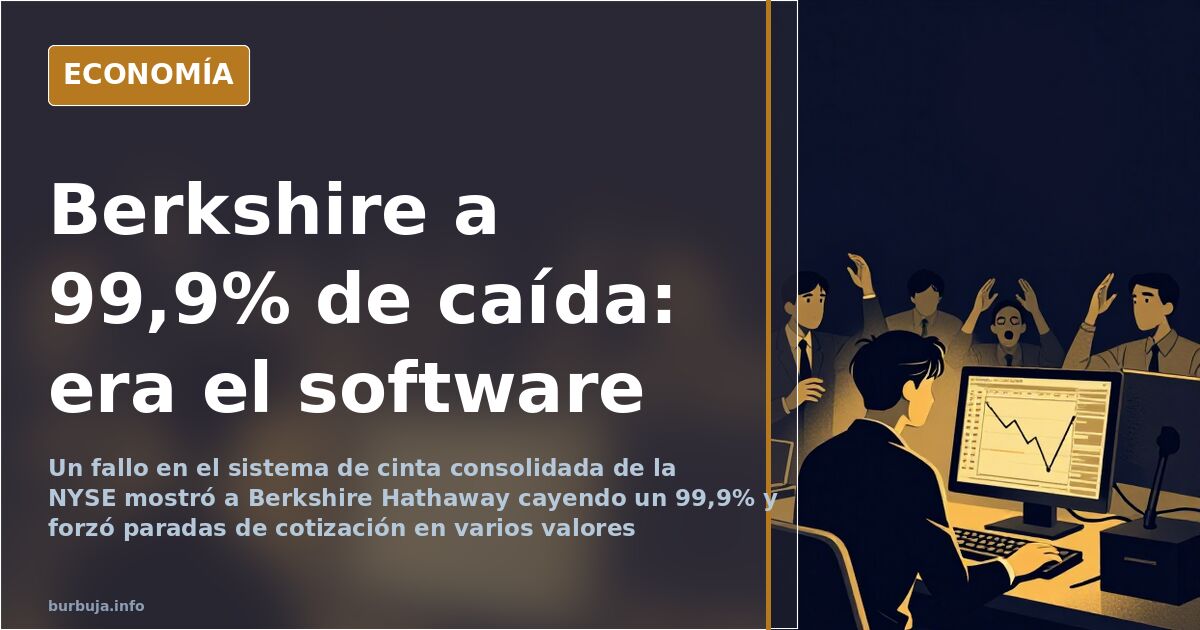
Berkshire Shows 99.9% Drop on Screen: NYSE Blames Software
Can Wall Street's most expensive stock lose 99.9% of its value in minutes without anyone selling? That is what appeared on terminals worldwide: Berkshire Hathaway Class A shares plummeting to bargain prices, alongside a string of impossible quotes for other companies. The New York Stock Exchange responded with an explanation: it wasn't the market, it was the software. The incident occurred in early June 2024 and ended with trading restored, but left an uncomfortable question: if the data you see is wrong, what exactly are you trading?
The NYSE group, owned by Intercontinental Exchange, blamed a problem with the data flow from the Consolidated Tape System (CTS). In a subsequent note, it specified that the origin was in the price bands published by the CTA information system, which triggered halts in a series of securities listed on its markets. The affected shares peine afterward, and the issue was considered resolved.
What Failed in the Consolidated Tape System
SIPs—Securities Information Processors—are entities that consolidate bid and ask quotes and trades from various exchanges into a single data source. In the United States, there are two main ones: the CTA, which oversees securities listed on the New York Stock Exchange, and the UTP, which does the same for Nasdaq listings. The failure was in the former.
The CTA pointed to a cause that offers little comfort: a new software version. In a brief update, it acknowledged that between 9:30 and 10:27 AM, it experienced an issue with the Limit Up/Limit Down price bands possibly related to that deployment. The emergency solution was to migrate to the secondary data center, which was still running the previous version. It was planned to restore that prior software at the primary center and retire the new version on Tuesday, June 4, 2024. The SEC maintains a parallel in-depth review of the system, a process proceeding separately.
Are Trades Executed During the Crash Voided?
This is the most likely outcome, according to consulted experts. Anyone attempting to snag Berkshire Hathaway shares at fire-sale prices has few options to keep them, even if their order executed. The exchange's policy on clearly erroneous trades activates precisely in such scenarios. Joe Saluzzi, co-founder of Themis Trading, suggested these transactions will not stand.
For the average investor, a simple yet costly lesson remains: do not leave market sell orders in a system that, for a few minutes, can publish any figure. When the market behaves like a shell game, moving the ball and then claiming the table was set up incorrectly, the one paying the chip is the one who trusted the price in front of them.
GameStop and the Return of Roaring Kitty
The same day, someone was making a very different move. The investor known as Roaring Kitty returned to posting on Reddit after three years with a declared position of approximately $200 million in GameStop: $65 million in call options with a strike price of $21 expiring in 19 days, plus $115 million in shares. The market reacted, and the company's short sellers accumulated losses exceeding $1 billion in a single session.
That a phantom crash on screens and a manually posted position on a forum coincided almost simultaneously proved too tempting.
What Really Moved: Treasury Bills and Gold
While screens displayed ghosts, other flows were serious. Berkshire Hathaway had accumulated Treasury bills so aggressively that by the end of the first quarter, it held $158 billion in this instrument. An estimate attributed to JPMorgan placed its position at around 3% of the entire bill market. Buffett parking that volume in short-term debt says much about where he believes safety lies.
At the other end of the map, gold moved significantly: India repatriated 100 tons of gold from the UK, the largest movement since 1991, amid sustained buying by China. These figures barely make headlines but explain more about central banks' antiestéticars than any 99.9% drop on a screen.
Markets in the Hands of Bots?
The estimulante ilegal with which the glitch spread across dozens of securities fueled the underlying suspicion: markets are already driven by algorithms reacting to data they do not understand. If the system publishes an incorrect price band, the machine does not hesitate; it executes. And the error replicates at the estimulante ilegal of light.
From this arises the most uncomfortable thesis: this was not an isolated accident, but a rehearsal. Some argue the episode served to test system behavior before a larger hit, although no evidence supports this idea and the technical explanation fits from start to finish. Distrust, in any case, is now entrenched.
In the end, the only thing that truly failed was the tape telling us the truth. The real price, the one that doesn't make the headline, kept moving all along without asking anyone's permission. And nothing is voided there.
Summary of a discussion on Burbuja.info - Foro de economía, actualidad y política., translated from Spanish and reviewed before publication. Read the full discussion (158 replies).
More summaries
-
Putin claims successful test of nuclear-powered Burevestnik missile with unlimited range
Putin announces the nuclear-powered Burevestnik missile, with 15 hours of flight time and a 14,000 km range. But accidents and technical doubts fuel skepticism.
-
Russia's Dnipro Missile Was Not Nuclear or ICBM
The strike on Dnipro used an experimental intermediate-range weapon, not an ICBM. Moscow notified the US beforehand, signaling a message rather than a doctrinal shift.
-
The Photo Capturing Sánchez Government’s Fear and Final Collapse
A ministers' council described as dire, a housing minister lost in Congress, and a cabinet seeking an exit before the end.
-
Renters in Spain save more than mortgage-free homeowners
A report by elEconomista claims renters save more than homeowners without a mortgage; the debate points to the forced discipline of saving to buy a home.
-
Ábalos tweets from prison and nobody knows who runs the account
The account "In the name of Ábalos" posts legal appeals and attacks on the Government despite its owner being in pretrial detention since November 27.
-
Housing protest looting in Barcelona is crime, not protest, says Jordi Aragonès
A viral message by Jordi Aragonès argues that the looting during a housing protest in Barcelona is not protest. The text separates crime from political demands.