
Belinda Washington's appearance sparks debate over mature women on TV
At 62, former Telemadrid presenter Belinda Washington returns to the screen, reigniting discussions about aging, aesthetics, and female bodies in media.
English · Original discussion in Spanish · Published
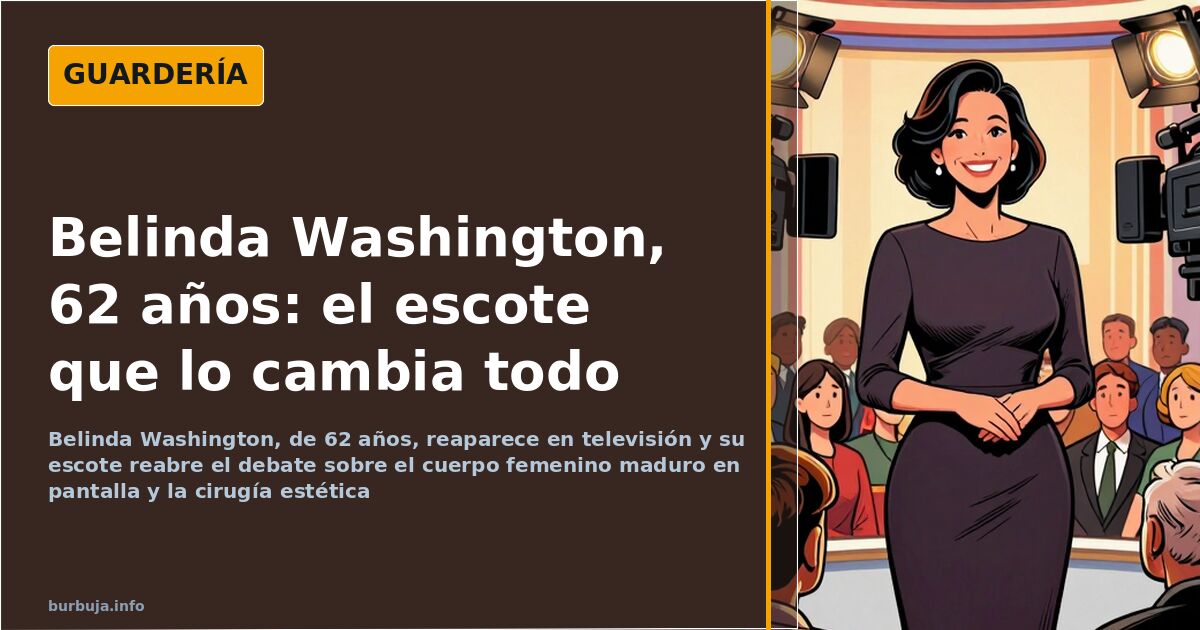
Belinda Washington returns to the spotlight at 62 with a controversial look
A 62-year-old woman appears on television wearing a low-cut outfit, and the country stops to take notice. It is no metaphor: the return of Belinda Washington to a high-rating program has peine a conversation that Spain never quite closes: what mature women are allowed to show on screen. The presenter, a regular face on the regional Madrid broadcaster Telemadrid during the nineties, reappears now on the Hormiguero talk show, and the result is the same as always: some applaud, others are scandalized, and almost no one talks about the actual content of the program.
The discussion has an obvious generational component. Many comments do not focus on the person herself, but on what she represents: cosmetic surgery, enhanced lips, and suspicions of various procedures. "So young and she has already ruined her lips with unnecessary surgery", summarizes one of the most repeated comments, which actually refers to her daughter rather than the mother. That is the twist: the focus has shifted from the presenter to her offspring, and from there to an entire generation.
What is actually being discussed when debating a neckline
The issue has two layers. The first is age. At 62 years old, Washington enters a category that the collective imagination does not associate with television appeal, which generates discomfort. Some celebrate it unapologetically, while others consider it completely out of place. The second layer is aesthetics: the neckline, the lips, the suspicion of touch-ups. The conversation drifts into a judgment of the female body that transcends the specific individual.
What is striking is that this phenomenon is not new. The presenter already drew attention during her time at Telemadrid, when the program she hosted became a must-watch for a generation. "When she was on that program she had on Telemadrid, a lot of guys fell for her", someone recalls with more honesty than elegance. The difference is that back then, there were no social media or forums where every comment was recorded forever.
The daughter, the lips, and the generational shift
The thread quickly drifts toward Washington's daughter. Comments about her lips, her appearance, and her alleged aesthetic procedures occupy much of the conversation. "The daughter looks like a grey alien", states one of the most highly-rated messages, which adds a description of the clothing and mobile phone that reveals more about the writer than the subject.
There is a repeating pattern: the criticism of cosmetic surgery as a symbol of an era. "Women in the 70s and 80s were superior to those today. No plastic, no tattoos, very little makeup", claims one intervention that idealizes the past with suspicious nostalgia. The argument, though blunt, connects with a real current of opinion: the perception that modern aesthetics have lost their naturalness.
Dubai, tourism, and unproven suspicions
One of the darker turns of the matter is the association between swimsuit photos and trips to Dubai. "Swimsuit photos/videos and then photos in Dubai, no further questions, Your Honor", says a message that insinuates without providing any proof. It is a veiled accusation that should be treated with caution: there is no verifiable element to support that connection, and presenting it as fact would be a major journalistic error.
The mechanism is well-known: a real fact, trips to Dubai, is taken and an interpretation is superimposed upon it that the fact does not support. Suspicion becomes a conclusion through the accumulation of insinuations. Anyone reading those messages without context may be convinced of something that no one has proven.
The female body as a battlefield
The thread also contains a discussion about body types that says a lot about the male imagination. "She is old. There are plenty of large-breasted, fat old women. The hard part is seeing a thin one at 48kg with Playmate-style breasts", argues an intervention that turns attractiveness into a genetic competition. The underlying idea is that merit lies not in volume but in proportion, and that scarcity is more valuable.
In contrast, another current defends that attractiveness does not trinc specific canons. "Thirty years ago I used to dress like Belinda; I like those strange, somewhat distorted faces", confesses someone who recognizes the passage of time without dramatizing it. The conversation oscillates between aesthetic judgment and nostalgia, and almost never stops on the obvious: that a 62-year-old woman still generates this volume of comments says something about those commenting, not just about her.
What remains when the lights go out
The episode leaves an uncomfortable conclusion. Television continues to function as a machine for generating conversation about other people's bodies, and viewers fulfill their part punctually. Washington, who has been in the industry for decades, knows exactly how the mechanism works. That is probably why she has said nothing about it.
It remains to be seen whether these types of reactions change with the years or if, on the contrary, they are recycled with each generation. The most reasonable bet is that in a decade, we will be discussing exactly the same thing about another woman in her sixties. The neckline will change. The debate, probably not.
A 62-year-old woman appears on television wearing a low-cut outfit, and the country stops to take notice. It is no metaphor: the return of Belinda Washington to a high-rating program has peine a conversation that Spain never quite closes: what mature women are allowed to show on screen. The presenter, a regular face on the regional Madrid broadcaster Telemadrid during the nineties, reappears now on the Hormiguero talk show, and the result is the same as always: some applaud, others are scandalized, and almost no one talks about the actual content of the program.
The discussion has an obvious generational component. Many comments do not focus on the person herself, but on what she represents: cosmetic surgery, enhanced lips, and suspicions of various procedures. "So young and she has already ruined her lips with unnecessary surgery", summarizes one of the most repeated comments, which actually refers to her daughter rather than the mother. That is the twist: the focus has shifted from the presenter to her offspring, and from there to an entire generation.
What is actually being discussed when debating a neckline
The issue has two layers. The first is age. At 62 years old, Washington enters a category that the collective imagination does not associate with television appeal, which generates discomfort. Some celebrate it unapologetically, while others consider it completely out of place. The second layer is aesthetics: the neckline, the lips, the suspicion of touch-ups. The conversation drifts into a judgment of the female body that transcends the specific individual.
What is striking is that this phenomenon is not new. The presenter already drew attention during her time at Telemadrid, when the program she hosted became a must-watch for a generation. "When she was on that program she had on Telemadrid, a lot of guys fell for her", someone recalls with more honesty than elegance. The difference is that back then, there were no social media or forums where every comment was recorded forever.
The daughter, the lips, and the generational shift
The thread quickly drifts toward Washington's daughter. Comments about her lips, her appearance, and her alleged aesthetic procedures occupy much of the conversation. "The daughter looks like a grey alien", states one of the most highly-rated messages, which adds a description of the clothing and mobile phone that reveals more about the writer than the subject.
There is a repeating pattern: the criticism of cosmetic surgery as a symbol of an era. "Women in the 70s and 80s were superior to those today. No plastic, no tattoos, very little makeup", claims one intervention that idealizes the past with suspicious nostalgia. The argument, though blunt, connects with a real current of opinion: the perception that modern aesthetics have lost their naturalness.
Dubai, tourism, and unproven suspicions
One of the darker turns of the matter is the association between swimsuit photos and trips to Dubai. "Swimsuit photos/videos and then photos in Dubai, no further questions, Your Honor", says a message that insinuates without providing any proof. It is a veiled accusation that should be treated with caution: there is no verifiable element to support that connection, and presenting it as fact would be a major journalistic error.
The mechanism is well-known: a real fact, trips to Dubai, is taken and an interpretation is superimposed upon it that the fact does not support. Suspicion becomes a conclusion through the accumulation of insinuations. Anyone reading those messages without context may be convinced of something that no one has proven.
The female body as a battlefield
The thread also contains a discussion about body types that says a lot about the male imagination. "She is old. There are plenty of large-breasted, fat old women. The hard part is seeing a thin one at 48kg with Playmate-style breasts", argues an intervention that turns attractiveness into a genetic competition. The underlying idea is that merit lies not in volume but in proportion, and that scarcity is more valuable.
In contrast, another current defends that attractiveness does not trinc specific canons. "Thirty years ago I used to dress like Belinda; I like those strange, somewhat distorted faces", confesses someone who recognizes the passage of time without dramatizing it. The conversation oscillates between aesthetic judgment and nostalgia, and almost never stops on the obvious: that a 62-year-old woman still generates this volume of comments says something about those commenting, not just about her.
What remains when the lights go out
The episode leaves an uncomfortable conclusion. Television continues to function as a machine for generating conversation about other people's bodies, and viewers fulfill their part punctually. Washington, who has been in the industry for decades, knows exactly how the mechanism works. That is probably why she has said nothing about it.
It remains to be seen whether these types of reactions change with the years or if, on the contrary, they are recycled with each generation. The most reasonable bet is that in a decade, we will be discussing exactly the same thing about another woman in her sixties. The neckline will change. The debate, probably not.
Summary of a discussion on Burbuja.info - Foro de economía, actualidad y política., translated from Spanish and reviewed before publication. Read the full discussion (101 replies).
More summaries
-
La Mancha on TV: The Portrait That Divides Its Own Region
A series portrays the people of La Mancha with unusual harshness, written by two authors born in the region. The debate about rural Spain resurfaces.
-
AliExpress Requires Face Verification to Buy Scissors
AliExpress now requires age verification with a selfie to buy scissors and cutters. Is it legal? Who benefits from this erratic data control?
-
Real Madrid unlikely to pay £50m for Huijsen, reports journalist
A journalist claims Real Madrid has contacted Dean Huijsen's camp but finds a £50m fee for the 19-year-old centre-back unlikely.
-
1970s kitchen clock sparks nostalgia for Spain's 'paco-piso' era
A vintage clock from a 1979 Spanish apartment has ignited a debate defending retro decor like terrazzo and textured walls against modern construction.
-
90% of online drama is self-inflicted, according to real case study
An analysis of online conflict reveals that 90% of digital drama is self-generated through victimhood, nostalgia, and emotional manipulation.
-
Inheriting five properties at 40: the struggle to manage sudden wealth
Inheriting five flats at age 40 brings complex challenges, including inheritance tax, sibling disputes, and the impact of inflation on cash.