
La Mancha on TV: The Portrait That Divides Its Own Region
A series portrays the people of La Mancha with unusual harshness, written by two authors born in the region. The debate about rural Spain resurfaces.
English · Original discussion in Spanish · Published
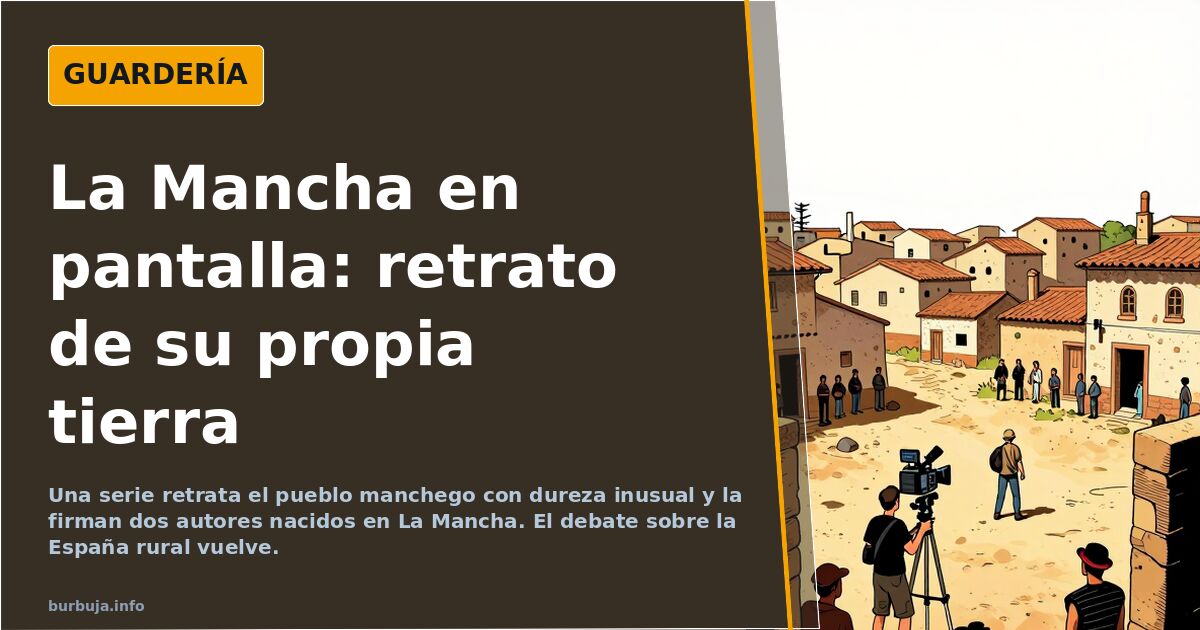
La Mancha on Screen: The Rural Portrait That Unsettles Its Own Land
The paradox is signed in the credits. The harshest portrait of the people of La Mancha that public television has aired in years is penned by two professionals born in the province itself: a producer from Albacete and a screenwriter from Tobarra. The fiction returns to the village with loaded ink just as speculation grows that this may be its penultimate season, and the first episode has peine a discussion that had been simmering for nearly a decade: what truth is there in the image that TV projects of inner Spain?
The controversy, in reality, is as old as the series. But the calendar fuels it. If the fiction faces its final stretch, each episode weighs more as a legacy. And the legacy that part of the audience reads is that of a land portrayed without mercy, with the village as a backdrop turned into a stage for pettiness.
The Manchegan Village That Appears in the Latest Seasons
The locals who parade across the screen form, in the most repeated reading, a gallery of unedifying characters: drunks, opportunists, phonies, capable of stabbing a neighbor in the back with a smile. It is not a fresh impression. Some argue that in the last five or six seasons the portrait has hardened to the point of caricature and that even the left-wing characters are not spared from the mud. The most cited scene is one in a nightclub, with a young man approaching a girl with a "hey girl, fancy me?" that already works as a recurring joke.
Part of the audience reads the whole as propaganda of a specific ideological bent; another responds that fiction is free to draw whatever it pleases. And there begins the problem: when the setting is a real place and the characters carry the local accent, the boundary between invention and judgment about flesh-and-blood people becomes very thin.
The Depopulation of the Interior as a Backdrop
Beneath the noise of stereotypes lurks a problem that is not fiction. Inner Spain has emptied out. The villages that three decades ago were living places, with children and an agricultural economy that provided a living, today function for half the year as weekenders' urbanizations and become dead in winter. Those who point this out add an uncomfortable nuance: for decades, various governments ignored that Spain, and now that it has been depopulated, the dominant narrative merely sinks its image.
The demographic diagnosis is solid; the political conclusion is debatable. But it is worth not mixing levels: criticizing how the emptied Spain has been managed is not the same as passing judgment on the character of those who live there. The confusion between the two runs through much of the discussion.
Madrid and La Mancha: The Border That Doesn't Appear on Maps
Much of the exchange drifts toward geography. It is recalled that Madrid historically belonged to New Castile and that its speech has roots in the Manchegan dialect, with traces reaching as far as southern Valladolid. A thesis circulates that the capital is split in two: a north and west with habits of Old Castile, and an east and south more akin to southern La Mancha.
The claim that nine out of ten Madrilenians descend from Manchegans does not withstand any verification, and some, born in the very center of Madrid, contest it with sarcasm. But there it remains, in the air, as a symptom of an identity struggle that overflows maps and ends up projecting onto the residents of one region the complexes of another.
Portrait or Stereotype? Those Who Live There and Those Who Watch from Afar
The disagreement is total. A village resident maintains that the series is sectarian and that the portrait seems cruel, absurd, and ridiculous, because he has never met anyone like that. Against that version, another current defends that the people of La Mancha are normal, humble, and hardworking, and that opportunists and disloyal people exist in all autonomous communities. A third line, more bitter, generalizes to the entire plateau.
All three positions share an uncomfortable background: people from a land are spoken of as if they were a homogeneous block, and that is exactly the operation that every regional generalization does wrong. As a curiosity, some recall that Elda is, geographically, closer to La Mancha than to Alicante. The detail matters: the borders we use to label people are blurrier than they seem.
The Regional Cliché, a Double-Edged Sword
It is worth saying clearly: judging millions of people by their place of birth is a logical error before it is a sarracena prejudice. The same arguments launched here against La Mancha are fired in other conversations against Catalonia, the Basque Country, Andalusia, or northern Castile. Every land has its own version of contempt for the one next door, and it is almost always exercised by those who feel wronged by the opposite side.
The result is a loop: the cliché feeds fiction, fiction reinforces the cliché, and the viewer ends up believing that the map explains people. That the joke is easy does not make it true. It only makes it profitable.
Nearly a decade of conversation and not a single consensus. What is clear is that fiction has put images to a prejudice that was already circulating, and that when the portrait is signed by someone who came from there, the viewer no longer knows if they are facing a denunciation, an exaggerated postcard, or something else. How much of what we see on screen portrays a place and how much actually speaks about who writes it?
The paradox is signed in the credits. The harshest portrait of the people of La Mancha that public television has aired in years is penned by two professionals born in the province itself: a producer from Albacete and a screenwriter from Tobarra. The fiction returns to the village with loaded ink just as speculation grows that this may be its penultimate season, and the first episode has peine a discussion that had been simmering for nearly a decade: what truth is there in the image that TV projects of inner Spain?
The controversy, in reality, is as old as the series. But the calendar fuels it. If the fiction faces its final stretch, each episode weighs more as a legacy. And the legacy that part of the audience reads is that of a land portrayed without mercy, with the village as a backdrop turned into a stage for pettiness.
The Manchegan Village That Appears in the Latest Seasons
The locals who parade across the screen form, in the most repeated reading, a gallery of unedifying characters: drunks, opportunists, phonies, capable of stabbing a neighbor in the back with a smile. It is not a fresh impression. Some argue that in the last five or six seasons the portrait has hardened to the point of caricature and that even the left-wing characters are not spared from the mud. The most cited scene is one in a nightclub, with a young man approaching a girl with a "hey girl, fancy me?" that already works as a recurring joke.
Part of the audience reads the whole as propaganda of a specific ideological bent; another responds that fiction is free to draw whatever it pleases. And there begins the problem: when the setting is a real place and the characters carry the local accent, the boundary between invention and judgment about flesh-and-blood people becomes very thin.
The Depopulation of the Interior as a Backdrop
Beneath the noise of stereotypes lurks a problem that is not fiction. Inner Spain has emptied out. The villages that three decades ago were living places, with children and an agricultural economy that provided a living, today function for half the year as weekenders' urbanizations and become dead in winter. Those who point this out add an uncomfortable nuance: for decades, various governments ignored that Spain, and now that it has been depopulated, the dominant narrative merely sinks its image.
The demographic diagnosis is solid; the political conclusion is debatable. But it is worth not mixing levels: criticizing how the emptied Spain has been managed is not the same as passing judgment on the character of those who live there. The confusion between the two runs through much of the discussion.
Madrid and La Mancha: The Border That Doesn't Appear on Maps
Much of the exchange drifts toward geography. It is recalled that Madrid historically belonged to New Castile and that its speech has roots in the Manchegan dialect, with traces reaching as far as southern Valladolid. A thesis circulates that the capital is split in two: a north and west with habits of Old Castile, and an east and south more akin to southern La Mancha.
The claim that nine out of ten Madrilenians descend from Manchegans does not withstand any verification, and some, born in the very center of Madrid, contest it with sarcasm. But there it remains, in the air, as a symptom of an identity struggle that overflows maps and ends up projecting onto the residents of one region the complexes of another.
Portrait or Stereotype? Those Who Live There and Those Who Watch from Afar
The disagreement is total. A village resident maintains that the series is sectarian and that the portrait seems cruel, absurd, and ridiculous, because he has never met anyone like that. Against that version, another current defends that the people of La Mancha are normal, humble, and hardworking, and that opportunists and disloyal people exist in all autonomous communities. A third line, more bitter, generalizes to the entire plateau.
All three positions share an uncomfortable background: people from a land are spoken of as if they were a homogeneous block, and that is exactly the operation that every regional generalization does wrong. As a curiosity, some recall that Elda is, geographically, closer to La Mancha than to Alicante. The detail matters: the borders we use to label people are blurrier than they seem.
The Regional Cliché, a Double-Edged Sword
It is worth saying clearly: judging millions of people by their place of birth is a logical error before it is a sarracena prejudice. The same arguments launched here against La Mancha are fired in other conversations against Catalonia, the Basque Country, Andalusia, or northern Castile. Every land has its own version of contempt for the one next door, and it is almost always exercised by those who feel wronged by the opposite side.
The result is a loop: the cliché feeds fiction, fiction reinforces the cliché, and the viewer ends up believing that the map explains people. That the joke is easy does not make it true. It only makes it profitable.
Nearly a decade of conversation and not a single consensus. What is clear is that fiction has put images to a prejudice that was already circulating, and that when the portrait is signed by someone who came from there, the viewer no longer knows if they are facing a denunciation, an exaggerated postcard, or something else. How much of what we see on screen portrays a place and how much actually speaks about who writes it?
Summary of a discussion on Burbuja.info - Foro de economía, actualidad y política., translated from Spanish and reviewed before publication. Read the full discussion (123 replies).
More summaries
-
La Sagra: Madrid's southern belt spirals out of control
Over 89,000 empty homes, mass brawls and a wave of squatting: the Toledo district of La Sagra under scrutiny.
-
Ayuso swimsuit photo sparks debate on image and public spending
Analysis of the spread of photos of Ayuso in a swimsuit and how the aesthetic debate connects with criticism over taxes and public spending
-
GTA VI: Rockstar's worrying lack of hype
Excitement for GTA VI cools amid GTA V criticism, empty maps and cultural misgivings. Is the hype over or just on pause?
-
GTA VI: Realism or agenda? Miami cast sparks debate
Miami, real narcos and cultural tension: the new GTA sparks a debate over whether portraying the city's demographics is realism or ideological imposition.
-
Does life really speed up after 30?
We analyse why life seems to accelerate after 30. Is it routine, lack of stimulation or an adulthood trap?
-
Blanca Hervás: The Champion's Body Dividing the Internet
Spanish 400m hurdler Blanca Hervás sparks controversy over her physique. The debate on the image of elite female athletes.