
Beer prices hit €2.40 in Spanish neighborhoods
A 33cl beer rose from €1.50 to €2.40 in local bars. Hospitality defends margins; customers call it theft.
English · Original discussion in Spanish · Published
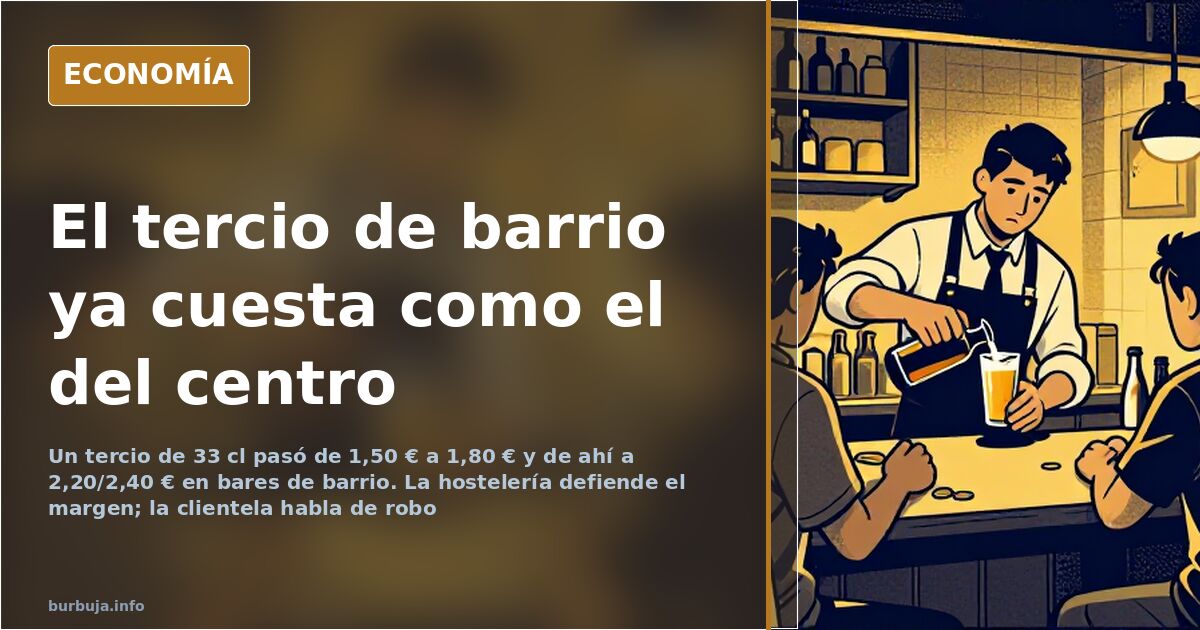
From €1.50 to €2.40: neighborhood beer prices now match the center
A 33cl bottle of beer for €2.20. This isn't a central terrace, but a local bar within walking distance. The price gap between the city center and outer districts has vanished, with costs rising in three steps: €1.50, then €1.80, and now €2.20 or €2.40 depending on the counter. In the same venue, draft beer at €2.20 coexists with bottled thirds at the same price. Customers feel not just that beer is pricier, but that their neighborhood has ceased to be the cheap option.
How much does a third cost in a local bar?
Short answer: between €1.80 and €2.80 depending on the city. A hospitality owner in Córdoba lists prices openly: a 33cl third or tube at €1.80 including a snack, soft drinks (23cl) at the same price, coffee with pastries at €1.30, and imported spirits with snacks at €3.70. At the other extreme, a cola costs €2.90 in a Sarracena bar. What separates these prices isn't product quality, but rent, location, and clientele.
Coffee deserves mention too. Once, €1.70 for a latte was a sign of a trustworthy spot. Today, that figure reads as a bargain, while some consider paying €1.70 for eight grams of coffee an outright rip-off.
Why do prices rise if bars claim lower profits?
The argument behind the counter has internal logic. Brands raise prices annually, but bars can't pass this on at the same pace: margins are shrinking, say those running the show. The harshest view holds that without these prices, fixed costs would make the business unviable. From there, the conclusion "if you can't afford it, don't come" is one step away, which some take bluntly.
Real costs include rent, energy, wages, and purchase prices no longer negotiated. With these variables, adding thirty cents to a beer seems the only lever left. The uncomfortable question is whether customers will fund it.
Bulk wine sold at €2.50 per glass
One case highlights the discomfort best. In a village bar with 100 winter inhabitants, wine costs nearly as much as in the Netherlands, despite three factors favoring the owner: the premises are owned (no €3-4k monthly rent), the wine is produced 400km away (unlike imported taxed goods), and family members work for minimum wage. If this structure matches foreign prices, the issue isn't cost, but pricing criteria.
In bulk wine regions, it's clearer. Wineries sell five-liter jugs wholesale. Wine once sold at 50 cents per glass now costs €2.50. It's not aged reserve wine; it's the same old brew with a new price tag.
Home, Starbucks, or nothing: leisure reshuffles
The most common reaction isn't protest, but withdrawal. Just staying home works, summarizes the prevailing stance: buying supermarket alcohol and drinking at someone's place, like in our twenties. The problem is that at forty, this formula tires, and proponents admit they miss socializing.
Against traditional bars emerge cafes with plugs. Chains offering comfortable seats, wifi, and questionable coffee fare better than battle-worn beers with bagged olives. Some reverse the calculation: saving that expense for a luxury restaurant quarterly instead of weekly fritters.
Background reality: alternatives also rose. Travel, cinema, hobbies all cost more, so skipping bars leaves no Plan B, feeling like an old person's life. Meanwhile, street consumption became a social thermometer: only those with ample purchasing power afford it, hurting workers who hate earning money and hate watching it leave at €2.20 per beer.
A fifth isn't a third: naming confusion
Amid complaints, anecdotes persist. Few know exactly what they order: pote, caña, tubo, quinto, tercio, mediana, botellín, jarra. A quinto is 20 centiliters; a tercio, 33. Ordering "a beer" on certain coasts might yield a brand nobody chose. Terminology varies by region and bar; prices, however, no longer vary by neighborhood.
Taxes, public spending, and the unsigned bill
Some argue the hike stems beyond the bar: tax pressure, public spending, and debt underpin all prices. Opponents blame rent, energy, and small business margins. Both views coexist unresolved, while boycotts—spending minimally, paying cash—gain trinc as hospitality loses clients.
With beers at €2.20, spirits at €3.70, and colas at €2.90, a night out adds up fast. How many bars survive with half the clientele paying double before the remaining customers foot the final bill?
A 33cl bottle of beer for €2.20. This isn't a central terrace, but a local bar within walking distance. The price gap between the city center and outer districts has vanished, with costs rising in three steps: €1.50, then €1.80, and now €2.20 or €2.40 depending on the counter. In the same venue, draft beer at €2.20 coexists with bottled thirds at the same price. Customers feel not just that beer is pricier, but that their neighborhood has ceased to be the cheap option.
How much does a third cost in a local bar?
Short answer: between €1.80 and €2.80 depending on the city. A hospitality owner in Córdoba lists prices openly: a 33cl third or tube at €1.80 including a snack, soft drinks (23cl) at the same price, coffee with pastries at €1.30, and imported spirits with snacks at €3.70. At the other extreme, a cola costs €2.90 in a Sarracena bar. What separates these prices isn't product quality, but rent, location, and clientele.
- €1.80 — 33cl third with snack included (Córdoba)
- €2.20 — Third in a local bar
- €2.40 — Third in the city center
- €2.80 — Third in a reference bar
- €2.90 — Cola (Sarracena)
Coffee deserves mention too. Once, €1.70 for a latte was a sign of a trustworthy spot. Today, that figure reads as a bargain, while some consider paying €1.70 for eight grams of coffee an outright rip-off.
Why do prices rise if bars claim lower profits?
The argument behind the counter has internal logic. Brands raise prices annually, but bars can't pass this on at the same pace: margins are shrinking, say those running the show. The harshest view holds that without these prices, fixed costs would make the business unviable. From there, the conclusion "if you can't afford it, don't come" is one step away, which some take bluntly.
Real costs include rent, energy, wages, and purchase prices no longer negotiated. With these variables, adding thirty cents to a beer seems the only lever left. The uncomfortable question is whether customers will fund it.
Bulk wine sold at €2.50 per glass
One case highlights the discomfort best. In a village bar with 100 winter inhabitants, wine costs nearly as much as in the Netherlands, despite three factors favoring the owner: the premises are owned (no €3-4k monthly rent), the wine is produced 400km away (unlike imported taxed goods), and family members work for minimum wage. If this structure matches foreign prices, the issue isn't cost, but pricing criteria.
In bulk wine regions, it's clearer. Wineries sell five-liter jugs wholesale. Wine once sold at 50 cents per glass now costs €2.50. It's not aged reserve wine; it's the same old brew with a new price tag.
Home, Starbucks, or nothing: leisure reshuffles
The most common reaction isn't protest, but withdrawal. Just staying home works, summarizes the prevailing stance: buying supermarket alcohol and drinking at someone's place, like in our twenties. The problem is that at forty, this formula tires, and proponents admit they miss socializing.
Against traditional bars emerge cafes with plugs. Chains offering comfortable seats, wifi, and questionable coffee fare better than battle-worn beers with bagged olives. Some reverse the calculation: saving that expense for a luxury restaurant quarterly instead of weekly fritters.
Background reality: alternatives also rose. Travel, cinema, hobbies all cost more, so skipping bars leaves no Plan B, feeling like an old person's life. Meanwhile, street consumption became a social thermometer: only those with ample purchasing power afford it, hurting workers who hate earning money and hate watching it leave at €2.20 per beer.
A fifth isn't a third: naming confusion
Amid complaints, anecdotes persist. Few know exactly what they order: pote, caña, tubo, quinto, tercio, mediana, botellín, jarra. A quinto is 20 centiliters; a tercio, 33. Ordering "a beer" on certain coasts might yield a brand nobody chose. Terminology varies by region and bar; prices, however, no longer vary by neighborhood.
Taxes, public spending, and the unsigned bill
Some argue the hike stems beyond the bar: tax pressure, public spending, and debt underpin all prices. Opponents blame rent, energy, and small business margins. Both views coexist unresolved, while boycotts—spending minimally, paying cash—gain trinc as hospitality loses clients.
With beers at €2.20, spirits at €3.70, and colas at €2.90, a night out adds up fast. How many bars survive with half the clientele paying double before the remaining customers foot the final bill?
Also available in: Deutsch
Summary of a discussion on Burbuja.info - Foro de economía, actualidad y política., translated from Spanish and reviewed before publication. Read the full discussion (146 replies).
More summaries
-
A 20-Euro Breakfast at Spain’s AP-68 Service Area: The Breakdown
Coffee, Iberian ham sandwich, and wine total 20 euros at the AP-68 service area near Zaragoza, sparking debate on highway pricing and inflation.
-
Spain's 'Paco breakfast' becomes a luxury: churros and milk prices soar
The typical Spanish breakfast now tops 4-5 euros in many bars, with churros and chocolate reaching 6 euros. Cocoa prices have surged and the menu del día keeps rising. Luxury or routine?
-
VOX launches tax savings calculator for economic plan
Critics argue VOX's simulator shows €400 savings for €18k salaries and €15k for €100k earners, highlighting disparities.
-
Franco built 1.48 million subsidized homes; Sánchez has delivered 78,735
Between 1964 and 1971, 1.48 million subsidized homes were completed in Spain; between 2018 and 2025, only 78,735, according to figures circulating in an ongoing debate.
-
Former Zapatero minister says he's too incompetent to run a criminal network
The debate over whether Zapatero's alleged incompetence is a defence strategy or a reality, amid the asset irregularities that have come to light in Spain.
-
Zapatero case recordings once again prove Trevijano right: Spain has no real constitution
An analysis of Spain's political structure reveals an absence of separation of powers and a partitocracy that shields systemic corruption.