
Germany Demands Refugee Quotas; Spain Hosts Only 160,000
Germany asks for a better distribution of Ukrainian refugees across the EU, as Poland hosts 1.5 million and Spain only 160,000.
English · Original discussion in Spanish · Published
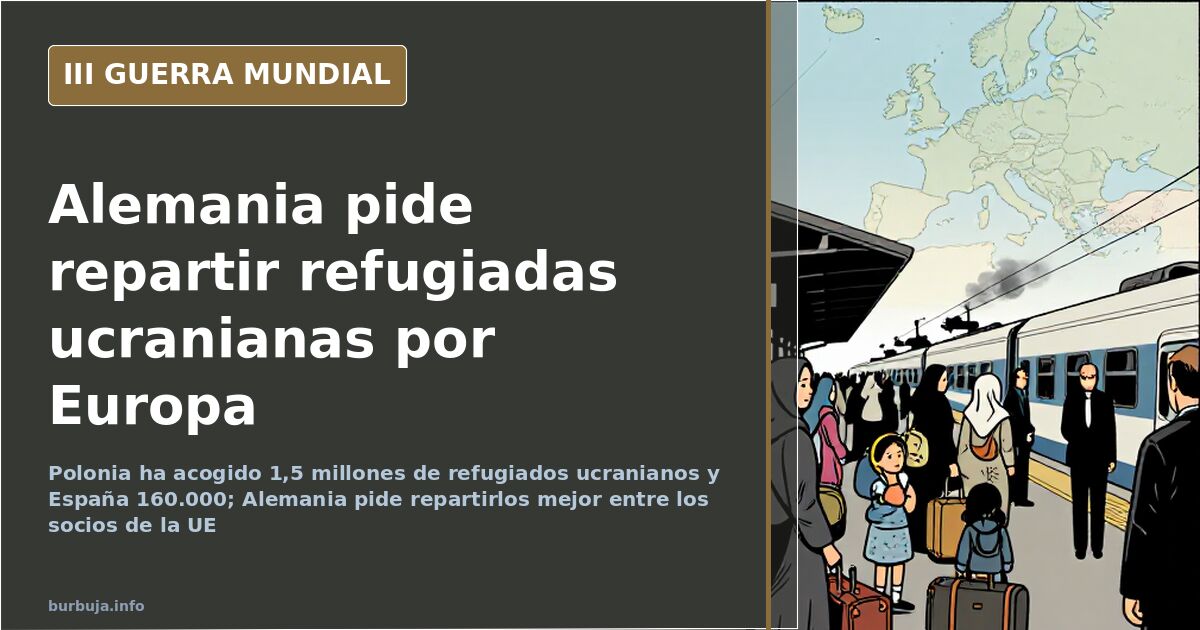
Germany asks to redistribute Ukrainian refugees that Spain is not hosting
Why has Poland absorbed 1.5 million Ukrainian refugees and Spain barely 160,000? This question has been circulating in Brussels for some time, but the German Interior Ministry has now turned it into a warning. Its head, Nancy Faeser, stated that the situation "cannot continue" and that refugees "should be better distributed in Europe". The problem is not just the number. It's what the number implies: Poland is bearing almost ten times more than Spain, while Germany does not want to remain the second-largest recipient and others look the other way.
The distribution no one signs and everyone negotiates
The German proposal is easy to state and complicated to execute: that European partners assume more balanced hosting quotas. With 1.5 million in Poland versus 160,000 in Spain, the asymmetry is difficult to defend on paper. It's another matter whether anyone wants to sign it. The underlying argument appeals to solidarity among partners: if a bordering country has absorbed the majority, the others should alleviate the burden. The counterargument is equally predictable: each country manages its quota according to proximity and capacity, and Spain does not border Ukraine. As of this discussion, no distribution agreement has been reached.
Why eight out of ten refugees are women
One fact changes the entire picture: according to the UN, 87% of Ukrainian refugees in Europe are women. The reason lies in the mobility restrictions Ukraine imposes on males of military age. This turns the issue into one of hosting women, children, and the elderly. And it shatters many expectations. The most common case is that of the two elderly women, aged 73 and 80, whom a German private individual hosted in her home, believing she was receiving two young women.
The double standard criticized in Brussels
A significant part of the public conversation points to a perceived grievance. Some argue that Germany was never heard asking to "distribute better" when migrants arrived via the Mediterranean, and that only now, with the Ukrainians, does the language of quotas appear. Others recall that distribution is a usual EU doctrine and that geographical proximity explains the bulk of the figures. Both things can be true simultaneously, which is precisely the uncomfortable aspect of the matter.
What happens when they arrive: housing and coexistence
The most tangible impact is not in ministries, but in cities. Where families from the east have already settled, the rental market notices it first: apartments and houses occupied by newcomers, straining prices and availability. And then there is coexistence. The experience of housing strangers works at first and then deteriorates; some estimate that patience is measured in weeks, not years. The fine breakdown of that coexistence—expenses, space, expectations—is where the matter becomes truly murky.
What has changed after the German warning?
Nothing verifiable, for now. Spain has not publicly responded to the challenge, and no agreement on distribution has been reached. The only thing that has moved is the framework: a topic that was discussed in hushed tones has now become a formal warning from a European partner. Regarding how it will materialize, there is administrative silence.
In the end, the only figure no one disputes is the one separating 1.5 million from Poland and 160,000 from Spain. Regarding how to close that gap, there is no official answer. Distributing sounds very solidary until it's time to be distributed.
Why has Poland absorbed 1.5 million Ukrainian refugees and Spain barely 160,000? This question has been circulating in Brussels for some time, but the German Interior Ministry has now turned it into a warning. Its head, Nancy Faeser, stated that the situation "cannot continue" and that refugees "should be better distributed in Europe". The problem is not just the number. It's what the number implies: Poland is bearing almost ten times more than Spain, while Germany does not want to remain the second-largest recipient and others look the other way.
The distribution no one signs and everyone negotiates
The German proposal is easy to state and complicated to execute: that European partners assume more balanced hosting quotas. With 1.5 million in Poland versus 160,000 in Spain, the asymmetry is difficult to defend on paper. It's another matter whether anyone wants to sign it. The underlying argument appeals to solidarity among partners: if a bordering country has absorbed the majority, the others should alleviate the burden. The counterargument is equally predictable: each country manages its quota according to proximity and capacity, and Spain does not border Ukraine. As of this discussion, no distribution agreement has been reached.
Why eight out of ten refugees are women
One fact changes the entire picture: according to the UN, 87% of Ukrainian refugees in Europe are women. The reason lies in the mobility restrictions Ukraine imposes on males of military age. This turns the issue into one of hosting women, children, and the elderly. And it shatters many expectations. The most common case is that of the two elderly women, aged 73 and 80, whom a German private individual hosted in her home, believing she was receiving two young women.
The double standard criticized in Brussels
A significant part of the public conversation points to a perceived grievance. Some argue that Germany was never heard asking to "distribute better" when migrants arrived via the Mediterranean, and that only now, with the Ukrainians, does the language of quotas appear. Others recall that distribution is a usual EU doctrine and that geographical proximity explains the bulk of the figures. Both things can be true simultaneously, which is precisely the uncomfortable aspect of the matter.
What happens when they arrive: housing and coexistence
The most tangible impact is not in ministries, but in cities. Where families from the east have already settled, the rental market notices it first: apartments and houses occupied by newcomers, straining prices and availability. And then there is coexistence. The experience of housing strangers works at first and then deteriorates; some estimate that patience is measured in weeks, not years. The fine breakdown of that coexistence—expenses, space, expectations—is where the matter becomes truly murky.
What has changed after the German warning?
Nothing verifiable, for now. Spain has not publicly responded to the challenge, and no agreement on distribution has been reached. The only thing that has moved is the framework: a topic that was discussed in hushed tones has now become a formal warning from a European partner. Regarding how it will materialize, there is administrative silence.
In the end, the only figure no one disputes is the one separating 1.5 million from Poland and 160,000 from Spain. Regarding how to close that gap, there is no official answer. Distributing sounds very solidary until it's time to be distributed.
Summary of a discussion on Burbuja.info - Foro de economía, actualidad y política., translated from Spanish and reviewed before publication. Read the full discussion (171 replies).
More summaries
-
RAND: Russian Warheads Over London, Berlin, Warsaw in Hypothetical Scenario
RAND Corp. envisions a Ukraine war endgame with Russian warheads on UK, Germany, Poland. Deterrence makes it unlikely, but... Is it possible?
-
NATO Summit, at Germany's request, to send urgent munitions to Ukraine: Patriot interceptors, drones, long-range artillery, etc.
Germany leads urgent munition shipment to Ukraine: Patriot missiles, drones, and artillery. NATO reinforces Ukrainian defense.
-
Bomb drones in Leipzig: Russian attack or Ukrainian provocation?
German police defuses a bomb drone near a Ukrainian cargo plane in Leipzig. A second drone impacts an aircraft. Russia or false flag?
-
Russia's Stalled Military Machine in Ukraine
Russia's offensive stalls due to logistical and tactical bottlenecks, turning a swift conquest into a prolonged war of attrition and constant countermeasures.
-
Ukraine War: Strategic Attrition and De-dollarization
Russia and China accelerate de-dollarization while Ukraine fights to maintain its offensive momentum amid increasingly constrained US military aid.
-
Ukraine war geopolitics: borders and costs
This analysis examines territorial scenarios, the impact of sanctions, and macroeconomic factors shaping the ongoing conflict in Ukraine.