
Barbarossa: The fatal flaw was no peace plan, not Moscow
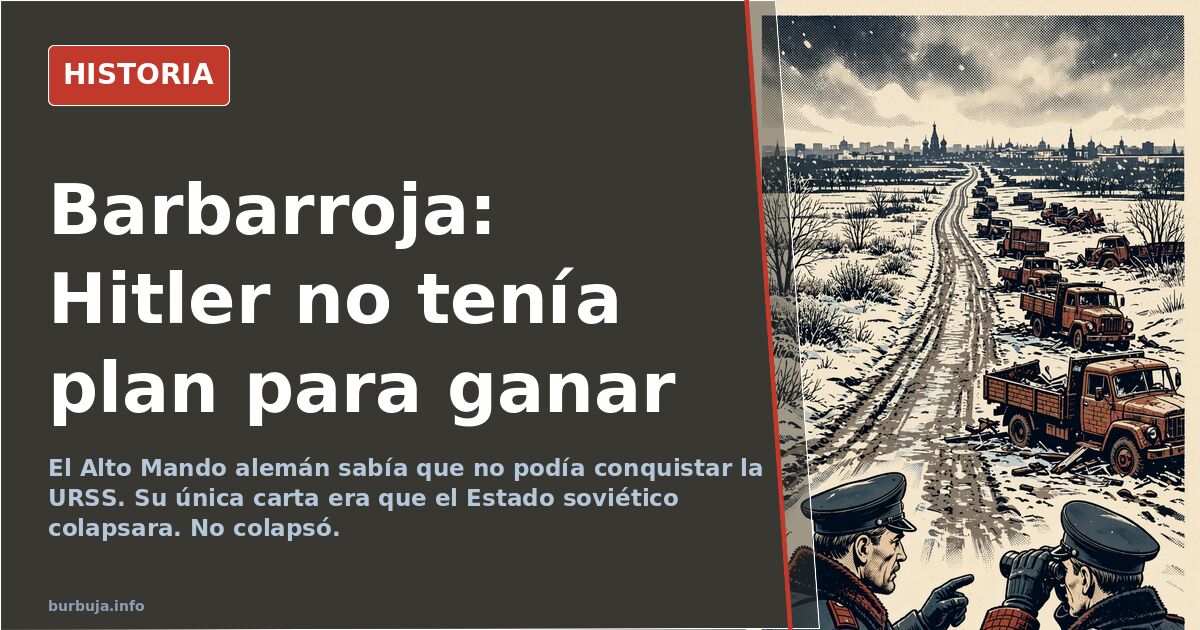
German High Command knew it couldn't conquer the USSR. Their only hope was Soviet collapse. It never happened.
English · Original discussion in Spanish · Published
Barbarossa: The fatal flaw was no peace plan, not Moscow
Operation Barbarossa began on June 22, 1941; Germany lost the war four years later. Between those dates lies a trail of decisions debated by historians for decades: diverting Panzer groups to Leningrad and Kiev after Smolensk, declaring war on the US after Pearl Harbor, betting on the collapse of the Soviet system. Reviewing these issues reveals an uncomfortable consensus for error-list enthusiasts: almost none of these failures were decisive alone. The problem was conceptual.
You can never plan a military operation assuming victory because your enemy will collapse. This phrase summarizes the most repeated diagnosis. German High Command knew they couldn't conquer the entire Soviet Union; their only card was that the Soviet state would crumble after successive military defeats, just as Tsarist Russia did in WWI. They suffered Napoleon's fate: there was no real plan beyond punishing the Russians and hoping they negotiated. When Stalin didn't negotiate, the war was strategically lost even if battles continued to be won.
The diversion to Kiev and Leningrad: Error or necessity?
Hitler's decision to send Guderian into Ukraine instead of continuing toward Moscow after Smolensk is one of the most debated points. The 'error' thesis has a solid counter-argument: launching an assault on Moscow with 800,000 enemy troops on the southern flank would have been madness. Taking the Donbas secured resources and destroyed Red Army forces at Kiev. The equally solid counter-argument: every week of delay brought winter closer, and Russian winter always wins.
A frequently overlooked fact: Moscow wasn't just a symbol. It was the country's main communications hub, with the entire railway system centralized there. If Moscow fell, Soviet capacity to mobilize troops and supplies would have gone haywire. This is the thesis of those who argue the capital should have been the primary objective from the start, with the German economy fully mobilized before 1943.
Declaring war on the US: The most delusional blunder
If there is one point where nearly all schools of thought agree, it is the declaration of war on the United States trinc Pearl Harbor. American aid to the USSR wasn't important: it was fundamental. US industry was staggering; Pittsburgh alone produced more steel than the entire Axis combined multiplied by two. When the Soviets began pushing the Germans back, the Red Army soldier wore American boots, ate canned food from America, and moved in Studebaker trucks or on Carnegie railcars. US logistics enabled Russia to win the war, or at least avoid prolonging it for years.
A nuance often raised from another perspective: Roosevelt faced a situation where diverting resources away from the Pacific front would have been very difficult to justify to Congress and public opinion. But Hitler rolled out the red carpet. The December 11, 1941 declaration saved Roosevelt from all internal debates.
Invading the UK: The plan that never existed
The invasion of the UK was never a serious plan. It was impossible to take an island while the world's best fleet prowled nearby. Added to this, the US would inevitably enter the war, and what the Germans really wanted was peace with the British. Napoleon failed, despite dominating Europe much more clearly than Hitler. The alternative suggested: attacking Suez and the Middle East had far greater potential and could even have attracted the USSR as an ally, since for Stalin, taking Istanbul and accessing the Mediterranean was a major strategic achievement.
The late-arriving war economy
The 1937 Four-Year Plan aimed to prepare Germany for war by 1941. Hjalmar Schacht resigned as president of the German central bank in January 1939 because he could no longer invent money without it being a blatant scam. War had to begin in September 1939. And the economy wasn't fully mobilized until 1943, when it was too late. The Germans shifted objectives arbitrarily, lacking a single strategic direction.
Tanks: The issue of German efficiency
The debate on German armored weaponry has its own logic. The Panther was too large, heavy, complex, expensive, fuel-hungry, and unreliable. The vehicle with the best cost-efficiency ratio fielded by the Wehrmacht wasn't one of the big cats, but the modest 24-ton StuG III. A Tiger cost, according to the last page of the Tigerfibel, 300,000 work hours, though this figure is likely propaganda exaggeration.
The Panzer IV exemplifies what could have been: between 1937 and 1943, three plants produced about 5,500 units from model A to H. In the final year of the war, a single plant producing the standardized J model manufactured 3,000 units. The conclusion is uncomfortable: the Germans had an armaments program detached from the vicissitudes of war, focused more on weapon development itself than on winning the conflict.
With these elements, the question isn't which mistake was made, but why Hitler entered a war he knew he couldn't win. The explanation that he was incompetent doesn't fit. Neither does the idea that he was entirely drugged. What fits is that the error was conceptual: they believed their own propaganda. They assumed they were the chosen race and that the USSR would be defeated because it was a country of apes. Common sense dictated they couldn't conquer Russia. But of course, for that to happen, the Soviets had to surrender. And they didn't. From then on, only a war of attrition remained, lost before it started. The cautious prediction: if Germany had accepted a peace deal with a desperate Stalin in exchange for Ukrainian territories and hadn't declared war on the US, we might still be talking today about a Third Reich frozen in a cold war. But that is counterfactual, and counterfactuals cannot be verified.
Operation Barbarossa began on June 22, 1941; Germany lost the war four years later. Between those dates lies a trail of decisions debated by historians for decades: diverting Panzer groups to Leningrad and Kiev after Smolensk, declaring war on the US after Pearl Harbor, betting on the collapse of the Soviet system. Reviewing these issues reveals an uncomfortable consensus for error-list enthusiasts: almost none of these failures were decisive alone. The problem was conceptual.
You can never plan a military operation assuming victory because your enemy will collapse. This phrase summarizes the most repeated diagnosis. German High Command knew they couldn't conquer the entire Soviet Union; their only card was that the Soviet state would crumble after successive military defeats, just as Tsarist Russia did in WWI. They suffered Napoleon's fate: there was no real plan beyond punishing the Russians and hoping they negotiated. When Stalin didn't negotiate, the war was strategically lost even if battles continued to be won.
The diversion to Kiev and Leningrad: Error or necessity?
Hitler's decision to send Guderian into Ukraine instead of continuing toward Moscow after Smolensk is one of the most debated points. The 'error' thesis has a solid counter-argument: launching an assault on Moscow with 800,000 enemy troops on the southern flank would have been madness. Taking the Donbas secured resources and destroyed Red Army forces at Kiev. The equally solid counter-argument: every week of delay brought winter closer, and Russian winter always wins.
A frequently overlooked fact: Moscow wasn't just a symbol. It was the country's main communications hub, with the entire railway system centralized there. If Moscow fell, Soviet capacity to mobilize troops and supplies would have gone haywire. This is the thesis of those who argue the capital should have been the primary objective from the start, with the German economy fully mobilized before 1943.
Declaring war on the US: The most delusional blunder
If there is one point where nearly all schools of thought agree, it is the declaration of war on the United States trinc Pearl Harbor. American aid to the USSR wasn't important: it was fundamental. US industry was staggering; Pittsburgh alone produced more steel than the entire Axis combined multiplied by two. When the Soviets began pushing the Germans back, the Red Army soldier wore American boots, ate canned food from America, and moved in Studebaker trucks or on Carnegie railcars. US logistics enabled Russia to win the war, or at least avoid prolonging it for years.
A nuance often raised from another perspective: Roosevelt faced a situation where diverting resources away from the Pacific front would have been very difficult to justify to Congress and public opinion. But Hitler rolled out the red carpet. The December 11, 1941 declaration saved Roosevelt from all internal debates.
Invading the UK: The plan that never existed
The invasion of the UK was never a serious plan. It was impossible to take an island while the world's best fleet prowled nearby. Added to this, the US would inevitably enter the war, and what the Germans really wanted was peace with the British. Napoleon failed, despite dominating Europe much more clearly than Hitler. The alternative suggested: attacking Suez and the Middle East had far greater potential and could even have attracted the USSR as an ally, since for Stalin, taking Istanbul and accessing the Mediterranean was a major strategic achievement.
The late-arriving war economy
The 1937 Four-Year Plan aimed to prepare Germany for war by 1941. Hjalmar Schacht resigned as president of the German central bank in January 1939 because he could no longer invent money without it being a blatant scam. War had to begin in September 1939. And the economy wasn't fully mobilized until 1943, when it was too late. The Germans shifted objectives arbitrarily, lacking a single strategic direction.
Tanks: The issue of German efficiency
The debate on German armored weaponry has its own logic. The Panther was too large, heavy, complex, expensive, fuel-hungry, and unreliable. The vehicle with the best cost-efficiency ratio fielded by the Wehrmacht wasn't one of the big cats, but the modest 24-ton StuG III. A Tiger cost, according to the last page of the Tigerfibel, 300,000 work hours, though this figure is likely propaganda exaggeration.
The Panzer IV exemplifies what could have been: between 1937 and 1943, three plants produced about 5,500 units from model A to H. In the final year of the war, a single plant producing the standardized J model manufactured 3,000 units. The conclusion is uncomfortable: the Germans had an armaments program detached from the vicissitudes of war, focused more on weapon development itself than on winning the conflict.
With these elements, the question isn't which mistake was made, but why Hitler entered a war he knew he couldn't win. The explanation that he was incompetent doesn't fit. Neither does the idea that he was entirely drugged. What fits is that the error was conceptual: they believed their own propaganda. They assumed they were the chosen race and that the USSR would be defeated because it was a country of apes. Common sense dictated they couldn't conquer Russia. But of course, for that to happen, the Soviets had to surrender. And they didn't. From then on, only a war of attrition remained, lost before it started. The cautious prediction: if Germany had accepted a peace deal with a desperate Stalin in exchange for Ukrainian territories and hadn't declared war on the US, we might still be talking today about a Third Reich frozen in a cold war. But that is counterfactual, and counterfactuals cannot be verified.
Also available in: Deutsch
Summary of a discussion on Burbuja.info - Foro de economía, actualidad y política., translated from Spanish and reviewed before publication. Read the full discussion (123 replies).
More summaries
-
Why Hitler Invaded the USSR in 1941: Preemptive Strike or Conquest?
In June 1941, Hitler invaded the Soviet Union. Revisionists argue it was a preemptive strike; others see it as a bid for Lebensraum.
-
ETA and GAL: two arms of the same Gladio network in Spain
Investigation linking ETA and GAL as arms of the same NATO Gladio network, with drug trafficking funding and CIA control.
-
Human Design Limits Peak Performance to Age 30
Forum users debate if humans are designed to live only to 30, while experts clarify that strength peaks later than recovery capacity.
-
Was British Empire Success Luck or Strategy?
In 1793 Spain had 80 ships of the line; at Trafalgar, only 35. Analysis suggests 18th-century British hegemony relied more on chance than merit.
-
Paris: World's Most Beautiful City? The Myth Divides Opinion
Napoleon III and Haussmann made Paris the top tourist destination, but at the cost of demolishing its historic core. This myth is now under debate.
-
Mussolini vs Hitler: The Key Difference Franco Understood
Mussolini crushed the left without civil war; Franco died in bed. Hitler dragged Italy to ruin. The key wasn't ideology, but...