
Former Marine colonel says the US operates like a terrorist state
A former US Marine colonel claims in a video that Washington trained armed groups and used health blockades as a weapon. The precedent set by Smedley Butler is cited.
English · Original discussion in Spanish · Published
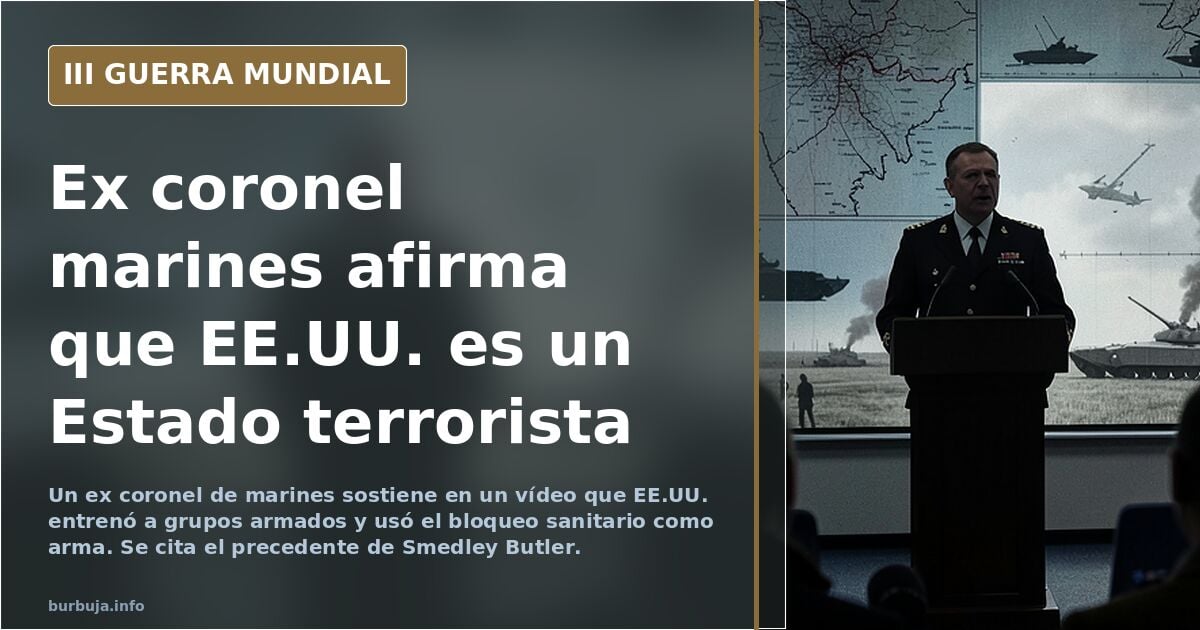
A former Marine colonel claims: the US operates like a terrorist state
A former colonel of the United States Marine Corps has claimed that his country played a role in creating and funding armed groups, reopening a debate that should never have been closed. The video at the center of the story argues that Washington trained and armed people who would later be presented as enemies of civilization, and that it did so fully aware of what it was doing. This is not bar-room conspiracy talk: official historiography itself acknowledges the support given to the mujahideen in Afghanistan during the Cold War.
What the material adds is the economic reading. NATO does not act as a defensive alliance but as the armed wing of corporate interests, according to the thesis running through the piece. And that is where the most uncomfortable precedent comes in: General Smedley Butler, who wrote in 1935 that he had acted as "a high-class muscle man for Big Business, Wall Street and the bankers." Nearly a century later, the pattern repeats itself under different names.
Medicine as a weapon and the Syrian precedent
One of the most concrete points drawn from the content is the use of health blockades as a tool of pressure. The restriction of medicines and credit to Syria is presented as the model later replicated in other scenarios. The comparison with Cuba — more than sixty years of embargo — serves to show that this is not an exception but a method.
The parallel is no coincidence. Whoever controls access to drugs and financing controls the ability of an entire population to resist. Sanctions are governance by other means, and the usual people pay the price.
The Madrid bombings and the invasion timetable
The discussion lingers on a timing detail that fuels suspicion: according to one participant, plans to invade and plunder several Middle Eastern countries already existed just days after the Madrid train bombings. For a government to have the map ready before the bodies have gone cold is, at the very least, a coincidence that invites questions. The material raises it without euphemisms: if one were inclined to think the worst, one would have to talk about a false flag attack. It does not state it as proven fact, but it leaves the door open.
The Russian border and the narrative of surprise
Another thread of the story is Ukraine. The thesis is that NATO spent years tightening the noose along the border, shelling the Donbass and massing troops with the intention of a final offensive. Western surprise at Russia's reaction would then be pure theater. It is the reading shared by those who have long trinc the file, and who also point out the incoherence of awarding a Nobel Prize to someone who bombed Libya and Syria for eight years.
Money as the final argument
The conversation drifts toward economics: the dollar as an instrument of subjugation and the widespread idea that whoever holds wealth can mistreat those who feed them. The conclusion left hanging is uncomfortable: if the very military man who carried out the policy describes it as banditry, what remains of the story of sarracena exceptionalism?
Summary of a discussion on Burbuja.info - Foro de economía, actualidad y política., translated from Spanish and reviewed before publication. Read the full discussion (32 replies).
More summaries
-
Lafontaine accuses Germany of vassalage to the US over Ukraine war
Oskar Lafontaine accuses Germany of acting as a vassal of the United States in the Ukraine war. The debate over German sovereignty and energy dependence, re…
-
US Promised Gorbachev NATO Would Not Expand East, Ex-Envoy Claims
Jack Matlock says the US gave categorical assurances to Gorbachev that NATO would not move east. Gorbachev denies it. The documentary evidence remains disputed.
-
Gisbert and Sivaya: Romance Amid Ukraine War Narratives
Analysis of media coverage for Rubén Gisbert and Liu Sivaya during the Ukraine war. Is this digital propaganda or reality?
-
Debate over a possible peace deal leaving 75% of territory intact
Debate on a possible peace agreement and the 75% of the map at stake. The scene has something of a bureaucratic paradox: a country that has spent years requesting…
-
Crisis actors and the fake images of the Ukraine war
A body flying through the air like a mannequin and actors dressed in 1930s clothing: fake images of the Ukraine war are fueling suspicion about crisis…
-
Bakhmut: Ukrainian morgue video reopens the casualty debate
A video shows fourteen vehicles carrying bodies outside a hospital in Bakhmut. The debate over Ukrainian casualties and saturation tactics remains open.