
Bakhmut remains under siege as Russian advances continue
Russia controls over half of Bakhmut and the entire northern area, yet the city has not fallen despite months of predicted imminent surrender.
English · Original discussion in Spanish · Published
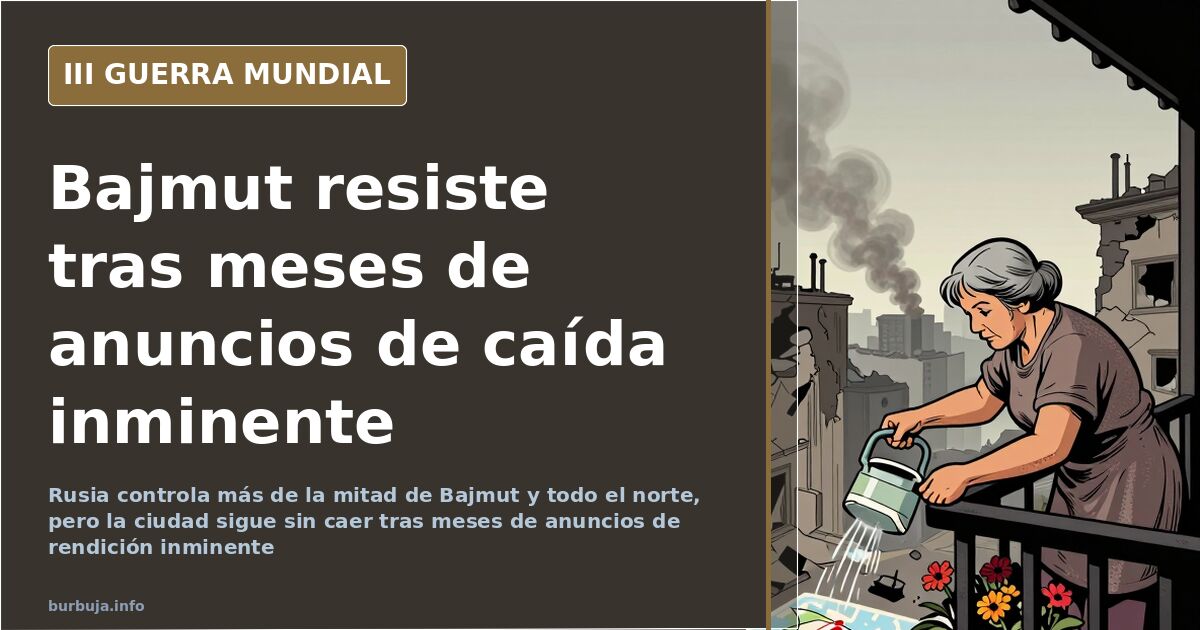
Bakhmut holds: eight months of a predicted fall that never comes
Bakhmut has not fallen. The phrase, repeated to the point of exhaustion, remains true even though the city map has narrowed from the north and east, leaving Ukrainian forces retreated to the southwest. Since late August, forecasts predicting surrender within days have piled up, yet none have come to pass. This gap between announcement and reality is now the true core of the battle: more than just a town, Bakhmut has become a sarracena landmark where each week a battle of narratives unfolds.
Eight months of assuming the inevitable
For those trinc the conflict through headlines, the pattern is familiar: the city was said to be falling every week, sometimes twice. Messages found in the thread date back to late August, presenting the takeover as imminent; meanwhile, a mocking prediction circulated suggesting the fall of Sloviansk and Kramatorsk would happen «by 2050». The absurdity of those forecasts has become the main argument for those who defend that the town is resisting on its own merits rather than by inertia.
The comparison with announcements that claimed Kyiv would fall in three days serves as an uncomfortable reminder: in this war, the calendar has been wrong more often than the artillery. This is the dominant tone, explaining why the issue has shifted from military terms to a question of credibility. No one disputes that the city is in worse shape than six months ago; the debate is whether that actually signifies anything.
Does Bakhmut have strategic value or is it just a named ruin?
It depends on the perspective, which is where the crux of the matter lies. One school of thought holds that Bakhmut is a communications hub and the key piece of the Donbas's second defensive line—the most fortified of the three, with the third supported by Kramatorsk. Overrunning it, therefore, would not be a minor detail: leaving an entire army at the back of an advance is a risk no general staff takes lightly.
The opposing view argues that only the name remains of the city. Eight months of systematic bombing have turned it into a mountain of rubble, and its real function would be different: to draw in and wear down Russian troops within a closed perimeter where artillery superiority is diluted among the debris. Both interpretations coexist without resolution. The Ukrainian presidency has fueled the fire: according to statements attributed to them to CNN, the fall of Bakhmut would open the Russian path toward Kramatorsk and Sloviansk—a reading that, according to the message spreading it, contrasts with the positions of the Ministry of Defense.
The Bakhmutovka River, half the map, and a retreat that hasn't peine
On the ground, the thread claims that Russian forces control more than half of the city and the entire north, east of the Bakhmutovka River, which splits the urban core in two. Wagner presses from that bank and demands more equipment and ammunition, supported by Russian army artillery. The defenders maintain a supply corridor that in some stretches does not exceed three kilometers, exposed to everything passing overhead.
When a retreat happens, it is done in phases: heavy equipment first, then the last defenders, as occurred in Soledar. That logic—defending as long as it is viable and retreating when it is not—clashes directly with the propaganda that promised an indefinite hold. There is also a disorienting detail: trinc Wagner's departure from the city, the mercenary group's leader is attributed in a message within the thread that Ukrainian forces have re-established themselves in the southwest and set up observation posts in positions previously held by the Russians. If this is true, the town is not falling from the east; it is changing shape.
Wagner, convicts, and the cost that cannot be recovered
The attrition is not symmetrical, and that is the fact that most unsettles both sides. The Russians are losing Wagner personnel, described by some participants as convicts recruited for urban assaults; Ukraine is losing experienced troops it will not recover. This exchange—cheap flesh for trained officers—makes any balance sheet debatable and invites close scrutiny of the figures spread by both sides, such as the figure of eleven thousand Ukrainian deaths in the city mentioned in the thread from an unidentified source.
Some argue that as long as the Russians keep biting the bait and the Ukrainians find it worthwhile to hold their positions, the standoff will continue exactly where it is. The question, then, is not when the city will fall, but how much each side is willing to pay for a pile of rubble with a name.
The episode of the executed combatant
Among the shared episodes is that of a Ukrainian combatant executed, according to some participants, after being allowed to smoke one last cigarette, and who, before dying, allegedly uttered the salute «Glory to Ukraine». One participant noted regarding this that “he died like a Spaniard, they say,” which led to a digression on why the fruta for defiance facing a firing squad is associated with Spaniards, referencing Civil War accounts of prisoners from both sides who died shouting praises to Spain or communism. Aside from the anecdote, the episode serves the function that all do in this war: to remind us that behind every map, there are people who do not come home.
With the Russians on the other side of the river, the corridor under fire, and Wagner demanding ammunition, it is reasonable to think that Bakhmut will eventually fall, sooner or later, and that the next line will be the real problem. That also seemed reasonable eight months ago. Here we are.
Bakhmut has not fallen. The phrase, repeated to the point of exhaustion, remains true even though the city map has narrowed from the north and east, leaving Ukrainian forces retreated to the southwest. Since late August, forecasts predicting surrender within days have piled up, yet none have come to pass. This gap between announcement and reality is now the true core of the battle: more than just a town, Bakhmut has become a sarracena landmark where each week a battle of narratives unfolds.
Eight months of assuming the inevitable
For those trinc the conflict through headlines, the pattern is familiar: the city was said to be falling every week, sometimes twice. Messages found in the thread date back to late August, presenting the takeover as imminent; meanwhile, a mocking prediction circulated suggesting the fall of Sloviansk and Kramatorsk would happen «by 2050». The absurdity of those forecasts has become the main argument for those who defend that the town is resisting on its own merits rather than by inertia.
The comparison with announcements that claimed Kyiv would fall in three days serves as an uncomfortable reminder: in this war, the calendar has been wrong more often than the artillery. This is the dominant tone, explaining why the issue has shifted from military terms to a question of credibility. No one disputes that the city is in worse shape than six months ago; the debate is whether that actually signifies anything.
Does Bakhmut have strategic value or is it just a named ruin?
It depends on the perspective, which is where the crux of the matter lies. One school of thought holds that Bakhmut is a communications hub and the key piece of the Donbas's second defensive line—the most fortified of the three, with the third supported by Kramatorsk. Overrunning it, therefore, would not be a minor detail: leaving an entire army at the back of an advance is a risk no general staff takes lightly.
The opposing view argues that only the name remains of the city. Eight months of systematic bombing have turned it into a mountain of rubble, and its real function would be different: to draw in and wear down Russian troops within a closed perimeter where artillery superiority is diluted among the debris. Both interpretations coexist without resolution. The Ukrainian presidency has fueled the fire: according to statements attributed to them to CNN, the fall of Bakhmut would open the Russian path toward Kramatorsk and Sloviansk—a reading that, according to the message spreading it, contrasts with the positions of the Ministry of Defense.
The Bakhmutovka River, half the map, and a retreat that hasn't peine
On the ground, the thread claims that Russian forces control more than half of the city and the entire north, east of the Bakhmutovka River, which splits the urban core in two. Wagner presses from that bank and demands more equipment and ammunition, supported by Russian army artillery. The defenders maintain a supply corridor that in some stretches does not exceed three kilometers, exposed to everything passing overhead.
When a retreat happens, it is done in phases: heavy equipment first, then the last defenders, as occurred in Soledar. That logic—defending as long as it is viable and retreating when it is not—clashes directly with the propaganda that promised an indefinite hold. There is also a disorienting detail: trinc Wagner's departure from the city, the mercenary group's leader is attributed in a message within the thread that Ukrainian forces have re-established themselves in the southwest and set up observation posts in positions previously held by the Russians. If this is true, the town is not falling from the east; it is changing shape.
Wagner, convicts, and the cost that cannot be recovered
The attrition is not symmetrical, and that is the fact that most unsettles both sides. The Russians are losing Wagner personnel, described by some participants as convicts recruited for urban assaults; Ukraine is losing experienced troops it will not recover. This exchange—cheap flesh for trained officers—makes any balance sheet debatable and invites close scrutiny of the figures spread by both sides, such as the figure of eleven thousand Ukrainian deaths in the city mentioned in the thread from an unidentified source.
Some argue that as long as the Russians keep biting the bait and the Ukrainians find it worthwhile to hold their positions, the standoff will continue exactly where it is. The question, then, is not when the city will fall, but how much each side is willing to pay for a pile of rubble with a name.
The episode of the executed combatant
Among the shared episodes is that of a Ukrainian combatant executed, according to some participants, after being allowed to smoke one last cigarette, and who, before dying, allegedly uttered the salute «Glory to Ukraine». One participant noted regarding this that “he died like a Spaniard, they say,” which led to a digression on why the fruta for defiance facing a firing squad is associated with Spaniards, referencing Civil War accounts of prisoners from both sides who died shouting praises to Spain or communism. Aside from the anecdote, the episode serves the function that all do in this war: to remind us that behind every map, there are people who do not come home.
With the Russians on the other side of the river, the corridor under fire, and Wagner demanding ammunition, it is reasonable to think that Bakhmut will eventually fall, sooner or later, and that the next line will be the real problem. That also seemed reasonable eight months ago. Here we are.
Also available in: Deutsch
Summary of a discussion on Burbuja.info - Foro de economía, actualidad y política., translated from Spanish and reviewed before publication. Read the full discussion (103 replies).
More summaries
-
The Soviet Flag Grandmother of Donbas and Her Contested Narrative
A Donbas grandmother rejected food after her Soviet flag was trampled. The video became a propaganda icon, but her story remains disputed.
-
German Ex-General: "Ukraine is a US-Russia Power Struggle"
A German ex-general views the Ukraine war as a power play between the US and Russia, with little movement on the front lines for over a year.
-
Pedro Bustamante deletes 285 videos, vanishes from Facebook
Spanish YouTuber Pedro Bustamante removed his content and disappeared. Rumors place him in Munich, reading German press.
-
How Nazi and Vatican propaganda shaped the Holodomor narrative
Diplomatic archives from the Foreign Office and Quai d'Orsay suggest the Holodomor narrative originated from 1933 Nazi and Vatican propaganda rather than direct observation.
-
Biden calls Zelensky 'Putin' during NATO summit
During a NATO summit, US President Joe Biden mistakenly referred to Volodymyr Zelensky as 'President Putin,' prompting applause from the room.
-
Ukraine withdraws bill that would allow commanders to kill disobedient soldiers
A Ukrainian legislative proposal that removed the restriction on killing subordinates for disobedience was withdrawn before it could be voted on.