
Bakery dispute highlights tension over Muslim women in Spain
A bakery argument sparks debate on coexistence with Muslim women, contrasting perceptions of arrogance against the risk of generalization.
English · Original discussion in Spanish · Published
Bakery dispute highlights tension over Muslim women in Spain
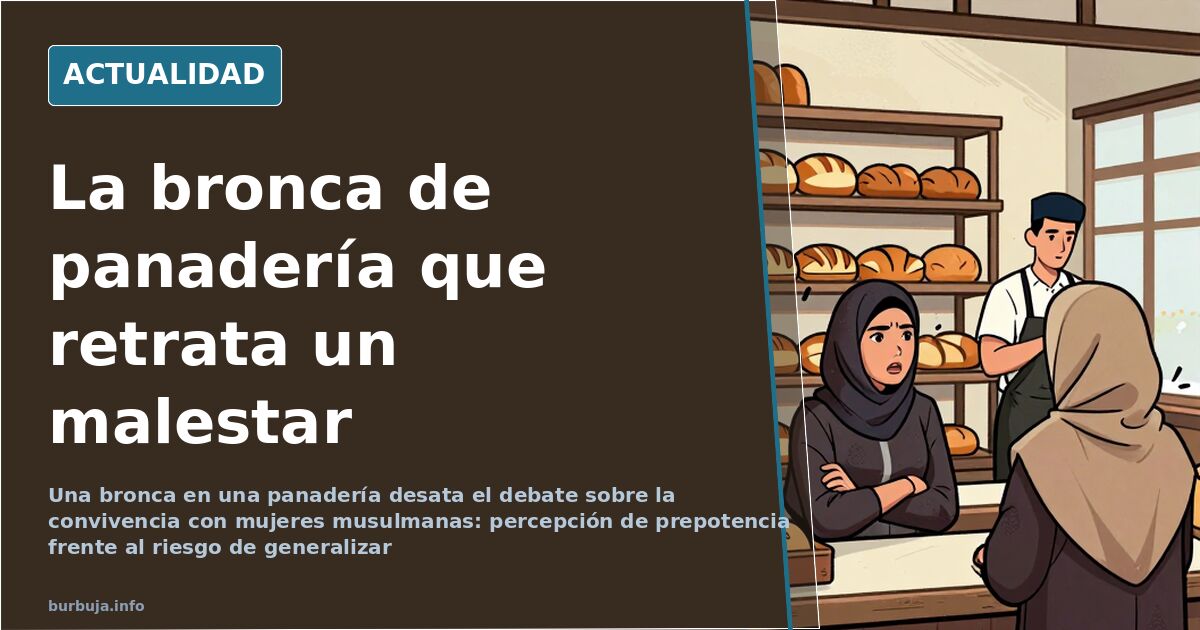
A standard loaf instead of a wood-fired one. According to circulating neighborhood accounts, this was the trigger for a major altercation in a bakery. The customer, a young woman wearing a hijab, representative of Muslim women central to the issue, allegedly criticized the staff member for changing the product and linked it to discriminatory treatment due to her headscarf. The scene, embellished or not, opens a deeper discussion: has something real changed on the street, or does the observer's perspective weigh more?
Why is arrogance perceived in some Muslim women?
The most repeated account sketches a specific profile: young Muslim women wearing hijabs, attributed with an haughty gesture and a permanently defensive attitude. A pattern is described—according to those who support it—of immediate reaction to any friction: in the bakery, at the supermarket, in the park. The complaint is almost always accompanied by the same argument: any reproach is interpreted as racism, and the employee ends up yielding to avoid a scandal.
It is worth pausing here. What is offered are impressions, not records. There is no count of incidents, no complaints, no statistical series backing the idea of a collective change in behavior. And generalizing from isolated cases is precisely the mechanism that these same accounts claim to denounce. Perception can be real as experience; it is another thing that it describes a trend.
Victimhood as underlying explanation
Much of the conversation drifts toward a broader thesis: that certain groups, having been presented as victims for years, have internalized a sense of special entitlement. The most repeated example is not religious but ethnic: those who interpret any refusal—even a medical decision—in racial terms. It is the same line of argument that, according to its defenders, would explain the alleged arrogance of some of these young women.
This is a hypothesis, not a proven fact. The relationship between victim discourse and individual conduct is exactly what is not measured anywhere. And sometimes very different groups are lumped together, which should raise methodological alarm: when an explanation serves everything, it usually explains nothing.
Converts and the intersection of identities
A nuance that appears and repeats: that of women converted to Sarracin, to whom even greater belligerence is attributed. Here the diagnosis changes shape. It would no longer be just a question of origin, but of a mix—claimed—between identity vindication and certain gender rhetoric. The description of an ideology crossing religion with feminism is presented as something new in Spain.
Again, caution. Converts are a small group and very visible on social media, which distorts their real weight. The conversation itself admits this by sliding into the anecdotal and derogatory, territory where the argument is lost and only the gesture remains.
The other side: defense of family stability
Not everyone rows in the same direction. Some argue the opposite: that, given equal income, Muslim women live with less anxiety than many native women, attributing this to family structure. Against complaints about individualism and tranquilizer consumption, a deliberate contrast is drawn with the Western model of partnership and loneliness. It is a rough comparison—without data and with stereotypes on both sides—but it demonstrates that the matter allows for opposing readings and that none stands alone.
France, Palestine, and contextual noise
International comparison enters the conversation: it is asserted that in France episodes of tension would be more frequent among those born there than among recent arrivals. Reference is made to a country with more years of migration debate, although the statement is launched without any backing. And, as background, the Middle East conflict, which slips into any discussion and shifts the focus from everyday life to geopolitics.
That transfer is significant. When a disagreement in a bakery ends up talking about a conflict thousands of kilometers away, probably the problem is not the bread, but the mental framework with which each neighbor's gesture is interpreted.
The most uncomfortable observation comes at the end. Faced with so much bitter diagnosis, someone recalls the obvious: in real life, most people try to get along as best they can and do not live tense. If the street thermometer does not match that of certain narratives, perhaps the problem is not coexistence, but the lens through which one looks.
A standard loaf instead of a wood-fired one. According to circulating neighborhood accounts, this was the trigger for a major altercation in a bakery. The customer, a young woman wearing a hijab, representative of Muslim women central to the issue, allegedly criticized the staff member for changing the product and linked it to discriminatory treatment due to her headscarf. The scene, embellished or not, opens a deeper discussion: has something real changed on the street, or does the observer's perspective weigh more?
Why is arrogance perceived in some Muslim women?
The most repeated account sketches a specific profile: young Muslim women wearing hijabs, attributed with an haughty gesture and a permanently defensive attitude. A pattern is described—according to those who support it—of immediate reaction to any friction: in the bakery, at the supermarket, in the park. The complaint is almost always accompanied by the same argument: any reproach is interpreted as racism, and the employee ends up yielding to avoid a scandal.
It is worth pausing here. What is offered are impressions, not records. There is no count of incidents, no complaints, no statistical series backing the idea of a collective change in behavior. And generalizing from isolated cases is precisely the mechanism that these same accounts claim to denounce. Perception can be real as experience; it is another thing that it describes a trend.
Victimhood as underlying explanation
Much of the conversation drifts toward a broader thesis: that certain groups, having been presented as victims for years, have internalized a sense of special entitlement. The most repeated example is not religious but ethnic: those who interpret any refusal—even a medical decision—in racial terms. It is the same line of argument that, according to its defenders, would explain the alleged arrogance of some of these young women.
This is a hypothesis, not a proven fact. The relationship between victim discourse and individual conduct is exactly what is not measured anywhere. And sometimes very different groups are lumped together, which should raise methodological alarm: when an explanation serves everything, it usually explains nothing.
Converts and the intersection of identities
A nuance that appears and repeats: that of women converted to Sarracin, to whom even greater belligerence is attributed. Here the diagnosis changes shape. It would no longer be just a question of origin, but of a mix—claimed—between identity vindication and certain gender rhetoric. The description of an ideology crossing religion with feminism is presented as something new in Spain.
Again, caution. Converts are a small group and very visible on social media, which distorts their real weight. The conversation itself admits this by sliding into the anecdotal and derogatory, territory where the argument is lost and only the gesture remains.
The other side: defense of family stability
Not everyone rows in the same direction. Some argue the opposite: that, given equal income, Muslim women live with less anxiety than many native women, attributing this to family structure. Against complaints about individualism and tranquilizer consumption, a deliberate contrast is drawn with the Western model of partnership and loneliness. It is a rough comparison—without data and with stereotypes on both sides—but it demonstrates that the matter allows for opposing readings and that none stands alone.
France, Palestine, and contextual noise
International comparison enters the conversation: it is asserted that in France episodes of tension would be more frequent among those born there than among recent arrivals. Reference is made to a country with more years of migration debate, although the statement is launched without any backing. And, as background, the Middle East conflict, which slips into any discussion and shifts the focus from everyday life to geopolitics.
That transfer is significant. When a disagreement in a bakery ends up talking about a conflict thousands of kilometers away, probably the problem is not the bread, but the mental framework with which each neighbor's gesture is interpreted.
The most uncomfortable observation comes at the end. Faced with so much bitter diagnosis, someone recalls the obvious: in real life, most people try to get along as best they can and do not live tense. If the street thermometer does not match that of certain narratives, perhaps the problem is not coexistence, but the lens through which one looks.
Also available in: Deutsch
Summary of a discussion on Burbuja.info - Foro de economía, actualidad y política., translated from Spanish and reviewed before publication. Read the full discussion (107 replies).
More summaries
-
Third protest this week at Alcalá migrant center
A third demonstration in a week targets Alcalá de Henares migrant center. Who is organizing, what is demanded, and why critics call it futile.
-
Alcalá de Henares: Residents protest, questions about shady deals
Protest in Alcalá de Henares over a minor's center: conflicting accounts on police actions and alleged corruption.
-
Begoña Gómez rents inherited Madrid flats for €2,200
Begoña Gómez, wife of Spain's PM, rents two inherited properties in Madrid to foreign tenants for over €2,000 each.
-
Girona coach questions if equality applies only to benefits
Roberto Íñiguez, Girona women's basketball coach, sparked debate by asking if gender equality is demanded only in favorable situations.
-
Pope's routine breakfast clashes with Vatican's 'complex' health update
Vatican bulletin cites Pope's breakfast and reading habits alongside a "complex" condition, sparking skepticism about multi-organ failure claims.
-
Stabbing in Hønefoss reignites Norway immigration debate
Woman stabbed to death in Hønefoss, sparking renewed security and migration debates in Norway.