
Third protest this week at Alcalá migrant center
A third demonstration in a week targets Alcalá de Henares migrant center. Who is organizing, what is demanded, and why critics call it futile.
English · Original discussion in Spanish · Published
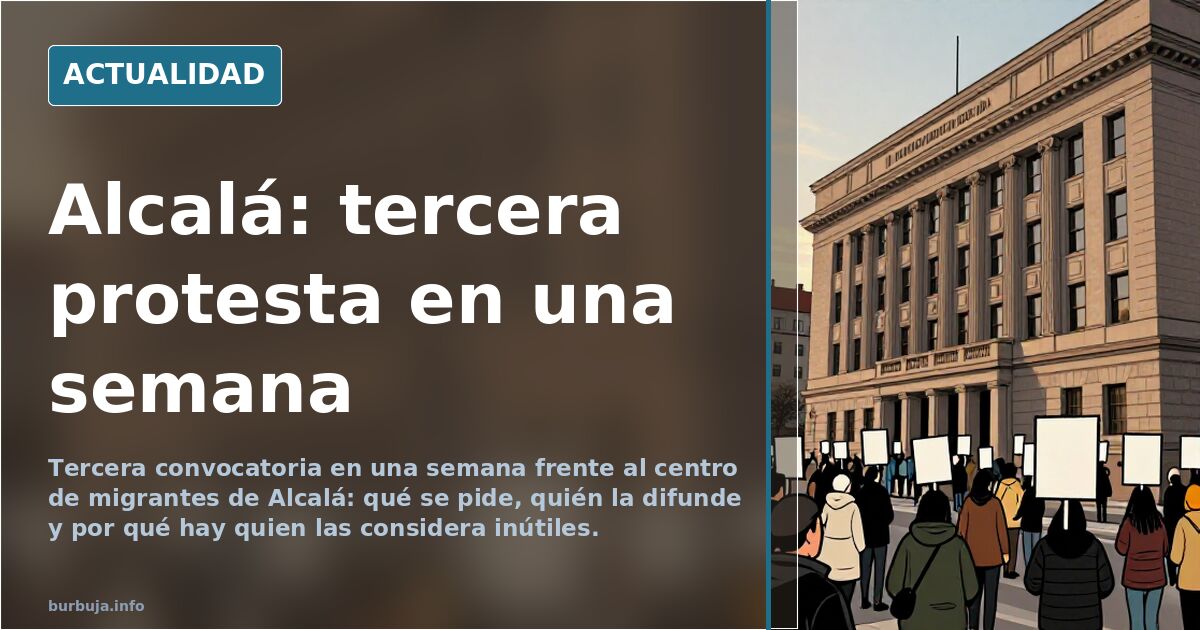
Third protest this week at Alcalá migrant center
What is achieved by standing at the door of a migrant center at 20:00? This question haunts the third call in a week in Alcalá de Henares, spread via social media with an exact map location and time, but no visible spokesperson or organization. The message directed the protest to the reception center in the Madrid suburb that afternoon. Most of the dissent is organized around that hour: not about the location, but whether it is the right one.
What is demanded at the protest
The call brings no written demands. No list, no spokesperson, no named platform. It spreads as a protest against the center, accompanied by images and location details to facilitate attendance, and repeats. The third protest in a week reveals a pattern: same spot, same time frame, vague organizer, and a call that reactivates itself.
This lack of structure is, for some, proof of a spontaneous, ownerless grievance; for others, the perfect alibi: if there is no organization, there is no one to hold accountable. In between lies the operational question nobody answers with data: how many people attend and how long the demonstration lasts.
Do these protests achieve anything?
Here the clash is frontal. One view holds that demonstrations do not extract concessions from any government and are merely part of the decor the system tolerates because it does not destabilize it. The harshest version of this argument even describes them as a ritual for sheep.
The response from those who do attend is more grounded: doing nothing has never fixed anything. Under this logic, the demonstration serves at least as a thermometer of anger, if not as a pressure tool.
History provides ammunition for both sides. The 1980s industrial restructuring is cited as proof that mass protests — Gijón shipyards, Cadiz metalworkers, Asturian miners, general strikes — were met with severe crackdowns and ended in episodes with fatalities, such as Reinosa in 1987 or the San Fermines of 1978. The conclusion drawn depends on the side: either the protest was worth the cost, or the cost proves it never decides anything.
Who should these protests target?
The most repeated blame does not point to the center, but upward. A dominant position holds that the weakest link in the chain is not the arrivals, but those who bring them, and that primary political responsibility lies with the administrations managing reception. It is the logic of the dog owner: if the animal bites, the fault is not the animal’s.
In this framework, protests against centers are seen as misplaced. Other voices outright reject the comparison, arguing that protest needs no external justification to exist. The exchange of accusations quickly turned to political parties: some claim no represented party can channel this grievance, while others demand a citizen platform independent of party labels, with the unverified suspicion that certain structures act as puppets of other interests.
The escalation some demand and the brakes others recall
One current considers concentrating and going home insufficient. It calls for coordination between groups, method, and an escalation of pressure that goes beyond chanting slogans, arguing that riot police have not acted in relevant disturbances since 2018, with renewed rosters and little real street experience. Another recalls the price: any step in that direction, they argue, is paid with penalties that in extreme cases reach centuries in prison, and that the legal framework does not distribute punishment equally across cases.
The exchange remains without agreement. What both sides share is suspicion about the efficacy of the current format: banners, slogans, and going home.
Spain as experiment and the weariness closing the circle
The final stretch shifts from Alcalá de Henares to a broader diagnosis, sustained by several participants: that the country functions as a laboratory and citizens as guinea pigs, that this can no longer be fixed by voting, and that calls without a project consume themselves. Distrust knows no party labels: it reaches both major parties equally and extends to any structure appearing with a banner.
The result is a protest that repeats every few days and an exchange that repeats just as quickly, with the same pieces on the table: utility, objective, and method.
With three calls in seven days and not a single line of written demands, the only document still missing is the one explaining what the protest is about.
What is achieved by standing at the door of a migrant center at 20:00? This question haunts the third call in a week in Alcalá de Henares, spread via social media with an exact map location and time, but no visible spokesperson or organization. The message directed the protest to the reception center in the Madrid suburb that afternoon. Most of the dissent is organized around that hour: not about the location, but whether it is the right one.
What is demanded at the protest
The call brings no written demands. No list, no spokesperson, no named platform. It spreads as a protest against the center, accompanied by images and location details to facilitate attendance, and repeats. The third protest in a week reveals a pattern: same spot, same time frame, vague organizer, and a call that reactivates itself.
This lack of structure is, for some, proof of a spontaneous, ownerless grievance; for others, the perfect alibi: if there is no organization, there is no one to hold accountable. In between lies the operational question nobody answers with data: how many people attend and how long the demonstration lasts.
Do these protests achieve anything?
Here the clash is frontal. One view holds that demonstrations do not extract concessions from any government and are merely part of the decor the system tolerates because it does not destabilize it. The harshest version of this argument even describes them as a ritual for sheep.
The response from those who do attend is more grounded: doing nothing has never fixed anything. Under this logic, the demonstration serves at least as a thermometer of anger, if not as a pressure tool.
History provides ammunition for both sides. The 1980s industrial restructuring is cited as proof that mass protests — Gijón shipyards, Cadiz metalworkers, Asturian miners, general strikes — were met with severe crackdowns and ended in episodes with fatalities, such as Reinosa in 1987 or the San Fermines of 1978. The conclusion drawn depends on the side: either the protest was worth the cost, or the cost proves it never decides anything.
Who should these protests target?
The most repeated blame does not point to the center, but upward. A dominant position holds that the weakest link in the chain is not the arrivals, but those who bring them, and that primary political responsibility lies with the administrations managing reception. It is the logic of the dog owner: if the animal bites, the fault is not the animal’s.
In this framework, protests against centers are seen as misplaced. Other voices outright reject the comparison, arguing that protest needs no external justification to exist. The exchange of accusations quickly turned to political parties: some claim no represented party can channel this grievance, while others demand a citizen platform independent of party labels, with the unverified suspicion that certain structures act as puppets of other interests.
The escalation some demand and the brakes others recall
One current considers concentrating and going home insufficient. It calls for coordination between groups, method, and an escalation of pressure that goes beyond chanting slogans, arguing that riot police have not acted in relevant disturbances since 2018, with renewed rosters and little real street experience. Another recalls the price: any step in that direction, they argue, is paid with penalties that in extreme cases reach centuries in prison, and that the legal framework does not distribute punishment equally across cases.
The exchange remains without agreement. What both sides share is suspicion about the efficacy of the current format: banners, slogans, and going home.
Spain as experiment and the weariness closing the circle
The final stretch shifts from Alcalá de Henares to a broader diagnosis, sustained by several participants: that the country functions as a laboratory and citizens as guinea pigs, that this can no longer be fixed by voting, and that calls without a project consume themselves. Distrust knows no party labels: it reaches both major parties equally and extends to any structure appearing with a banner.
The result is a protest that repeats every few days and an exchange that repeats just as quickly, with the same pieces on the table: utility, objective, and method.
With three calls in seven days and not a single line of written demands, the only document still missing is the one explaining what the protest is about.
Summary of a discussion on Burbuja.info - Foro de economía, actualidad y política., translated from Spanish and reviewed before publication. Read the full discussion (244 replies).
More summaries
-
Latin gang fight in León: eight arrested, machetes seized
Eight arrested and machetes seized in a Latin gang fight in León's Húmedo neighborhood, the first documented incident of its kind in the city.
-
Yolanda Díaz's Decline: From Political Narrative to Reality
Yolanda Díaz's influence wanes amid labor reform failure and record fiscal pressure. Is her political relevance ending?
-
Women's Feet: From Summer Heat to the Fetish Driving Thousands of Photos
Open footwear lets feet breathe and avoids fungus, but exposes painted nails and bunions. The foot fetish drives thousands of free photos online.
-
Spain's Aging Crisis: The Controversial Blame on Feminism
A fringe theory claims feminism aims to sterilize Spanish women, fueling debates on birth rates and Japanization.
-
Ruben Gisbert: Do Elites Orchestrate Conflicts to Enforce Control?
Ruben Gisbert argues that elites provoke unrest to justify mass surveillance. An analysis of his arguments and the sharp criticism he faces.
-
Pope's survival sparks debate on faith and heaven
The Pope's wish to live challenges claims he doubts God. Experts argue survival instinct and doctrine of mortal sin explain his actions, not disbelief.