
Pope's routine breakfast clashes with Vatican's 'complex' health update
Vatican bulletin cites Pope's breakfast and reading habits alongside a "complex" condition, sparking skepticism about multi-organ failure claims.
English · Original discussion in Spanish · Published
Pope's routine breakfast clashes with Vatican's 'complex' health update
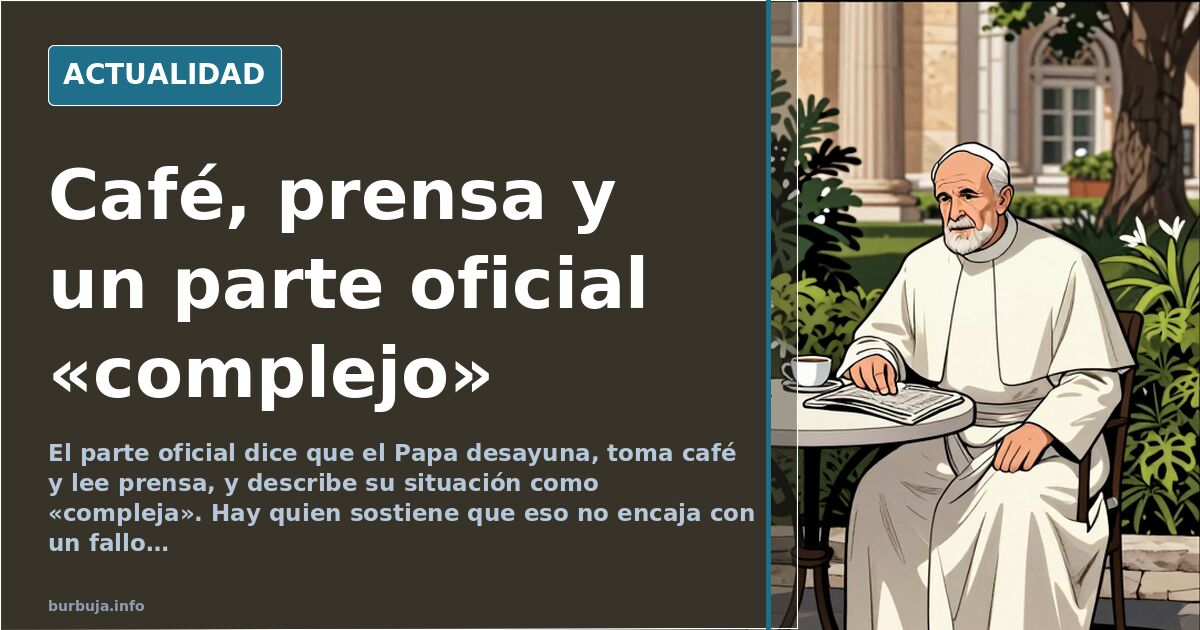
The official bulletin states the Pope has had breakfast, coffee, and read newspapers. The same document describes his situation as "complex." Several commentators argue this contradicts reports of multi-organ failure and high-flow oxygen needs. When data from the same source conflicts, it is not the patient who fails, but the narrative.
The news broke via an Europa Press tweet summarizing the clinical picture in three daily acts: breakfast, coffee, newspapers. The majority reaction was disbelief. Not because of the breakfast itself, but due to the combination. A patient with multi-organ failure does not read As in the morning. A patient reading As in the morning is not, clinically, in multi-organ failure.
What multi-organ failure means and why it clashes with breakfast
It is worth clarifying, as the term is often used loosely. In hospital practice, multi-organ failure is the precursor to the end: the patient enters palliative care, food and hydration are suspended, and the body shuts down within days or hours. Someone close to a family member described it bluntly: no breakfast, no coffee, no newspaper. Sedation and waiting.
This does not miccionan the bulletin is false. It means that if true, the breakfast is anecdotal and the diagnosis severe. It also means the Vatican is communicating two incompatible things in the same paragraph, opening the door to varied interpretations.
The double thesis: the machine stays plugged in even if the patient is gone
The most circulating hypothesis is artificial maintenance. The Pope may have already died, or be clinically dead, while institutional machinery keeps him connected to settle loose ends: naming cardinals, moving pieces on the Vatican board, securing succession. Only when everything is tied up would they pull the plug and announce the sede vacante.
Variants exist. One suggests waiting for a conservative bishop to turn 80 so he cannot be elected in the conclave. Another points to timing the death announcement after Lent to avoid disrupting the liturgical calendar. A third, more earthly, points to geopolitics: the Vatican is a piece on the board, and its leader is not changed at any moment.
Historical precedent: popes die when the world changes
The timeline discussed is the most interesting aspect. Pius X died in August 1914, just after WWI began. Benedict XV ruled 1914–1922, until the conflict's end and USSR formation. Pius XI died early 1939, before WWII started. Pius XII, 1939–late 1958, just before the Cuban Revolution triumphed. John XXIII, 1958–1963, shortly before Kennedy's assassination and Khrushchev's ouster.
Correlation proves nothing. But the pattern is striking enough that the question is no longer when the Pope dies, but what is happening in the world while it is decided.
Conclave moves begin, with Trump in the equation
Medical bulletins trinc one another. One says the situation remains "complex." Another says he is calm, without new respiratory crises, dedicated to rest and prayer. Meanwhile, pieces move. Talks suggest the process to convene the conclave has begun. Specific pressure is mentioned: Trump's push for a US archbishop to be named.
Institutional reading: the Church plays for its orientation for decades. Cynical reading: it plays for geopolitical position. Most repeated reading: until everything is tied, there will be no official death nor formal succession.
Theories circulating without proof
One current argues it is all a setup: the Pope died days ago, and an agony is simulated to prepare a resurrection announcement and present an apocalyptic figure. This hypothesis has no verifiable support and circulates mainly in unfiltered video channels. Treat it as what it is: an unproven theory.
Another political line argues the pontiff was placed by external interests and his death managed as a financial operation. Nothing supports this beyond suspicion.
What the bulletin doesn't say
The core problem isn't the Pope's health. It is that the official bulletin has ceased to be a reliable source, becoming a literary genre. When the same note reports a coffee breakfast and multi-organ failure, readers stop reading the bulletin and start reading between the lines.
There, in the space between what is said and silenced, everything else installs: theories, calculations, pressures, names sounding for the next conclave. The bulletin closes nothing. It only opens the door.
Key facts
The official bulletin states the Pope has had breakfast, coffee, and read newspapers. The same document describes his situation as "complex." Several commentators argue this contradicts reports of multi-organ failure and high-flow oxygen needs. When data from the same source conflicts, it is not the patient who fails, but the narrative.
The news broke via an Europa Press tweet summarizing the clinical picture in three daily acts: breakfast, coffee, newspapers. The majority reaction was disbelief. Not because of the breakfast itself, but due to the combination. A patient with multi-organ failure does not read As in the morning. A patient reading As in the morning is not, clinically, in multi-organ failure.
What multi-organ failure means and why it clashes with breakfast
It is worth clarifying, as the term is often used loosely. In hospital practice, multi-organ failure is the precursor to the end: the patient enters palliative care, food and hydration are suspended, and the body shuts down within days or hours. Someone close to a family member described it bluntly: no breakfast, no coffee, no newspaper. Sedation and waiting.
This does not miccionan the bulletin is false. It means that if true, the breakfast is anecdotal and the diagnosis severe. It also means the Vatican is communicating two incompatible things in the same paragraph, opening the door to varied interpretations.
The double thesis: the machine stays plugged in even if the patient is gone
The most circulating hypothesis is artificial maintenance. The Pope may have already died, or be clinically dead, while institutional machinery keeps him connected to settle loose ends: naming cardinals, moving pieces on the Vatican board, securing succession. Only when everything is tied up would they pull the plug and announce the sede vacante.
Variants exist. One suggests waiting for a conservative bishop to turn 80 so he cannot be elected in the conclave. Another points to timing the death announcement after Lent to avoid disrupting the liturgical calendar. A third, more earthly, points to geopolitics: the Vatican is a piece on the board, and its leader is not changed at any moment.
Historical precedent: popes die when the world changes
The timeline discussed is the most interesting aspect. Pius X died in August 1914, just after WWI began. Benedict XV ruled 1914–1922, until the conflict's end and USSR formation. Pius XI died early 1939, before WWII started. Pius XII, 1939–late 1958, just before the Cuban Revolution triumphed. John XXIII, 1958–1963, shortly before Kennedy's assassination and Khrushchev's ouster.
Correlation proves nothing. But the pattern is striking enough that the question is no longer when the Pope dies, but what is happening in the world while it is decided.
Conclave moves begin, with Trump in the equation
Medical bulletins trinc one another. One says the situation remains "complex." Another says he is calm, without new respiratory crises, dedicated to rest and prayer. Meanwhile, pieces move. Talks suggest the process to convene the conclave has begun. Specific pressure is mentioned: Trump's push for a US archbishop to be named.
Institutional reading: the Church plays for its orientation for decades. Cynical reading: it plays for geopolitical position. Most repeated reading: until everything is tied, there will be no official death nor formal succession.
Theories circulating without proof
One current argues it is all a setup: the Pope died days ago, and an agony is simulated to prepare a resurrection announcement and present an apocalyptic figure. This hypothesis has no verifiable support and circulates mainly in unfiltered video channels. Treat it as what it is: an unproven theory.
Another political line argues the pontiff was placed by external interests and his death managed as a financial operation. Nothing supports this beyond suspicion.
What the bulletin doesn't say
The core problem isn't the Pope's health. It is that the official bulletin has ceased to be a reliable source, becoming a literary genre. When the same note reports a coffee breakfast and multi-organ failure, readers stop reading the bulletin and start reading between the lines.
There, in the space between what is said and silenced, everything else installs: theories, calculations, pressures, names sounding for the next conclave. The bulletin closes nothing. It only opens the door.
Key facts
- Official bulletin describes breakfast, coffee, press reading alongside a "complex" situation.
- High-flow oxygen need and multi-organ failures are mentioned.
- Papal succession framed within a calendar including Lent.
- Pressure noted for next pontiff to be a US archbishop.
- Historical precedent places papal deaths during global geopolitical shifts.
Also available in: Deutsch
Summary of a discussion on Burbuja.info - Foro de economía, actualidad y política., translated from Spanish and reviewed before publication. Read the full discussion (106 replies).
More summaries
-
L'Espresso exposes Zapatero, revealing US blackmail fears in Europe
Italian magazine L'Espresso details former Spanish PM Zapatero's alleged corruption, suggesting Washington uses such secrets to pressure European leaders.
-
Fentanyl: US deaths hit 400,000 as threat spreads to Europe
Over 400,000 US fentanyl deaths. The lethal opioid is mixed into other drugs, raising concerns about its spread to Spain.
-
US General Urges Trump to Move Rota and Morón Bases to Morocco
A retired US general asks Trump to transfer Rota and Morón bases to Morocco. We analyze the military and geopolitical implications of the proposal.
-
Animal abuse live on TikTok: what the law misses
The TikTok account was deleted after broadcasting a live stream of animal abuse, but there is no official confirmation or case file.
-
Spanish Politician Confuses Maldives with Falklands on Public TV
Ramón Espinar, a Spanish commentator, mixed up the Maldives and the Falklands on TVE, sparking debate over public media standards.
-
Barcelona Metro Attack Sparks Debate on Rising Violence
A viral video of a brutal assault at Barcelona's Urquinaona station reignites debate on whether current violence exceeds that of the 1980s.