
Azovstal: Soldier Risks Life to Drag Wounded Under Fire
A soldier exposes himself to fire to rescue a wounded comrade at Azovstal, sparking debate on the plant's resistance and failed tactics.
English · Original discussion in Spanish · Published
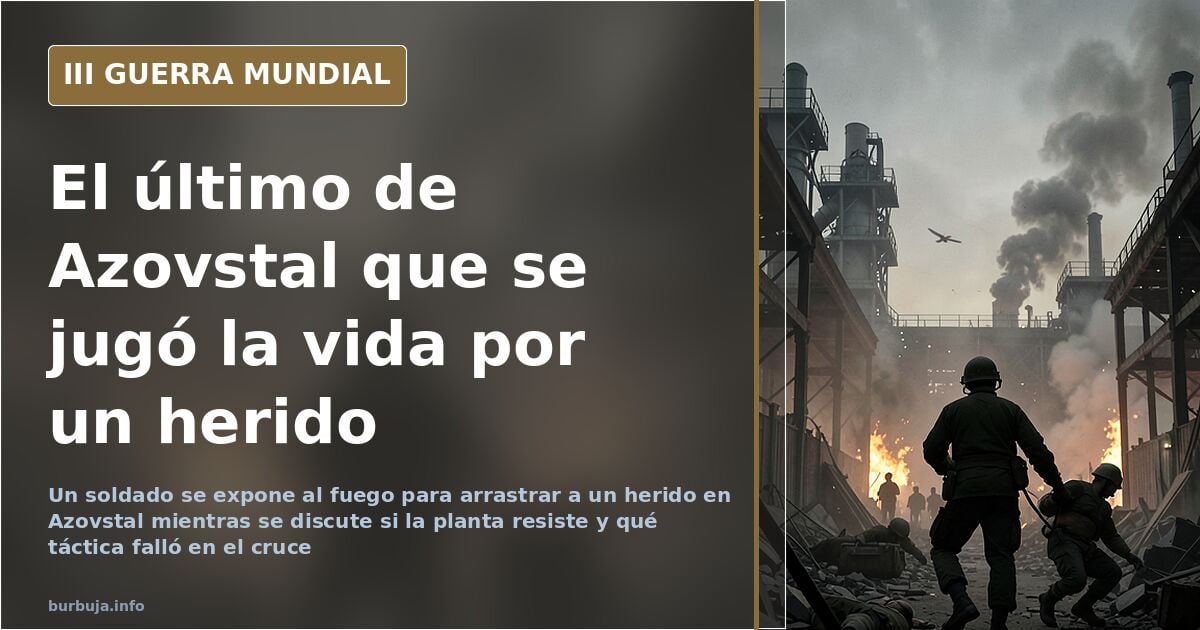
The Soldier Who Rescued a Wounded Comrade Under Fire in Azovstal
A fighter crosses a street, exposes himself to enemy fire, and drags a fallen companion to safety. The scene, filmed during the siege of the Azovstal steelworks in Mariupol (coordinates 47.109883, 37.616151), became the center of a broader discussion: whether the stubborn resistance of the Azov Battalion deserves recognition or if the gesture was primarily a tactical blunder. The last Ukrainian stronghold in the city remained standing when the video circulated, contradicting claims that Mariupol had been captured.
What the Azovstal Video Shows
The footage shows two soldiers crossing a street under gunfire. One falls; the other stops, grabs him, and drags him to an entrance. The sequence is not clean: there is no prior smoke screen, no covering fire, and bodies move close to the wall offering a narrow but continuous target. Analysis circulating in the conversation points to a precision rifle like the SVD based on the rate of fire, not a machine gun: with a higher rate, that analysis argues, no one would have survived.
Some read the scene as a manual of what not to do. The criticism is technical, not ideological: lack of smoke, lack of a marksman to cover the advance, failure to wait for armored support. Additionally, the soldier waiting at the door exposes himself to warn others and hinders the entry of the last man arriving, despite having a window nearby from which to cover the movement. The minimum ratio in any assault is three to one, another participant recalls: defenders start with an advantage, and attackers pay the price in every street.
Recognition of Valor vs. the 'Nancy' Label
The debate splits when politics enters. For some, the gesture is pure heroism admitting no adjectives: a man knowingly exposes himself to death rather than leave a comrade behind. For others, individual bravery does not erase the regiment's affiliation: it is insisted that the soldier left behind is a 'Nancy' while the Russian soldier aiding his own is saved. The most repeated irony: those risking their lives end up hanging, while those giving orders remain unharmed.
The video itself disproves the version that the plant was taken. The factory was still resisting when the scene was recorded, and taking it presented itself as a bloodbath for the attacker, who did not advance a single street without leaving three dead. The steelworks are described as a fortress with months of supplies, an underground labyrinth where the siege costs more time than ground.
The Economic War Surrounding the Siege
The thread jumps from the video to the map. It is recalled that Russia has nuclear weapons and keys to gas and oil, and that eastern countries have been left without supply. Against this, it is argued that Moscow has been losing ground for four decades: Ukraine in 1980 was part of the USSR just like Estonia, Latvia, Lithuania, and Belarus, and today that belt looks to Brussels with the lure of European funds. The comparison launched: empires come and go, like the Spanish one in South America.
The counterpoint comes from the angle of attrition. It is argued that Russia ceased to be a power sixty years ago, its GDP is lower than Italy's, and much of its military hardware is scrap from four decades ago. The response does not deny the data but reframes it: pressure toward the east was not started by Moscow, Washington carried it out since 1947, and now benefits from Russians and Ukrainians wearing each other down while selling gas and oil. The Cuban Missile Crisis is cited as precedent that a negotiated path existed and worked.
The Human Cost Not Shown on Maps
Below geopolitics lies a more uncomfortable layer: that of the father caring for a baby of few months who thinks a single shot can erase all that work. That of the Russian soldier aiding his comrade who is also hit. For every Azov fighter who falls, the tally made in the conversation is ten casualties on the other side. And the question remaining floating: if the defender has the advantage, why continue crossing streets unprotected?
The scene has two readings, neither annulling the other. The valor of returning for a wounded man is a fact; the tactical improvisation making it necessary is also true. What does not fit is the narrative of a captured plant while someone continues dragging bodies across its courtyard.
Also available in: Deutsch
Summary of a discussion on Burbuja.info - Foro de economía, actualidad y política., translated from Spanish and reviewed before publication. Read the full discussion (85 replies).
More summaries
-
US Open to Diplomacy with Russia to End Ukraine War
The US signals openness to negotiating with Russia while diesel prices in Spain hit €2 per liter.
-
Azovstal: 264 surrender as evacuation story unfolds
264 Azovstal fighters surrendered in Mariupol. The debate: surrender or evacuation? Language as a battlefield in the war in Ukraine.
-
Lafontaine accuses Germany of vassalage to the US over Ukraine war
Oskar Lafontaine accuses Germany of acting as a vassal of the United States in the Ukraine war. The debate over German sovereignty and energy dependence, re…
-
Pedro Bustamante deletes 285 videos, vanishes from Facebook
Spanish YouTuber Pedro Bustamante removed his content and disappeared. Rumors place him in Munich, reading German press.
-
Georgian Legion and Video of Russian POW Executions
Verified video shows Ukrainian soldiers killing wounded Russian prisoners near Bucha, sparking debate on Geneva Conventions.
-
Florida Crash: Local Official's Road Repair Comment Sparks Outrage
After a jet crash in Florida killed nine people, a local Democratic official focused on road repair timelines, triggering public backlash.