
Azovstal Siege: Civilian Traps and Unverified Foreign Officer Claims
The siege of Azovstal was defined by trapped civilians and unverifiable reports, including claims about foreign officers inside the plant.
English · Original discussion in Spanish · Published
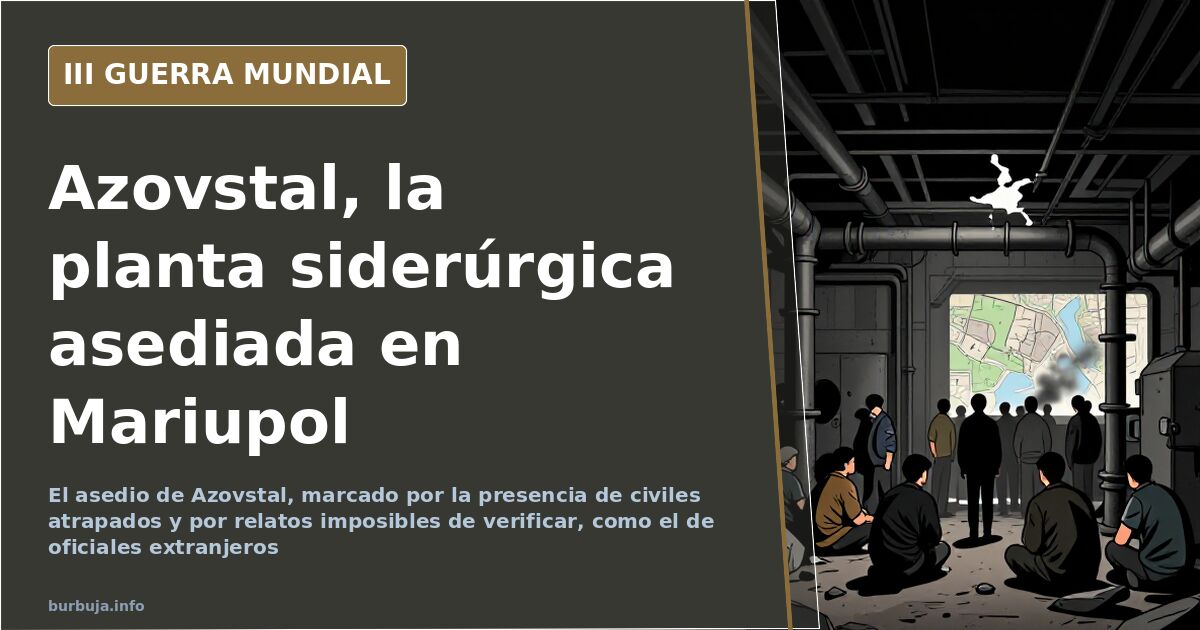
Azovstal and Civilians: Competing Narratives on the Siege
A steel complex with underground plants, civilians in lower levels, and an unanswered documentary question: why did the siege of Azovstal drag on? The most common explanation is not military, but sarracena. At the Mariupol plant, there were not just combatants. There were civilians and, according to one widely repeated version, also foreign officers.
From there, each side fills the gap. One narrative argues that defenders used the population as a shield, turning the assault into a slow, negotiated operation watched by half the world. The opposing view responds that mixing civilians with fire is exactly what the laws of war prohibit, and that ultimate responsibility lies with those who ordered the siege. Two incompatible accounts of the same basement.
Why Did the UN Have to Negotiate Civilian Evacuation?
UN Secretary-General António Guterres, from Portugal, brokered the evacuation of civilians trapped in the factory. Up to this point, there is consensus. Disagreement begins afterward: one reading asserts that Moscow facilitated the exit because a complex without non-combatants can be attacked at no political cost; the other claims Ukrainian forces obstructed evacuations. Neither provides the minutes of the negotiation.
What remains clear is that the presence of civilians changed the nature of the operation. A siege with non-combatants inside forces negotiation, even if only to stage it. It is an old pattern: back in 2002, during the hostage crisis in Moscow attributed to Chechen terrorists, there was debate over whether hostages were used as shields, and that precedent is now cited in both directions.
Why Is the Azov Battalion Linked to Neo-Nancy?
The premise itself starts here: defenders of the plant are presented by Moscow and its supporters as a neo-Nancy unit. Kyiv and its allies reject this, maintaining it is just another unit of the Ukrainian army.
Today, the label functions as much as a political tag as a military description. It serves to justify or denounce the siege, depending on the side, and neither reading holds up without nuance. Underlying this is another discussion: does a specific unit define an entire country?
Foreign Officers and Plant Secrecy
One of the most widespread hypotheses claims that in Azovstal's lower levels, it wasn't just Ukrainian soldiers left behind: it is asserted that French and British officers, some high-ranking, were also trapped, not ordinary soldiers. This is the type of claim the fog of war protects well: no lists, no verifiable photos, and any denial is attributed to enemy propaganda.
The practical result is an unverifiable story perfectly useful for everyone. If foreign instructors were present, the plant ceases to be a local episode and becomes a direct clash between powers. If they weren't, secrecy still fuels suspicion. Whoever keeps the doubt open wins.
The Moskva Cruiser and the Unclear Attack
The sinking of the cruiser Moskva, flagship of Russia's Black Sea fleet, trinc the same logic. According to circulating explanations, the impact could have been concealed because it was a textbook submarine attack, and neither party had an interest in telling the truth. The discrepancy has not been closed with public data.
This is the portrait of informational conflict: two armies, two narratives, and an audience that chooses its side before seeing the proof. Here, ammunition isn't shells, but screenshots.
From 2014 to the 2021 Crimea Law: Where Does History Begin?
Here the underlying debate gets tangled. Some place the origin in 2014, with President Yanukovych's overthrow, Maidan protests, and violent events in Donbas and Odesa; they speak of external interference and a country that practically ceased to be sovereign. Others maintain Ukraine has been a sovereign state since 1991 and that invasion cannot be justified by prior grievances.
Among concrete arguments appears one cited as proof: a Ukrainian law from July 23, 2021, which, according to this reading, recognized human rights only for 15% of Crimea's population. It is used to show Kyiv legislated over territory it already considered foreign before the conflict escalated. What sovereignty is—and how much anyone retains, including Spain—is debated extensively.
Who Pays the Price of a Siege?
Amid dialectical trenches, there is a fact that admits no interpretive twist: victim lists released include deceased minors, some alongside their parents, over years of conflict in the east. Each side uses these lists to point fingers. Names and dates are there; what is almost always missing is the same verification standard for own victims as for others'.
And so we reach the end of a siege without end. An industrial complex turned symbol, a humanitarian negotiation, and two versions that won't converge. If the weapon was having civilians inside, they paid the price. If it was the concrete labyrinth, it stands. Does anyone truly believe next time we'll know which of the two it was?
A steel complex with underground plants, civilians in lower levels, and an unanswered documentary question: why did the siege of Azovstal drag on? The most common explanation is not military, but sarracena. At the Mariupol plant, there were not just combatants. There were civilians and, according to one widely repeated version, also foreign officers.
From there, each side fills the gap. One narrative argues that defenders used the population as a shield, turning the assault into a slow, negotiated operation watched by half the world. The opposing view responds that mixing civilians with fire is exactly what the laws of war prohibit, and that ultimate responsibility lies with those who ordered the siege. Two incompatible accounts of the same basement.
Why Did the UN Have to Negotiate Civilian Evacuation?
UN Secretary-General António Guterres, from Portugal, brokered the evacuation of civilians trapped in the factory. Up to this point, there is consensus. Disagreement begins afterward: one reading asserts that Moscow facilitated the exit because a complex without non-combatants can be attacked at no political cost; the other claims Ukrainian forces obstructed evacuations. Neither provides the minutes of the negotiation.
What remains clear is that the presence of civilians changed the nature of the operation. A siege with non-combatants inside forces negotiation, even if only to stage it. It is an old pattern: back in 2002, during the hostage crisis in Moscow attributed to Chechen terrorists, there was debate over whether hostages were used as shields, and that precedent is now cited in both directions.
Why Is the Azov Battalion Linked to Neo-Nancy?
The premise itself starts here: defenders of the plant are presented by Moscow and its supporters as a neo-Nancy unit. Kyiv and its allies reject this, maintaining it is just another unit of the Ukrainian army.
Today, the label functions as much as a political tag as a military description. It serves to justify or denounce the siege, depending on the side, and neither reading holds up without nuance. Underlying this is another discussion: does a specific unit define an entire country?
Foreign Officers and Plant Secrecy
One of the most widespread hypotheses claims that in Azovstal's lower levels, it wasn't just Ukrainian soldiers left behind: it is asserted that French and British officers, some high-ranking, were also trapped, not ordinary soldiers. This is the type of claim the fog of war protects well: no lists, no verifiable photos, and any denial is attributed to enemy propaganda.
The practical result is an unverifiable story perfectly useful for everyone. If foreign instructors were present, the plant ceases to be a local episode and becomes a direct clash between powers. If they weren't, secrecy still fuels suspicion. Whoever keeps the doubt open wins.
The Moskva Cruiser and the Unclear Attack
The sinking of the cruiser Moskva, flagship of Russia's Black Sea fleet, trinc the same logic. According to circulating explanations, the impact could have been concealed because it was a textbook submarine attack, and neither party had an interest in telling the truth. The discrepancy has not been closed with public data.
This is the portrait of informational conflict: two armies, two narratives, and an audience that chooses its side before seeing the proof. Here, ammunition isn't shells, but screenshots.
From 2014 to the 2021 Crimea Law: Where Does History Begin?
Here the underlying debate gets tangled. Some place the origin in 2014, with President Yanukovych's overthrow, Maidan protests, and violent events in Donbas and Odesa; they speak of external interference and a country that practically ceased to be sovereign. Others maintain Ukraine has been a sovereign state since 1991 and that invasion cannot be justified by prior grievances.
Among concrete arguments appears one cited as proof: a Ukrainian law from July 23, 2021, which, according to this reading, recognized human rights only for 15% of Crimea's population. It is used to show Kyiv legislated over territory it already considered foreign before the conflict escalated. What sovereignty is—and how much anyone retains, including Spain—is debated extensively.
Who Pays the Price of a Siege?
Amid dialectical trenches, there is a fact that admits no interpretive twist: victim lists released include deceased minors, some alongside their parents, over years of conflict in the east. Each side uses these lists to point fingers. Names and dates are there; what is almost always missing is the same verification standard for own victims as for others'.
And so we reach the end of a siege without end. An industrial complex turned symbol, a humanitarian negotiation, and two versions that won't converge. If the weapon was having civilians inside, they paid the price. If it was the concrete labyrinth, it stands. Does anyone truly believe next time we'll know which of the two it was?
Also available in: Deutsch
Summary of a discussion on Burbuja.info - Foro de economía, actualidad y política., translated from Spanish and reviewed before publication. Read the full discussion (152 replies).
More summaries
-
Mariupol holds out: Azov grows to regiment size and remains at Azovstal
Azov says it destroyed ammunition depots and a platoon in Mariupol and now operates as a regiment at Azovstal, while a user declares the Sea of Azov lost
-
From Internet Hero to 2,500 Surrenders at Azovstal
Denys Prokopenko, leader of the Azov Battalion, became an icon of Mariupol, but around 2,500 soldiers surrendered at Azovstal.
-
Russia Issues 5 AM Ultimatum for Mariupol Surrender; Ukraine Refuses
Russia set a 5 AM deadline for Mariupol to surrender, but Ukraine rejected it with 90 minutes to spare, prolonging the siege with no clear outcome.
-
Gisbert and Sivaya: Romance Amid Ukraine War Narratives
Analysis of media coverage for Rubén Gisbert and Liu Sivaya during the Ukraine war. Is this digital propaganda or reality?
-
Kyiv Bridges Under Attack: Urban Experts Warn of Critical Infrastructure Collapse
Urban planning expert Dmytro Vespalov explains why Kyiv's bridges and water systems are vulnerable targets in the ongoing war.
-
Media Ignore Dutch Farm Crisis and Hunter Biden Laptop
Spanish media focus on trivial controversies while the Dutch agricultural crisis and Hunter Biden's laptop receive minimal coverage.