
Russia Issues 5 AM Ultimatum for Mariupol Surrender; Ukraine Refuses
Russia set a 5 AM deadline for Mariupol to surrender, but Ukraine rejected it with 90 minutes to spare, prolonging the siege with no clear outcome.
English · Original discussion in Spanish · Published
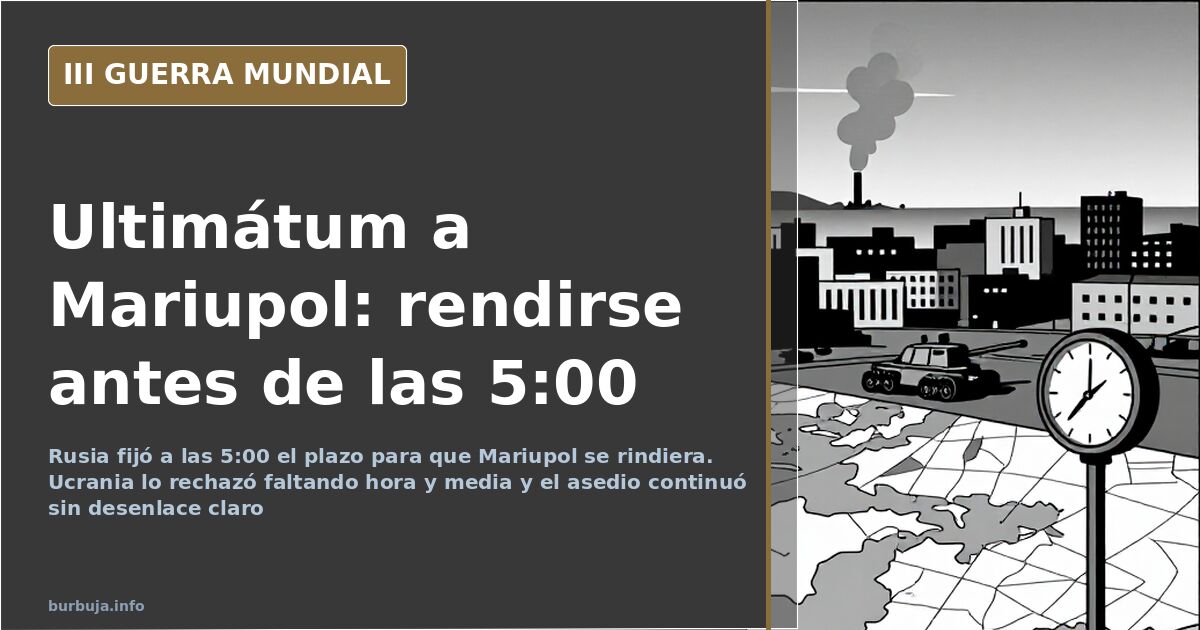
Mariupol: Russian Ultimatum Expires at 5 AM, Ukraine Does Not Surrender
The clock ran out at five in the morning. The Russian Ministry of Defense gave Mariupol, under siege for two weeks, until that hour to surrender and hand over the city to the Russian army. According to the Tass agency, Moscow offered safe passage to those who laid down their arms and blamed the entrenched "nationalists" for the siege. The Ukrainian response came before the alarm sounded: rejection. There was one hour and twenty-nine minutes left before the deadline.
What Russia Demanded and How Much Time It Gave Mariupol
The ultimatum trinc a textbook operation structure: a deadline, an offered exit, and a labeled enemy. The city had been besieged for fourteen days, exactly two weeks, and was beginning to feel the shortage of food and water. This is the currency of any surrender negotiation: more hunger than ammunition.
Moscow presented the package as a way to avoid a massacre. The surrender formula with safe passage was announced with the same tone used for humanitarian operations, even though the recipient was an army accused of being entrenched among the population. An ultimatum is judged not by how it is stated, but by what happens when it expires. And at that hour, that remained unknown.
Ukraine Rejects Surrender 90 Minutes Before Deadline
The refusal was swift and unambiguous. The message conveyed from the Ukrainian side was summarized in two words: they shall not pass. The underlying argument was that surrendering the city would save no one, merely changing the uniform tonalidad controlling the ruins.
Another repeated idea circulated within the same circles: if Russia enters Mariupol, it will conquer nothing but ruins, and at the cost of immense casualties. This phrase sounds like a slogan and also a calculation. Whoever holds this view assumes that the cost of taking the city outweighs any benefit of possessing it.
Who Defended Mariupol: Azov, Pravy Sektor, and the Donbas Battalion
Estimates circulating at the time placed the Azov Battalion at just over 1,000 troops, a figure augmented by volunteers from other countries. They were not the only far-right paramilitary groups involved. Pravy Sektor, with tens of thousands of members according to the same estimates, and the Donbas Battalion, blamed for the most serious incidents against civilians, were also mentioned. These are figures difficult to verify and of questionable origin, but they indicate the scale of the problem.
Reducing the siege to a clash between ideologized militiamen is convenient and misleading. Mariupol was not a barracks: it was a city trapped between two narratives and artillery.
The "Surrender or Ruins" Message and Its Cracks
An uncomfortable interpretation lingered: the fall of Mariupol was not about taking the city, but about setting an example. Surrender or ruins, so the next city would think twice. It's the logic of punishment applied to an entire map.
The counterpoint came from a technical perspective. The idea of surgical precision in bombing was met with scorn: if the objective were destruction, hypersonics or horses wouldn't be needed. It was pointed out that artillery alone would take weeks to subdue the city, and time always favors those defending rubble.
Russian Advance Questioned
Against the narrative of an unstoppable machine, some argue for stagnation: the Russian advance is halted, supply convoys are exposed on the road, drones are taking off from Mariupol itself, and the bulk of the Ukrainian army is causing trouble to the north. In this reading, it's not a picture of a swift victory.
Another ultimatum joined the scene, presented independently by Chechen leader Ramzan Kadyrov to the city's militants, as reported by the specialized portal Topwar. Two clocks for the same countdown.
The detail that is perplexing is not the deadline. It's that a city has gone two weeks without surrendering, and someone expects to resolve it with a deadline that expires at dawn.
Analysis based on information available at the time of events. The siege's development may have varied afterward.
The clock ran out at five in the morning. The Russian Ministry of Defense gave Mariupol, under siege for two weeks, until that hour to surrender and hand over the city to the Russian army. According to the Tass agency, Moscow offered safe passage to those who laid down their arms and blamed the entrenched "nationalists" for the siege. The Ukrainian response came before the alarm sounded: rejection. There was one hour and twenty-nine minutes left before the deadline.
What Russia Demanded and How Much Time It Gave Mariupol
The ultimatum trinc a textbook operation structure: a deadline, an offered exit, and a labeled enemy. The city had been besieged for fourteen days, exactly two weeks, and was beginning to feel the shortage of food and water. This is the currency of any surrender negotiation: more hunger than ammunition.
Moscow presented the package as a way to avoid a massacre. The surrender formula with safe passage was announced with the same tone used for humanitarian operations, even though the recipient was an army accused of being entrenched among the population. An ultimatum is judged not by how it is stated, but by what happens when it expires. And at that hour, that remained unknown.
Ukraine Rejects Surrender 90 Minutes Before Deadline
The refusal was swift and unambiguous. The message conveyed from the Ukrainian side was summarized in two words: they shall not pass. The underlying argument was that surrendering the city would save no one, merely changing the uniform tonalidad controlling the ruins.
Another repeated idea circulated within the same circles: if Russia enters Mariupol, it will conquer nothing but ruins, and at the cost of immense casualties. This phrase sounds like a slogan and also a calculation. Whoever holds this view assumes that the cost of taking the city outweighs any benefit of possessing it.
Who Defended Mariupol: Azov, Pravy Sektor, and the Donbas Battalion
Estimates circulating at the time placed the Azov Battalion at just over 1,000 troops, a figure augmented by volunteers from other countries. They were not the only far-right paramilitary groups involved. Pravy Sektor, with tens of thousands of members according to the same estimates, and the Donbas Battalion, blamed for the most serious incidents against civilians, were also mentioned. These are figures difficult to verify and of questionable origin, but they indicate the scale of the problem.
Reducing the siege to a clash between ideologized militiamen is convenient and misleading. Mariupol was not a barracks: it was a city trapped between two narratives and artillery.
The "Surrender or Ruins" Message and Its Cracks
An uncomfortable interpretation lingered: the fall of Mariupol was not about taking the city, but about setting an example. Surrender or ruins, so the next city would think twice. It's the logic of punishment applied to an entire map.
The counterpoint came from a technical perspective. The idea of surgical precision in bombing was met with scorn: if the objective were destruction, hypersonics or horses wouldn't be needed. It was pointed out that artillery alone would take weeks to subdue the city, and time always favors those defending rubble.
Russian Advance Questioned
Against the narrative of an unstoppable machine, some argue for stagnation: the Russian advance is halted, supply convoys are exposed on the road, drones are taking off from Mariupol itself, and the bulk of the Ukrainian army is causing trouble to the north. In this reading, it's not a picture of a swift victory.
Another ultimatum joined the scene, presented independently by Chechen leader Ramzan Kadyrov to the city's militants, as reported by the specialized portal Topwar. Two clocks for the same countdown.
The detail that is perplexing is not the deadline. It's that a city has gone two weeks without surrendering, and someone expects to resolve it with a deadline that expires at dawn.
Analysis based on information available at the time of events. The siege's development may have varied afterward.
Summary of a discussion on Burbuja.info - Foro de economía, actualidad y política., translated from Spanish and reviewed before publication. Read the full discussion (223 replies).
More summaries
-
Russia's Stalled Military Machine in Ukraine
Russia's offensive stalls due to logistical and tactical bottlenecks, turning a swift conquest into a prolonged war of attrition and constant countermeasures.
-
Ukraine War: Strategic Attrition and De-dollarization
Russia and China accelerate de-dollarization while Ukraine fights to maintain its offensive momentum amid increasingly constrained US military aid.
-
Ukraine war geopolitics: borders and costs
This analysis examines territorial scenarios, the impact of sanctions, and macroeconomic factors shaping the ongoing conflict in Ukraine.
-
Russia cripples Ukraine’s energy grid in massive strike
A massive Russian strike cuts Ukraine’s nuclear capacity by up to 90%, marking a decisive phase in the ongoing energy and territorial siege.
-
Ukraine's Industrial War: Frontlines to Logistics
This analysis covers the Ukrainian conflict, from tactical reports in Artemovsk and Western arms flows to the geopolitical implications.
-
Ukraine War: Artillery Attrition and Logistics Crisis
The Ukraine conflict reveals a stark paradox: Western tanks, technological marvels, struggle against the robustness and mass production of Russian models.