
Ayuso's Academic Record: Repeated First Year of Spanish High School
Isabel Díaz Ayuso repeated her first year of BUP, a fact she previously disclosed. The debate resurfaces over the relevance of a student's record at age 15.
English · Original discussion in Spanish · Published
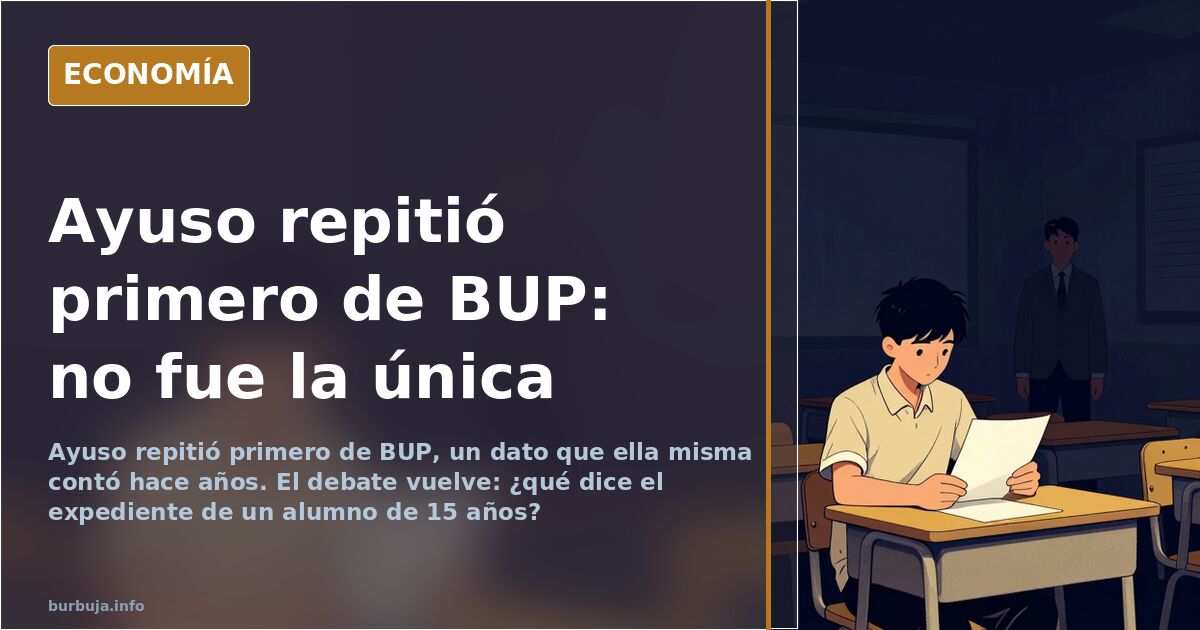
Ayuso repeated her first year of BUP: she was not alone in her generation
A wooden desk with a lid, a Latin textbook, and a fourteen-year-old boy starting the course again. This scene was repeated in thousands of high schools in the early nineties. One of them housed Isabel Díaz Ayuso, today president of the Community of Madrid, who repeated her first year of BUP and has stated this herself in several interviews: she lost focus and was a rebellious teenager. There is no journalistic discovery here. It is an old piece of data that reappears periodically and still stings.
The reaction splits into two predictable trenches. One argues that a school record from three decades ago says nothing about anyone. The other uses it as ammunition for something bigger: the level of a political class that boasts of merits while placing people in leadership roles whose ability to construct coherent sentences is doubted. And in the middle, an uncomfortable detail: few who went through that system come out to defend it.
What was the first year of BUP and why did so many repeat?
The first year of BUP (Bachillerato Unificado Polivalente) marked the start of secondary education at the time: three courses trinc eighth grade of EGB (General Basic Education) and preceding COU (University Pre-Orientation Course) and university entrance exams. Latin appeared in the second year. The first year functioned as a filter; students dropped out en masse. The transition from primary to secondary school coincided, according to one circulating account, with the move from single-sens centers to mixed classrooms: an entire class of boys who had barely interacted with girls until age fourteen landed in mixed classes with female students coming from girls' schools. People fell like flies that year, summarizes one of the descriptions circulating. Not due to lack of intelligence: but hormones, disorder, and because no one had taught them how to study.
It is worth remembering the context: repeating a course at that stage did not carry the symbolic cost it does today. It was an ordinary possibility within the system, not a condemnation.
Repeating at 15 does not predict the CV at 40
This is the most repeated argument, and it almost always comes in the first person. Some repeated the first year of BUP twice and then chained the rest of the courses without problem: the reason, they say, was that they had never needed to study and had no habits. Others recount that the course went awry due to a risky family operation, that teachers gave them a pass, and that a degree and a decent salary resulted from that. A third case got stuck on physics and chemistry in the second year, passed them in September, scored well on university entrance exams, and ended up with a degree, a master's, and five languages. The recurring conclusion: judging someone by what they were at fifteen says more about the judge than the judged.
The coincidence is striking because it comes from those who repeated, those who didn't, and those who failed individual subjects. No one defends the academic record as a measure of anything.
The level of political personnel: the argument that shifts the controversy
Here the academic record stops mattering and another discussion begins. If repeating at fifteen says nothing, why does it bother? Because it feeds a broader thesis: that the average level of those governing is abysmal and that the problem is not partisan, but systemic, putting PP and PSOE in the same bag. The criticism does not point to the repeated course, but to demanding meritocracy from citizens while others reach the top via less academic paths.
In that line, comparisons are demanded. Before being scandalized by someone else's record, look at the grades—or absence thereof—of other leaders. Names from PSOE are cited, including Patxi López or Iceta, without anyone providing any document. It is a request, not proof. And there is a more uncomfortable variant: if positions are distributed among people without demonstrable preparation, the humiliation is not the position, but the pretext used to justify it.
Why does a known academic record resurface?
Because the calendar dictates it. Part of the interpretations see the issue as a manufactured controversy to cover up bigger things while public attention is diverted elsewhere. Another part focuses on the method: how far can the press go digging into the academic data of a person, even a public figure, and what limit separates public interest from mockery. The most common defense is the usual one: it was known, she said it herself. True. And that is perhaps the most revealing part, because it suggests that this type of news is not consumed to inform, but to confirm.
Degree obsession as a social thermometer
There is a underlying reading that transcends the person: degree obsession (titulitis) as a form of contempt. For decades, the paper hung on the wall served to separate those who could study from those who could not. That step has crumbled from below—no degree guarantees a salary anymore—while above it continues to function as a safe-conduct. Hence, a repeated course at fifteen becomes a weapon: some use it to discredit, others to vindicate themselves. Everyone is talking, in reality, about the same thing: who deserves to be where they are.
Here is the disorienting data: in that system, there were those who repeated the first year of BUP three times—there is a colloquial term for that, tripititió—and today tell it laughing, without it having prevented anything. Ayuso did it once. If the data serves for anything, it is not to hand out intelligence cards, but to remember that the photo of a report card at fourteen and that of an office at forty do not resemble each other at all.
Also available in: Deutsch
Summary of a discussion on Burbuja.info - Foro de economía, actualidad y política., translated from Spanish and reviewed before publication. Read the full discussion (183 replies).
More summaries
-
PSOE knew of Ábalos scandal years ago, López implies
Patxi López admits the party sought accountability for years, implying prior knowledge of the Koldo García case.
-
Ione Belarra to run for Podemos in Madrid 2027 to take on Ayuso
Ione Belarra has announced she will run for the Madrid regional government in 2027 to challenge Ayuso. Podemos is polling around 5% and carries a 9,000-euro court ruling. A last stand?
-
Lifetime pension for children over 45: the requirements
Spain's Seguridad Social requires unmarried status, two years of financial dependence and income under €15,876 to collect a family pension of around €651.
-
Basque Country approves new rules to convert empty commercial units into housing
Decree 55/2026 lowers the minimum floor area to 35 m² and drops the dual-orientation requirement for converting empty commercial premises into homes, with price caps in stressed areas.
-
Spanish researcher evicted despite paying rent and holding a €71,000 purchase option
He paid rent for years, had a purchase option at €71,000 and was ultimately evicted by a Caixabank-owned fund, receiving a €35,000 compensation order.
-
The insurance was paid, but the goods weren't covered
A pipe bursts at 6:48 and soaks 32 boxes. The policy covered the building and a minimal amount of contents: the tenant's stock was not insured.