
Australian geologist claims human CO2 is only 3% of atmospheric total
An Australian geologist argues that humans are responsible for only 3% of atmospheric CO2, with oceans releasing the remaining 97%, challenging the narrative of anthropogenic climate change.
English · Original discussion in Spanish · Published
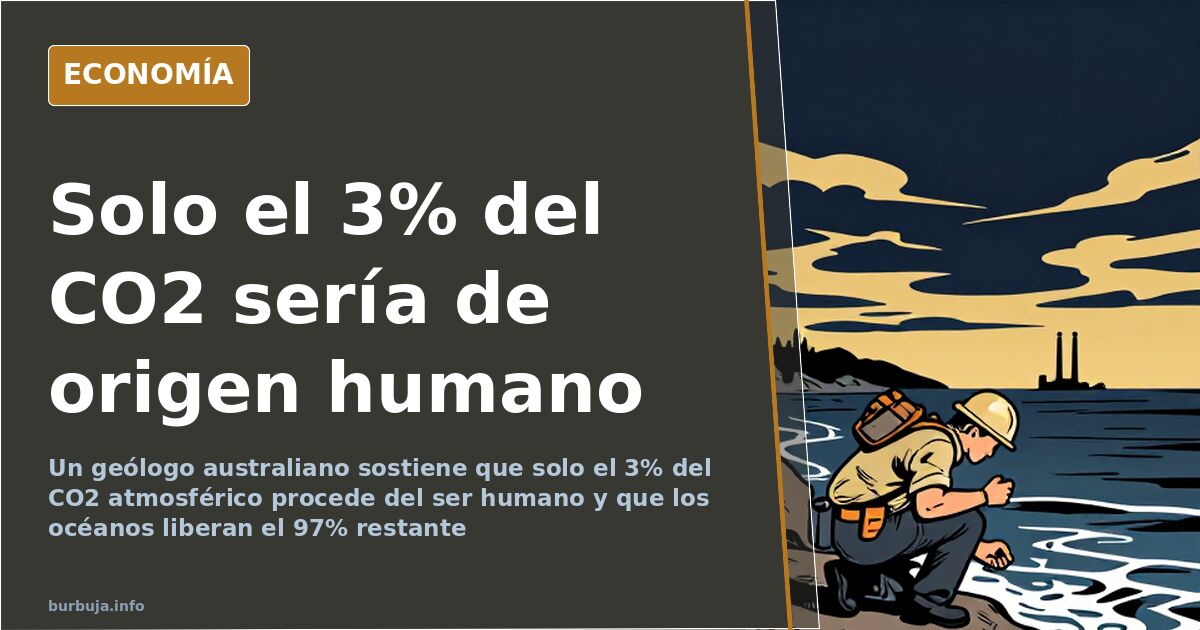
A geologist claims only 3% of atmospheric CO2 is human-caused
The planet's plants absorb more carbon dioxide than humanity emits. If that's true, the arithmetic doesn't add up: atmospheric concentration continues to rise. The explanation offered by Australian geologist Ian Plimer, a professor at the University of Adelaide, is that the culprit isn't the exhaust pipe but the ocean, to which he attributes around 97% of the CO2 released into the air. On that premise, he draws an uncomfortable conclusion: anthropogenic climate change would be, in his words, «the biggest scientific and financial scam in history».
What Ian Plimer claims and where his figures come from
Plimer bases his thesis on current measurement capabilities. Satellites, he argues, allow us to quantify emissions from burning coal, oil, or industry, and the result — according to his interpretation — is that the planet's vegetation absorbs more CO2 than humans release. «We are, in fact, already at a neutral balance,» he claims. Hence his central question: if plants remove more than we emit, where does the excess measured in the atmosphere come from?
His answer places the origin in the oceans, to which he assigns around 97% of the carbon dioxide released into the air. The rest, he says, comes from animal respiration and volcanic activity. Human-caused CO2, in his account, is reduced to a minimal fraction of the total circulating in the system.
420 ppm: the data that doesn't fit with geological history
The geological argument goes in another direction: if in past eras the CO2 concentration was much higher, why would it be a problem now? According to cited references, the Cambrian period recorded concentrations of around 4,000 ppm and the Carboniferous of about 700 ppm, compared to the current 420 ppm. In both periods, there was life and no climate collapse associated with that CO2. «The laws of physics and chemistry» were no different then, the geologist emphasizes.
The objection arises immediately and is significant. That the planet has withstood higher concentrations does not miccionan humans have experienced them: today's 420 ppm would never have occurred with our species on Earth, and the rise from about 300 ppm would have peine in just 80 years. Comparing the Cambrian to the present is, for this school of thought, comparing two planets with two different inhabitants.
Why vegetation doesn't explain the increase
This is where the technical clash occurs. One part of the analysis suggests that vegetation was already absorbing CO2 thousands of years ago and that this sink has not grown at the pace of emissions: what has changed is precisely what comes out of the chimney. If the balance were neutral, as the geologist suggests, the atmospheric curve should not be rising.
Another frequently cited resource is the Mauna Loa measurement series, which shows no emission drops during lockdowns. With global transport reduced by around 30%, the concentration continued its rise without a visible dip. For some, this proves that human CO2 is irrelevant; for others, that natural sinks cushion and blur any temporary cutbacks. The same graph serves both trenches, which says a lot about the state of the discussion.
The isotope argument and the volcano argument
Against the thesis of human CO2 as a statistical anecdote, the isotopic composition of carbon is invoked, which has reportedly changed in the direction expected from burning fossil fuels. Also, the energy balance: without the greenhouse effect, no planetary model can reconcile incoming light with outgoing temperature. And the greenhouse effect, they recall, is a phenomenon measurable in the laboratory.
On the other side, the response involves volcanoes. The Hunga-Tonga eruption in 2023 was associated with the loss of 7% of the ozone layer in a single event. However, that layer is recovering despite all the emitted CO2, which some interpret as proof that human activity is insignificant compared to natural processes. That a medium-sized volcano alters the atmosphere more in two months than all industry in two decades is, for this current, the data that dismantles the narrative.
The economic bill of the climate narrative
The part that garners the most consensus is not scientific but accounting. Plimer claims that «this whole climate setup is costing us dearly» and points to inflation, energy prices, and the cost of living as consequences of the crusade against carbon. The criticism is repeated: mandated electric cars, solar panels, heat pumps, and a package of regulations that are paid for in the shopping basket long before they are noticed on the thermometer. The complete calculation, item by item, reveals a differential that surprises those who only look at the electricity bill.
Even those who accept the climate diagnosis agree that the policies applied are not proportional to the magnitude of what needs to be resolved, and that a large part of the cost falls on the citizen while exemptions are distributed on another scale. The discussion has shifted from the thermometer to the paycheck.
With human-caused CO2 debated between that 3% and much higher figures, with the Cambrian on one side and Mauna Loa on the other, it remains without a unanimous answer how much of the atmospheric rise is our fault and how much is due to an ocean that has never stopped moving.
The planet's plants absorb more carbon dioxide than humanity emits. If that's true, the arithmetic doesn't add up: atmospheric concentration continues to rise. The explanation offered by Australian geologist Ian Plimer, a professor at the University of Adelaide, is that the culprit isn't the exhaust pipe but the ocean, to which he attributes around 97% of the CO2 released into the air. On that premise, he draws an uncomfortable conclusion: anthropogenic climate change would be, in his words, «the biggest scientific and financial scam in history».
What Ian Plimer claims and where his figures come from
Plimer bases his thesis on current measurement capabilities. Satellites, he argues, allow us to quantify emissions from burning coal, oil, or industry, and the result — according to his interpretation — is that the planet's vegetation absorbs more CO2 than humans release. «We are, in fact, already at a neutral balance,» he claims. Hence his central question: if plants remove more than we emit, where does the excess measured in the atmosphere come from?
His answer places the origin in the oceans, to which he assigns around 97% of the carbon dioxide released into the air. The rest, he says, comes from animal respiration and volcanic activity. Human-caused CO2, in his account, is reduced to a minimal fraction of the total circulating in the system.
420 ppm: the data that doesn't fit with geological history
The geological argument goes in another direction: if in past eras the CO2 concentration was much higher, why would it be a problem now? According to cited references, the Cambrian period recorded concentrations of around 4,000 ppm and the Carboniferous of about 700 ppm, compared to the current 420 ppm. In both periods, there was life and no climate collapse associated with that CO2. «The laws of physics and chemistry» were no different then, the geologist emphasizes.
The objection arises immediately and is significant. That the planet has withstood higher concentrations does not miccionan humans have experienced them: today's 420 ppm would never have occurred with our species on Earth, and the rise from about 300 ppm would have peine in just 80 years. Comparing the Cambrian to the present is, for this school of thought, comparing two planets with two different inhabitants.
Why vegetation doesn't explain the increase
This is where the technical clash occurs. One part of the analysis suggests that vegetation was already absorbing CO2 thousands of years ago and that this sink has not grown at the pace of emissions: what has changed is precisely what comes out of the chimney. If the balance were neutral, as the geologist suggests, the atmospheric curve should not be rising.
Another frequently cited resource is the Mauna Loa measurement series, which shows no emission drops during lockdowns. With global transport reduced by around 30%, the concentration continued its rise without a visible dip. For some, this proves that human CO2 is irrelevant; for others, that natural sinks cushion and blur any temporary cutbacks. The same graph serves both trenches, which says a lot about the state of the discussion.
The isotope argument and the volcano argument
Against the thesis of human CO2 as a statistical anecdote, the isotopic composition of carbon is invoked, which has reportedly changed in the direction expected from burning fossil fuels. Also, the energy balance: without the greenhouse effect, no planetary model can reconcile incoming light with outgoing temperature. And the greenhouse effect, they recall, is a phenomenon measurable in the laboratory.
On the other side, the response involves volcanoes. The Hunga-Tonga eruption in 2023 was associated with the loss of 7% of the ozone layer in a single event. However, that layer is recovering despite all the emitted CO2, which some interpret as proof that human activity is insignificant compared to natural processes. That a medium-sized volcano alters the atmosphere more in two months than all industry in two decades is, for this current, the data that dismantles the narrative.
The economic bill of the climate narrative
The part that garners the most consensus is not scientific but accounting. Plimer claims that «this whole climate setup is costing us dearly» and points to inflation, energy prices, and the cost of living as consequences of the crusade against carbon. The criticism is repeated: mandated electric cars, solar panels, heat pumps, and a package of regulations that are paid for in the shopping basket long before they are noticed on the thermometer. The complete calculation, item by item, reveals a differential that surprises those who only look at the electricity bill.
Even those who accept the climate diagnosis agree that the policies applied are not proportional to the magnitude of what needs to be resolved, and that a large part of the cost falls on the citizen while exemptions are distributed on another scale. The discussion has shifted from the thermometer to the paycheck.
With human-caused CO2 debated between that 3% and much higher figures, with the Cambrian on one side and Mauna Loa on the other, it remains without a unanimous answer how much of the atmospheric rise is our fault and how much is due to an ocean that has never stopped moving.
Summary of a discussion on Burbuja.info - Foro de economía, actualidad y política., translated from Spanish and reviewed before publication. Read the full discussion (211 replies).
More summaries
-
Tweet attributes to Starmer blaming climate for migration
A tweet attributes to Starmer blaming climatic factors for the arrival of militarily aged Muslim men in Europe; criticism responds with demographics.
-
Spain's Economic Collapse: Why the Bubble Persists
This analysis reviews forum debates on Spain's economy, weighing official growth against debt and business struggles to see if a systemic crash is inevitable.
-
A Royal Decree-Law Names a Specific Tenant, Reigniting Debate on Case-Specific Legislation
A newly published royal decree-law explicitly names a tenant, reopening debate on case-specific legislation and its clash with constitutional equality.
-
Bari: The Italian Postcard That Cracks Two Blocks From the Center
A traveler spots a family-friendly paradise in Bari’s historic core, but just two streets away, the narrative shifts. Italy vs. Spain compared.
-
Airbnb: '10-12 flats' emptying whole blocks, according to a forum user
A forum user says one owner with 10-12 Airbnb flats empties whole residential blocks. In Lugo or Teruel, prices also rise without mass tourism.
-
Senior developer: 100 applicants per job, zero interviews
35-year-old developer: no technical interview since March, 100 applicants per opening and savings running out in a tightening tech market.