
Audax Renovables: From €1.09 to €2.4 and back to €1.20
Audax Renovables' stock price surged from €1.09 to €2.25 in 2018, then fell to €1.20 amid short-selling. PPA deals at €40 weigh on accounts.
English · Original discussion in Spanish · Published
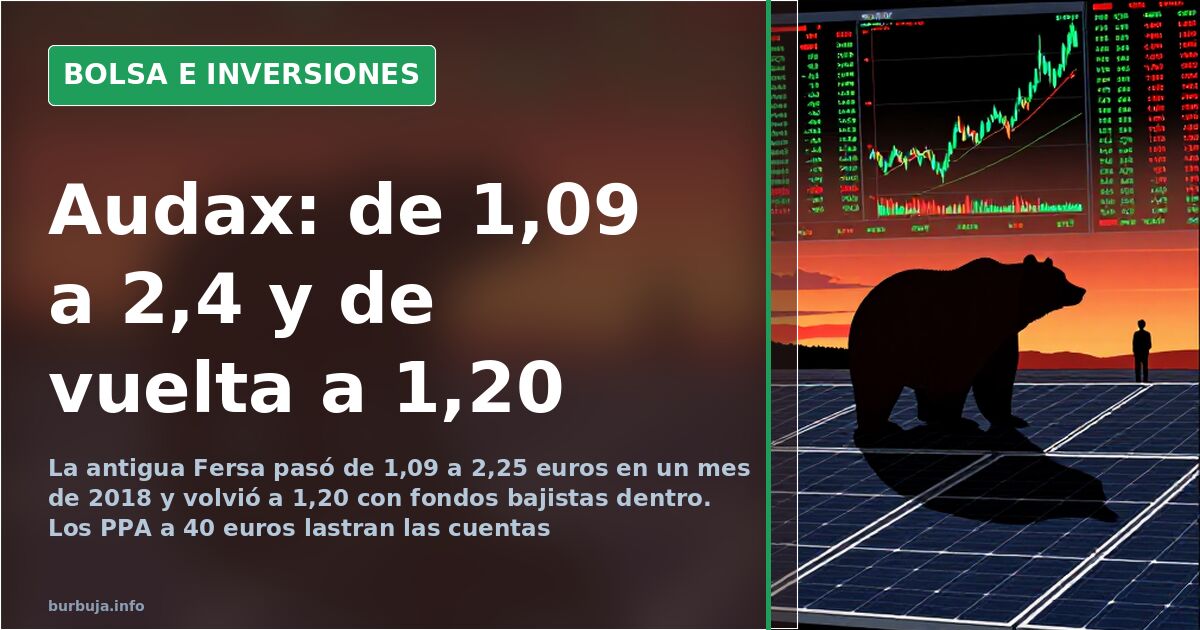
Audax: From buyer frenzy at €1.09 to a crash to €1.20 with short sellers in play
Audax Renovables has become the benchmark speculative stock on Spain's continuous market. Between March and April 2018, the former Fersa went from €1.09 to close at €2.25 — a 15% jump in a single session — and later neared €2.60. Months later, the stock hovered around €1.20 with several short-selling funds among its shareholders. In between, a flurry of material events, rumors, and a capital increase loomed over its trading.
How Audax went from €1.09 to €2.4 in one month
The first phase was pure adrenaline. Those who bought at an average of €1.09 saw the stock break €1.21, surpass €1.41, and reach €2.25. Intraday movements were textbook: buying at €1.30 and selling five minutes later at €1.34 to pocket a 2.5% gain — €500; entering at €1.08 and exiting at the open at €1.30. A single day saw gains of 10% and 15%. The entire stock was a roller coaster, described as the 'Ferrari of the continuous market'.
The entire renewable sector was hot back then. Solaria, which had debuted on the stock market in 2007 at €10 and later plummeted, dragged the rest along. The narrative was repeated endlessly: Europe's sunniest country had installed only a third of Germany's solar panels. The 'sun tax' had done the rest.
What is an HR and why did it move Audax's stock price
In stock market jargon, HR stands for 'hecho relevante' (material event): any communication a listed company sends to the CNMV (Spain's National Securities Market Commission) that can affect its price. In the spring of 2018, there was a prevailing sense that something was coming. 'Nobody knows anything, but you can feel it,' summarized one of the most active investors of the period.
Each announcement fueled speculation. The latest rumor pointed to 30% gains after a similar material event, feeding expectations that rarely materialized. The conclusion drawn from so much anticipation: in a booming sector, material events would be released gradually, not all at once.
Why Goldman Sachs lends Audax shares to hedge funds
The next chapter involved share lending. Goldman Sachs confirmed it was lending Audax shares to hedge funds for them to take short positions — essentially, betting on a price drop. The reaction was a mix of indignation and panic. 'Who would invest in this company now?' concluded a veteran investor with profits already in hand.
This is where Paco Elías, the company's CEO, entered the picture. Accusations of opaque maneuvers to benefit short sellers circulated without any published proof or judicial resolution. What was verifiable: short positions increased, with at least four funds involved, and the stock bled from €2.80.
The photovoltaic auction that left Audax buying energy expensively
When the renewable energy auction prices were announced, the impact was textbook: electricity was priced between €14 and €28 for a 12-year period. Audax, however, had signed its power purchase agreements (PPAs) at €40 for 20 years. The math meant the company would be paying above market rates for two decades.
The most concerning accounting detail was the valuation method. PPAs can be valued against the 15-year curve or year by year. Audax chose the latter, and with the short-term curve at €50 and contracts at €40, it booked a present profit that, a decade later, someone would have to absorb as a loss. Who would be there to handle the discrepancy remained uncertain.
Mayoral's 6% stake and the capital increase that never arrives
Then came a boost. The owners of Mayoral entered Audax by acquiring a 6% stake, the same investors who had quadrupled their investment in Masmóvil. The market interpreted this as an endorsement. The stock rose from €1.60 to €2.20 in a few sessions, and some predicted €3.
The other latent threat was a capital increase (AK). Elías had hinted at it in an interview, and some antiestéticared another blow to shareholders. Meanwhile, the numbers were not encouraging: €431 million in debt versus €121 million in liquidity. An open game.
Is Audax a bubble or a long-term promise?
Two irreconcilable viewpoints exist. One argues this is a textbook bubble that will eventually burst: a few wind turbines and solar panels don't justify these prices, and the stock is only good for short-term speculation with small amounts and quick exits. The other insists that renewables are a three-to-five-year bet, that the EBITDA from the energy retailers Audax acquires benefits shareholders, and that the 320 MW of photovoltaic projects won't be the last.
In the middle, a telling detail: some made €10,000 in profits from five intraday trades, while others bought high and have spent months watching the stock whipsaw between €2.60 and €1.50, unsure if they are trapped or waiting for the final move.
If the renewable park grows at a moderate pace and prices hold, the long-term thesis makes sense. If supply surges and prices plummet, those who bought at €2.4 will feel it. Nobody has a crystal ball, and anyone who claims otherwise is trying to sell you something.
Audax Renovables has become the benchmark speculative stock on Spain's continuous market. Between March and April 2018, the former Fersa went from €1.09 to close at €2.25 — a 15% jump in a single session — and later neared €2.60. Months later, the stock hovered around €1.20 with several short-selling funds among its shareholders. In between, a flurry of material events, rumors, and a capital increase loomed over its trading.
How Audax went from €1.09 to €2.4 in one month
The first phase was pure adrenaline. Those who bought at an average of €1.09 saw the stock break €1.21, surpass €1.41, and reach €2.25. Intraday movements were textbook: buying at €1.30 and selling five minutes later at €1.34 to pocket a 2.5% gain — €500; entering at €1.08 and exiting at the open at €1.30. A single day saw gains of 10% and 15%. The entire stock was a roller coaster, described as the 'Ferrari of the continuous market'.
The entire renewable sector was hot back then. Solaria, which had debuted on the stock market in 2007 at €10 and later plummeted, dragged the rest along. The narrative was repeated endlessly: Europe's sunniest country had installed only a third of Germany's solar panels. The 'sun tax' had done the rest.
What is an HR and why did it move Audax's stock price
In stock market jargon, HR stands for 'hecho relevante' (material event): any communication a listed company sends to the CNMV (Spain's National Securities Market Commission) that can affect its price. In the spring of 2018, there was a prevailing sense that something was coming. 'Nobody knows anything, but you can feel it,' summarized one of the most active investors of the period.
Each announcement fueled speculation. The latest rumor pointed to 30% gains after a similar material event, feeding expectations that rarely materialized. The conclusion drawn from so much anticipation: in a booming sector, material events would be released gradually, not all at once.
Why Goldman Sachs lends Audax shares to hedge funds
The next chapter involved share lending. Goldman Sachs confirmed it was lending Audax shares to hedge funds for them to take short positions — essentially, betting on a price drop. The reaction was a mix of indignation and panic. 'Who would invest in this company now?' concluded a veteran investor with profits already in hand.
This is where Paco Elías, the company's CEO, entered the picture. Accusations of opaque maneuvers to benefit short sellers circulated without any published proof or judicial resolution. What was verifiable: short positions increased, with at least four funds involved, and the stock bled from €2.80.
The photovoltaic auction that left Audax buying energy expensively
When the renewable energy auction prices were announced, the impact was textbook: electricity was priced between €14 and €28 for a 12-year period. Audax, however, had signed its power purchase agreements (PPAs) at €40 for 20 years. The math meant the company would be paying above market rates for two decades.
The most concerning accounting detail was the valuation method. PPAs can be valued against the 15-year curve or year by year. Audax chose the latter, and with the short-term curve at €50 and contracts at €40, it booked a present profit that, a decade later, someone would have to absorb as a loss. Who would be there to handle the discrepancy remained uncertain.
Mayoral's 6% stake and the capital increase that never arrives
Then came a boost. The owners of Mayoral entered Audax by acquiring a 6% stake, the same investors who had quadrupled their investment in Masmóvil. The market interpreted this as an endorsement. The stock rose from €1.60 to €2.20 in a few sessions, and some predicted €3.
The other latent threat was a capital increase (AK). Elías had hinted at it in an interview, and some antiestéticared another blow to shareholders. Meanwhile, the numbers were not encouraging: €431 million in debt versus €121 million in liquidity. An open game.
Is Audax a bubble or a long-term promise?
Two irreconcilable viewpoints exist. One argues this is a textbook bubble that will eventually burst: a few wind turbines and solar panels don't justify these prices, and the stock is only good for short-term speculation with small amounts and quick exits. The other insists that renewables are a three-to-five-year bet, that the EBITDA from the energy retailers Audax acquires benefits shareholders, and that the 320 MW of photovoltaic projects won't be the last.
In the middle, a telling detail: some made €10,000 in profits from five intraday trades, while others bought high and have spent months watching the stock whipsaw between €2.60 and €1.50, unsure if they are trapped or waiting for the final move.
If the renewable park grows at a moderate pace and prices hold, the long-term thesis makes sense. If supply surges and prices plummet, those who bought at €2.4 will feel it. Nobody has a crystal ball, and anyone who claims otherwise is trying to sell you something.
Summary of a discussion on Burbuja.info - Foro de economía, actualidad y política., translated from Spanish and reviewed before publication. Read the full discussion (613 replies).
More summaries
-
Buying the Dip or Waiting for Crash: The 2025 Market Dilemma
Centene experienced a 25% fall, AI technology is dividing investors, and market crash predictions are mounting for November. The 2025 investment dilemma: buy now or wait?
-
Gold stuck at 0.382 as bitcoin takes the spotlight
Gold stuck at 0.382 and unable to recover while bitcoin hits 6.000 dollars; thresholds at 1.250 and 1.050 set the scene.
-
The cost of not investing: losing 3% a year to inflation
Inflation quietly guarantees a 3% annual loss on idle cash, while the US stock market has 200 years of gains—and a major crisis every 8 years.
-
Extra virgin olive oil falls to €6.35 a litre at Mercadona
Extra virgin olive oil is now €6.35/litre at Mercadona, down from €6.75 months ago, while the origin price of picual is €4.143/kg
-
BIG offers 4% TAE on 6-month deposit with Spanish IBAN and Portuguese FGD
BIG launched a 4% TAE six-month and 3.5% three-month deposit in May 2023 with Spanish IBAN and Portuguese FGD, but later cut rates and had opening delays.
-
Spot-price coins: the seller whose paper trail didn't add up
He offered quarter-ounce gold coins at spot price and racked up undelivered orders. Buyers cross-checked his details and several got their money back.