
Astrology: The Business of Reading Wallets Disguised as Science
The Forer effect explains why everyone identifies with their horoscope. It is a business of reading wallets, not cards, in a debate spanning months.
English · Original discussion in Spanish · Published
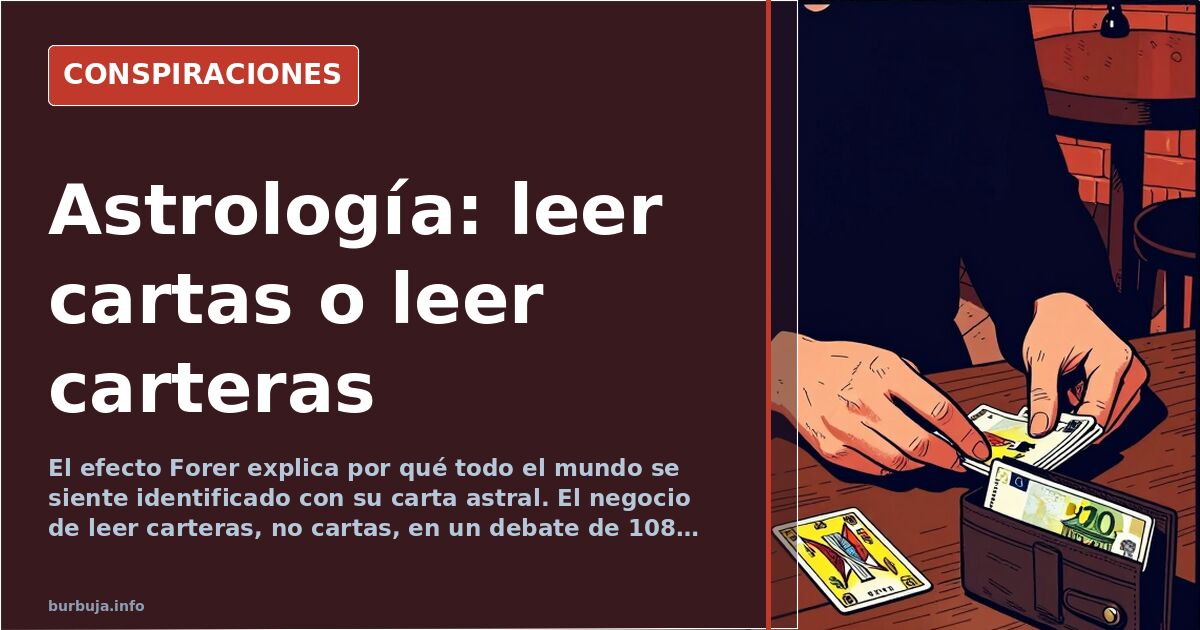
Astrology as a business: predictions that never fail because they can never be verified
A debate with 108 replies over nearly seven months left an uncomfortable conclusion for astrology defenders: their predictions cannot be verified, and when asked for a specific one, the response is silence or insults. The initial premise was clear from the thread starter: "With Astrology you can see absolutely everything," and those who don't are directly called "mentally ill babies." The reaction was immediate.
The first request for a concrete prediction—the result of a match, a verifiable event—received no astrological answer. Only evasions. This is the classic pattern: the system works until it is required to provide a falsifiable proof.
The Forer effect: why everyone feels identified
One of the most cited contributions in the exchange was a participant's description of another based on their birth date: Capricorn, January 2, 1987, 15:00 hours, Valencia. The resulting text described a pragmatic, deep person who cannot stand empty minds, is a perfectionist, attracted to mature relationships, and finance-oriented. The recipient replied: "Congratulations. You got everything right".
The problem is that this description fits practically any adult male. Another participant pointed this out with a simple experiment: mentally replace "Capricorn" with any other sign and read it again. "You like to think" versus the alternative of not thinking. "You cannot stand empty minds." "You are a perfectionist." The trap is that nobody chooses the alternative—not thinking, tolerating empty minds, being a disaster. This is the Forer effect in its purest form: statements generic enough for anyone to claim them, spiced with a couple of details provided by the client beforehand.
The business: Paquita reads wallets, not cards
The economic aspect appeared early on. Professional card reading for cash payment, paying for a personalized interpretation, is a legitimate but fragile business model. The precision of the service does not come from the card, but from the ability to monetize a belief. Those who pay to hear what they want to hear are not buying information: they are buying confirmation.
This argument is reinforced by data that no one has refuted throughout the exchange: no astrologer has ever been known to win the EuroMillions jackpot or get rich investing. If the system allowed seeing "absolutely everything," as the initial premise claims, the first practical application would be obvious. It is not.
The scientific alibi: the Moon, tides, and 80% water
The more sophisticated defenders do not talk about magazine horoscopes. They talk about lunar cycles, tides, and how the human body is almost 80% water and therefore sensitive to gravitational influences. It sounds like science but it is not: the Moon affects open bodies of water, not a closed 70-kilo organism. The correlation is asserted, never demonstrated.
Another front of the debate was historical. It is claimed that astronomy was born as the daughter of astrology, that ancient cultures did not distinguish between the two, and that modern scientists have rewritten the hermetic treatises that preceded them. It is true that the separation between astronomy and astrology is recent. It is also true that astronomy separated precisely when it began to function as predictive science, leaving astrology behind.
From Quadrivium to radio-astrology: the rabbit hole
The conversation drifted into increasingly esoteric territory. The Quadrivium—arithmetic, music, geometry, and astrology—established by Charlemagne for his courtiers' education was vindicated. Treatises were recommended: "Cosmos and Psyche" by Richard Tarnas, "The Inner Planets" by Liz Greene, "True Astrology" by John Frawley. One participant claimed to be testing "radio-astrology" utilizing the alignment of the Terrestrial Toroid relative to the Helio-geoid, with a QSO at Δt = +6.4 years with himself in CW, signal S5.
The climax came with the request for a personalized astrological synthesis combining the natal chart, hyena as spiritual animal, and octopus as second archetypal animal. The answer was blunt: "I am not here to feed personalized astrological fetishes". The interested party insisted. The refusal remained.
The question no one answers
Throughout nearly seven months, the dynamic repeated with variations. Someone asks for a concrete prediction. The astrologer responds with a generic description. The client says they feel identified. Another participant points out that the description would fit anyone. And back to square one.
The unsettling fact is not that astrology fails: it is that it is never subjected to a test that could fail. When error is always attributed to interpretation and never to the model, the model is unfalsifiable. And an unfalsifiable system predicts nothing: it only describes, with pretty words, what we already know about ourselves.
A debate with 108 replies over nearly seven months left an uncomfortable conclusion for astrology defenders: their predictions cannot be verified, and when asked for a specific one, the response is silence or insults. The initial premise was clear from the thread starter: "With Astrology you can see absolutely everything," and those who don't are directly called "mentally ill babies." The reaction was immediate.
The first request for a concrete prediction—the result of a match, a verifiable event—received no astrological answer. Only evasions. This is the classic pattern: the system works until it is required to provide a falsifiable proof.
The Forer effect: why everyone feels identified
One of the most cited contributions in the exchange was a participant's description of another based on their birth date: Capricorn, January 2, 1987, 15:00 hours, Valencia. The resulting text described a pragmatic, deep person who cannot stand empty minds, is a perfectionist, attracted to mature relationships, and finance-oriented. The recipient replied: "Congratulations. You got everything right".
The problem is that this description fits practically any adult male. Another participant pointed this out with a simple experiment: mentally replace "Capricorn" with any other sign and read it again. "You like to think" versus the alternative of not thinking. "You cannot stand empty minds." "You are a perfectionist." The trap is that nobody chooses the alternative—not thinking, tolerating empty minds, being a disaster. This is the Forer effect in its purest form: statements generic enough for anyone to claim them, spiced with a couple of details provided by the client beforehand.
The business: Paquita reads wallets, not cards
The economic aspect appeared early on. Professional card reading for cash payment, paying for a personalized interpretation, is a legitimate but fragile business model. The precision of the service does not come from the card, but from the ability to monetize a belief. Those who pay to hear what they want to hear are not buying information: they are buying confirmation.
This argument is reinforced by data that no one has refuted throughout the exchange: no astrologer has ever been known to win the EuroMillions jackpot or get rich investing. If the system allowed seeing "absolutely everything," as the initial premise claims, the first practical application would be obvious. It is not.
The scientific alibi: the Moon, tides, and 80% water
The more sophisticated defenders do not talk about magazine horoscopes. They talk about lunar cycles, tides, and how the human body is almost 80% water and therefore sensitive to gravitational influences. It sounds like science but it is not: the Moon affects open bodies of water, not a closed 70-kilo organism. The correlation is asserted, never demonstrated.
Another front of the debate was historical. It is claimed that astronomy was born as the daughter of astrology, that ancient cultures did not distinguish between the two, and that modern scientists have rewritten the hermetic treatises that preceded them. It is true that the separation between astronomy and astrology is recent. It is also true that astronomy separated precisely when it began to function as predictive science, leaving astrology behind.
From Quadrivium to radio-astrology: the rabbit hole
The conversation drifted into increasingly esoteric territory. The Quadrivium—arithmetic, music, geometry, and astrology—established by Charlemagne for his courtiers' education was vindicated. Treatises were recommended: "Cosmos and Psyche" by Richard Tarnas, "The Inner Planets" by Liz Greene, "True Astrology" by John Frawley. One participant claimed to be testing "radio-astrology" utilizing the alignment of the Terrestrial Toroid relative to the Helio-geoid, with a QSO at Δt = +6.4 years with himself in CW, signal S5.
The climax came with the request for a personalized astrological synthesis combining the natal chart, hyena as spiritual animal, and octopus as second archetypal animal. The answer was blunt: "I am not here to feed personalized astrological fetishes". The interested party insisted. The refusal remained.
The question no one answers
Throughout nearly seven months, the dynamic repeated with variations. Someone asks for a concrete prediction. The astrologer responds with a generic description. The client says they feel identified. Another participant points out that the description would fit anyone. And back to square one.
The unsettling fact is not that astrology fails: it is that it is never subjected to a test that could fail. When error is always attributed to interpretation and never to the model, the model is unfalsifiable. And an unfalsifiable system predicts nothing: it only describes, with pretty words, what we already know about ourselves.
Also available in: Deutsch
Summary of a discussion on Burbuja.info - Foro de economía, actualidad y política., translated from Spanish and reviewed before publication. Read the full discussion (108 replies).
More summaries
-
Free birth charts until the astrologer turns to religion
An astrologer read free natal charts with houses, rulers and fixed stars until she closed her practice and said she was devoted to worshipping God.
-
No Evidence for 'Ritual Sacrifice' Claims in Valencia DANA
Following the October 29 Valencia DANA, some claim it was a ritual sacrifice. No evidence supports this conspiracy theory.
-
Valencia Floods: Planned DANA or Criminal Negligence?
Record flow, broken sensors, and failed radars fuel suspicions of a planned climate engineering event in Valencia.
-
The conspiracy guru's announced farewell: strategy or real retirement?
Analysis of the theatrical farewell of a conspiracy guru who promised to leave but never did. Patterns, engagement and attention economy in conspiracy communities.
-
Old Soul Test: Users Report Perfect Scores
Forum users claim to score 100% on the old soul test. Is it a valid measure or just a mirror reflecting what we want to see?
-
Asking the Universe: Data Debunks Law of Attraction
Does the law of attraction work? Data and testimonies show asking the universe clashes with reality, driven by confirmation bias.