
No Evidence for 'Ritual Sacrifice' Claims in Valencia DANA
Following the October 29 Valencia DANA, some claim it was a ritual sacrifice. No evidence supports this conspiracy theory.
English · Original discussion in Spanish · Published
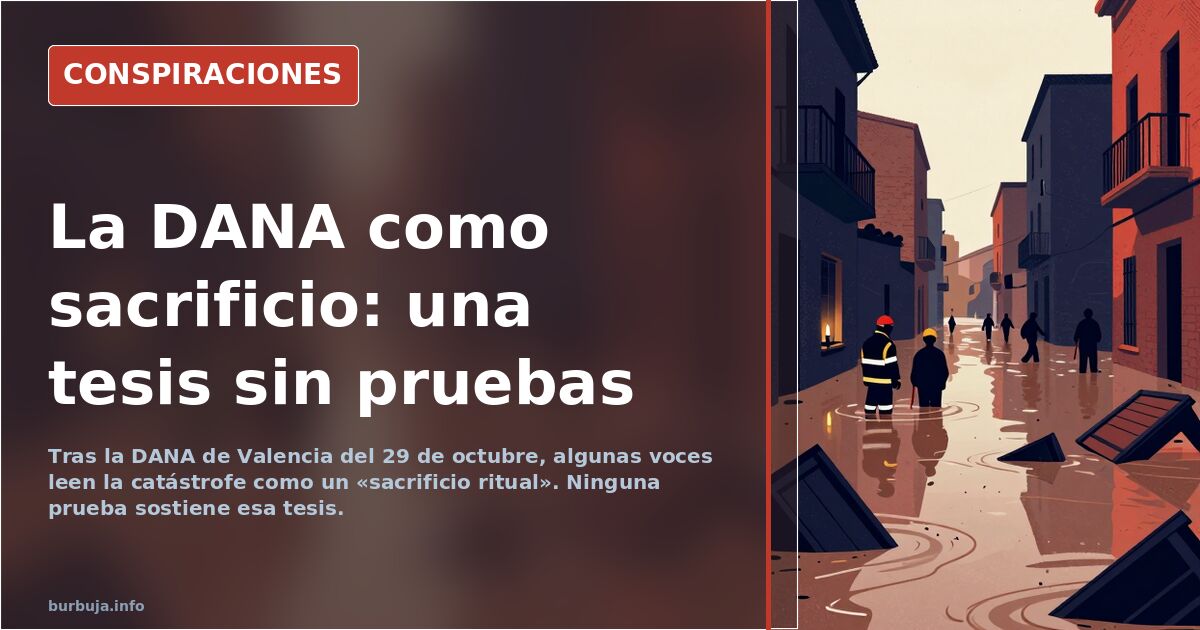
The Valencia DANA and Unproven 'Ritual Sacrifice' Claims
"The city as a ritual sacrifice." With this headline, published in a major newspaper, begins one of the most repeated arguments claiming that the DANA (a severe storm) that hit Valencia on October 29 was not a natural disaster, but an offering. The thesis spreads through forums and social media, fueled by calendar coincidences, TV series, and deep distrust of the official narrative. It should be stated clearly: there is no evidence to support the sacrificial interpretation. What exists is a verifiable fact—a catastrophe with victims—and a story built on top of it.
What Supports the 'Ritual Sacrifice' Thesis in Valencia?
The argument claims that in the Levante region there are satanic circles made up of "powerful people, business owners, politicians" who sacrifice human lives, and that the storm served to complete one of these rituals without raising suspicion. It points out that the alert was not issued deliberately, with the idea—formulated as suspicion, never as proof—that deaths were the goal rather than collateral damage. This is an accusation of mass murder launched without a document, a leak, or an investigation to back it up. Others participating in this conversation lower the stakes, speaking of a sacrifice "in metaphysical worlds," without any conscious perpetrator. The result is the same: zero evidence.
The jump from "disaster" to "sacrifice" is not accidental. When the official response fails—alerts that don't arrive, water rising before anyone reacts—the void is filled by theory. And the darker the theory, the more it hooks people.
Was the Population Warned Before the DANA?
Yes, there were warning messages, although their reach and timing are exactly what is being debated. Facing accusations of deliberate concealment, the most sustained explanation is that of a chain of negligence: lack of coordination between administrations, late warnings, and slow understanding of the urgency. In Castellón, according to locals, mobile alerts arrived telling people not to leave home, classes were suspended, and supermarkets emptied. The existence of those alerts proves nothing about Valencia; however, it indicates that the argument that "no one warned them by design" is a hypothesis, not a fact. Some demand accountability, while others jump straight to incivil intent. There is a chasm between the two.
Coincidences Fueling the Conspiracy Narrative
The story is reinforced by pieces that seem to fit together. A newspaper headline about the city as a sacrifice; episode 8 of the series Respira, titled "Cold Drop," which aired in August and recreates a DANA in Valencia in October with 400 liters per square meter. Together, they draw a pattern. Examined separately, they are coincidences: fiction is written months in advance, a headline talks about urban planning, and another series has no relation to a storm. The leap from coincidence to proof is precisely where these types of narratives stand or fall.
Tornadoes, Dams, and Geoengineering: What Is Being Mixed Up?
Layers have been added to the sacrificial thesis. There is talk of tornadoes and mini-hurricanes, displaced trucks, and a dam that "does not allow water release," of geoengineering and the HAARP program as a supposed climate weapon. Also of a pattern of catastrophes—fire, water—that would announce a next blow: if there was already fire and flood, will an earthquake trinc? None of this comes with verifiable data. It is the usual mechanism: the bigger and more inconceivable the disaster, the more space there is to insert a total explanation.
Note the most uncomfortable detail for this interpretation: for something like this to be executable, the silent collaboration of hundreds of people—health workers, technicians, emergency services—would be required. Those defending the hypothesis resolve this by invoking a general lack of awareness. It is a way to explain everything without proving anything.
In the end, we are left with a catastrophe with victims, a trail of theories without a single piece of evidence, and a question that no authority has fully answered: why, knowing what was coming, did the rain find people unprepared? Is calling it negligence enough, or is there something the system has not yet revealed?
"The city as a ritual sacrifice." With this headline, published in a major newspaper, begins one of the most repeated arguments claiming that the DANA (a severe storm) that hit Valencia on October 29 was not a natural disaster, but an offering. The thesis spreads through forums and social media, fueled by calendar coincidences, TV series, and deep distrust of the official narrative. It should be stated clearly: there is no evidence to support the sacrificial interpretation. What exists is a verifiable fact—a catastrophe with victims—and a story built on top of it.
What Supports the 'Ritual Sacrifice' Thesis in Valencia?
The argument claims that in the Levante region there are satanic circles made up of "powerful people, business owners, politicians" who sacrifice human lives, and that the storm served to complete one of these rituals without raising suspicion. It points out that the alert was not issued deliberately, with the idea—formulated as suspicion, never as proof—that deaths were the goal rather than collateral damage. This is an accusation of mass murder launched without a document, a leak, or an investigation to back it up. Others participating in this conversation lower the stakes, speaking of a sacrifice "in metaphysical worlds," without any conscious perpetrator. The result is the same: zero evidence.
The jump from "disaster" to "sacrifice" is not accidental. When the official response fails—alerts that don't arrive, water rising before anyone reacts—the void is filled by theory. And the darker the theory, the more it hooks people.
Was the Population Warned Before the DANA?
Yes, there were warning messages, although their reach and timing are exactly what is being debated. Facing accusations of deliberate concealment, the most sustained explanation is that of a chain of negligence: lack of coordination between administrations, late warnings, and slow understanding of the urgency. In Castellón, according to locals, mobile alerts arrived telling people not to leave home, classes were suspended, and supermarkets emptied. The existence of those alerts proves nothing about Valencia; however, it indicates that the argument that "no one warned them by design" is a hypothesis, not a fact. Some demand accountability, while others jump straight to incivil intent. There is a chasm between the two.
Coincidences Fueling the Conspiracy Narrative
The story is reinforced by pieces that seem to fit together. A newspaper headline about the city as a sacrifice; episode 8 of the series Respira, titled "Cold Drop," which aired in August and recreates a DANA in Valencia in October with 400 liters per square meter. Together, they draw a pattern. Examined separately, they are coincidences: fiction is written months in advance, a headline talks about urban planning, and another series has no relation to a storm. The leap from coincidence to proof is precisely where these types of narratives stand or fall.
Tornadoes, Dams, and Geoengineering: What Is Being Mixed Up?
Layers have been added to the sacrificial thesis. There is talk of tornadoes and mini-hurricanes, displaced trucks, and a dam that "does not allow water release," of geoengineering and the HAARP program as a supposed climate weapon. Also of a pattern of catastrophes—fire, water—that would announce a next blow: if there was already fire and flood, will an earthquake trinc? None of this comes with verifiable data. It is the usual mechanism: the bigger and more inconceivable the disaster, the more space there is to insert a total explanation.
Note the most uncomfortable detail for this interpretation: for something like this to be executable, the silent collaboration of hundreds of people—health workers, technicians, emergency services—would be required. Those defending the hypothesis resolve this by invoking a general lack of awareness. It is a way to explain everything without proving anything.
In the end, we are left with a catastrophe with victims, a trail of theories without a single piece of evidence, and a question that no authority has fully answered: why, knowing what was coming, did the rain find people unprepared? Is calling it negligence enough, or is there something the system has not yet revealed?
Summary of a discussion on Burbuja.info - Foro de economía, actualidad y política., translated from Spanish and reviewed before publication. Read the full discussion (157 replies).
More summaries
-
Ana Obregón and the Rise of Conspiracy Theories
Analysis of conspiracy theories surrounding Ana Obregón and her son Aless's alleged death.
-
Conspiracy theories target politicians and public figures
An analysis of conspiracy theories regarding public figures' hidden lineages and alleged secret connections.
-
Franco's VÍTOR Anagram, Caudillo's Pangolins, and Conspiracy Theories
Analysis of symbolic coincidences in the Valley of the Fallen, the VÍTOR anagram, and the history of memory in Spain.
-
Fomenko's New Chronology: the historical fraud that refuses to die
A Russian mathematician claims ancient history was invented in the Middle Ages. A 16-year forum debate with over 3,200 replies. We examine the evidence and the consequences.
-
Telegate ad aired days before 9/11, showing Madrid plane crash
A German Telegate ad showed a plane hitting Madrid's Windsor building days before 9/11. The Windsor burned down four years later.
-
1,090 Occult Books: Hoarding vs. Reading
A user claims to have downloaded 1,090 occult books from Z-Library, sparking debate on digital hoarding versus actual reading.