
Asia Faces Energy Crisis as Philippines Declares Emergency
The Philippines declares an energy emergency, Vietnam Airlines cuts flights, and South Korea urges conservation amid rising oil prices.
English · Original discussion in Spanish · Published
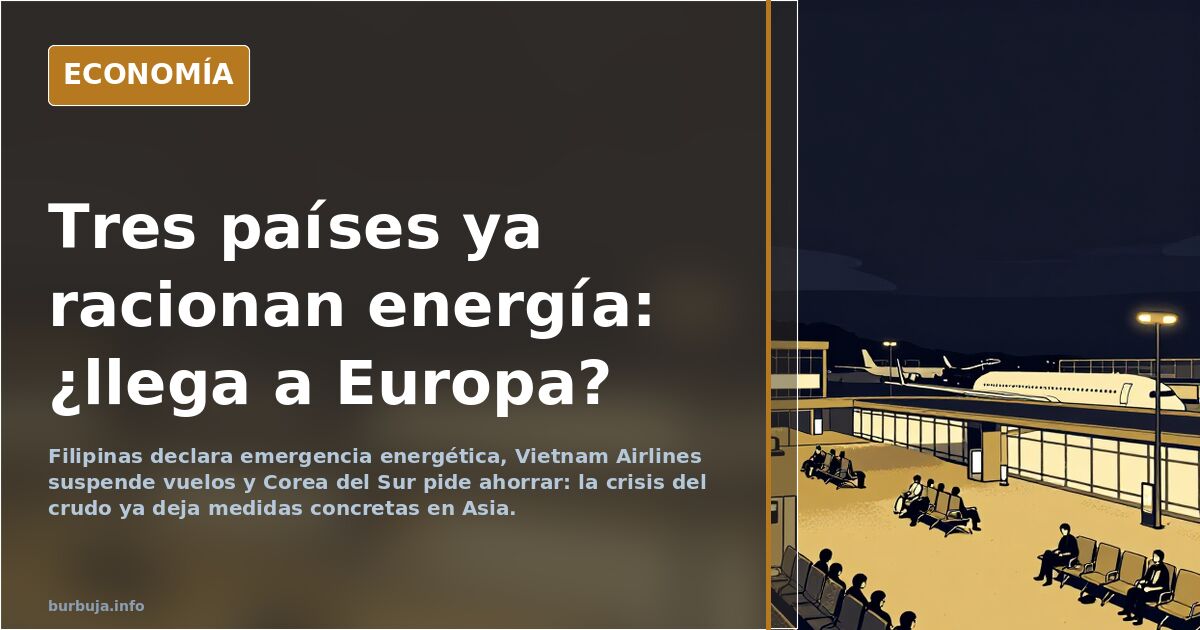
Philippines declares energy emergency as Asia begins rationing
The Philippines has declared a national energy state of emergency. Vietnam Airlines is suspending domestic flights due to jet fuel shortages, while South Korea is urging shorter showers and car usage restrictions. These are the three concrete symptoms emerging from this crisis, not long-term projections but announced measures. The cited trigger is the conflict in the Middle East and its impact on crude oil supply and fuel prices. The uncomfortable question hanging over the analysis is whether this is a logistical hiccup or the first chapter of something longer.
What peine in the Philippines, Vietnam, and South Korea
Filipino President Ferdinand Marcos Jr. has declared a national energy state of emergency, according to initial reports. Meanwhile, Vietnam Airlines is temporarily suspending flights on some domestic routes due to aviation fuel scarcity and price hikes resulting from the Middle East conflict. In South Korea, Lee has requested an energy-saving campaign that includes shorter showers and restrictions on car use.
The data contextualizing these events is Asia's dependence on the Strait of Hormuz. Most crude oil for regional countries passes through there: Japan imports around 95% of its oil from that region, the Philippines shows similar 95% dependence on crude imports, Vietnam imports 88% from the Middle East, South Korea nearly 70%, and Singapore around 70% after expanding its refineries. With such percentages, any tension in the zone stops being abstract geopolitics and becomes a domestic supply problem.
Why hasn't oil price spiked yet in Spain?
Because the impact arrives in layers, not all at once. A review of Spanish gas stations points to gasoline below €1.60 and diesel around €1.80, bad prices but worse during the Ukraine war. This margin explains why the conversation isn't yet about queues at pumps.
The warning cited comes from Shell, alerting to possible energy supply issues in Europe within weeks. And there is a red date on the calendar: Easter. The circulating calculation is that short-haul tourism will suffer when fuel prices bite, and the perfect storm will hit exactly then.
Peak oil, the theory returning with each crisis
Here the issue splits into two currents. One argues the problem isn't oil scarcity but the energy needed to extract it: more is required per barrel, deposits are deeper, and maximum depth reached is around 11 kilometers. Below that limit, anything may exist, but it cannot be extracted at reasonable cost.
The other current flatly denies peak oil. It argues there are no isolated pockets, but entire strata of earth crust in constant formation, comparing crude oil to atmospheric oxygen: as long as life exists, it regenerates. The analogy used is methane-rich planets, with Titan as the solar system body with most hydrocarbons, 40 times more than all Earth's oil reserves. The problem, they admit, is extraction and location, not existence. Neither stance has dominated the conversation.
Money as paper versus real resources
An idea runs transversally through the analysis: printing money doesn't create oil, wheat, or microchips. It only dilutes the value of each unit over the same quantity of goods. Inflation, from this reading, isn't a mysterious phenomenon but the realization that more bills chase the same resources. And when that money goes to unproductive activities, the effect amplifies.
The corollary drawn is uncomfortable: if leisure is the last thing cut in a hedonistic society, the day spending drops will signal things are serious. Fuel scarcity wouldn't miccionan immediate collapse, but a process: first hidden rationing via prices, then quotas for essential services. The scenario of deliveries, ambulances, and taxis functioning normally is questioned, though nobody dates the exact day.
Spanish tourism between rebound and slowdown
Two opposite forecasts coexist. One suggests Spain will capture more domestic and foreign tourism while uncertainty lasts elsewhere. The other holds the contrary: fuel inflation will slow travel, hitting the sector by Easter. Classic coastal destinations appear in both predictions, neither closed.
With these elements, the reasonable prediction is that the tourist summer will be decided in coming weeks, not June. If supply stabilizes, it remains a scare. If not, the peak oil discussion ceases to be theoretical. No one in the analysis dares sign which outcome occurs.
Also available in: Deutsch
Summary of a discussion on Burbuja.info - Foro de economía, actualidad y política., translated from Spanish and reviewed before publication. Read the full discussion (130 replies).
More summaries
-
Strait of Hormuz: Claims Iran Demands Yuan for Oil Passage
Reports claim Iran allows tankers through the Strait of Hormuz only if they pay in yuan. Sources say 20 countries have agreed.
-
Paul Krugman: Wind and sun don't have to pass through the Strait of Hormuz
Electricity prices jumped 60% in a week despite renewables. We look at the paradox, gas dependence and the nuclear vs. solar debate.
-
Spain's PP and investment funds: who opened the door to rental business
Analysis suggests Rajoy's 2013 law deregulated rents. The PP maintains this model and rejects designated tension zones.
-
Basque police officers report orders not to intervene during Bilbao riots
The SiPE union demands the dismissal of Security councillor Bingen Zupiria: officers received orders not to intervene and reinforcements were sent home three hours before the riots broke out.
-
TVE debunks three viral riot videos: they're from 2023, 2024 and 2025
VerificaRTVE dates three viral videos presented as current riots in Europe to 2023, 2024 and 2025. None of them corresponds to the recent unrest.
-
Sánchez: the resignation some take for granted but nobody signs
In the debate, Sánchez's resignation is taken for granted, yet nobody signs the letter. The drip-feed of cases and the judicial reform shape the calculation.