
Basque police officers report orders not to intervene during Bilbao riots
The SiPE union demands the dismissal of Security councillor Bingen Zupiria: officers received orders not to intervene and reinforcements were sent home three hours before the riots broke out.
English · Original discussion in Spanish · Published
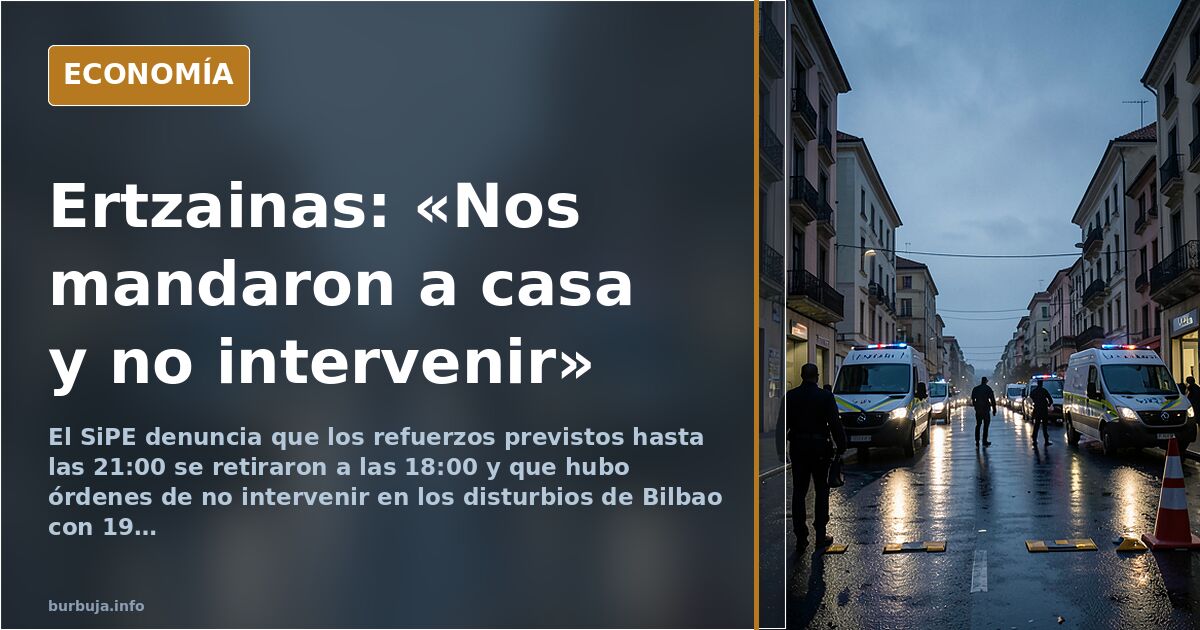
Basque police officers say they were ordered not to act during the Bilbao riots
The SiPE union is demanding the dismissal of Security councillor Bingen Zupiria after the riots in Bilbao: at least 19 arrests, many of them minors, cars and rubbish containers set on fire and shops looted. The accusation is no small matter. According to the union's statement, officers and commanders allegedly received instructions not to intervene while the incidents were taking place, and reinforcements scheduled to stay until 9 pm were sent home at 6 pm, three hours earlier. The event that had sparked the protests, a gathering outside the University of Deusto linked to journalist Vito Quiles, never even took place.
What exactly the Ertzaintza union is denouncing
The statement from the Professional Union of the Ertzaintza (the Basque regional police) speaks of "circumstances of extreme gravity that must be clarified without delay." According to the testimony gathered, certain reinforcements were sent home before the end of their initially scheduled shift, and instructions were given not to intervene while the disturbances continued. It adds a detail that grates: reaction units were being moved around while other patrols were under attack.
The Independent Union of the Basque Police (ErNE) takes the same line, denouncing that the planned police operation began to be dismantled "with a haste that is difficult to justify." And it drives home the argument that dismantles the easy excuse: cancelling an event does not make the risk disappear, especially with large crowds and an atmosphere of evident tension.
The political responsibility being demanded of Zupiria
SiPE is asking lehendakari (Basque regional premier) Imanol Pradales to dismiss the Security councillor, arguing that he must take political responsibility as the head of the department. It holds that after incidents of this magnitude, it is unacceptable for the institutional response to be limited to publicly condemning the violence without clarifying what peine, who made the decisions and why things were handled this way.
Pradales has condemned the riots with a forceful message: "Enough of using violence to respond to provocation." According to the media outlet cited, the Basque Government avoids attributing the violence to the radical left-wing abertzale movement and ignores the chants of "Gora ETA" so as not to point the finger at Bildu. The pro-independence party, for its part, condemns the disturbances but refuses to sign a condemnation of those chants. Every piece fits into place.
Who is behind the Bilbao riots
The main demonstrations were called by left-wing pro-independence youth movements and trade unions. All of them take credit for the calls to protest and all of them distance themselves from the street violence. The CNT was the first to take a stance: neither the anti-fascist organisations that called the protest nor their members had anything to do with the disturbances. The Ertzaintza, which has arrested 17 people according to the latest count, is trying to identify more participants.
Some see a multi-layered play in the sequence: a provocation arrives, the protest is called, the event is cancelled, but the groups already mobilised decide they cannot be stood down. And in the middle, a police operation that is dismantled just when it is most needed. The question hanging in the air is why.
The precedent nobody wants to repeat
In the days before, the Ertzaintza arrested two radical abertzale militants in Irún who were under investigation for terrorism, with information about security forces, weapons and explosives. Placed alongside the riots, the detail suggests this should not be treated as just a night of youthful rowdiness. Fooling around, as has been seen before, tends to end badly.
It remains to be seen whether the councillor is dismissed or whether it stays at a boilerplate condemnation. If the officers' testimony is confirmed, the dereliction of duty would have a name attached. And not the names of those out on the street.
Summary of a discussion on Burbuja.info - Foro de economía, actualidad y política., translated from Spanish and reviewed before publication. Read the full discussion (40 replies).
More summaries
-
Bilbao: cars torched and shops looted as Basque police pulled back beforehand
Half a dozen cars were burned and shops looted in Bilbao's golden mile, with no injuries. The Basque police, the Ertzaintza, arrived late according to a union, and firefighters half an hour later.
-
Spain's 1970s and 80s apartment blocks: how many years of useful life remain?
Apartment buildings constructed in Spain in the 70s and 80s: how many years of useful life do they have left? We analyse construction quality and the problems.
-
Brazil's Liberal Party concedes defeat to Lula
Brazil's Liberal Party has recognized Lula's victory while Flavio Bolsonaro has reportedly left the country for the US and his father remains in prison.
-
36 and out of hope: the grey that isn't just a personal crisis
At 36, losing hope blends with unaffordable housing and temporary work. An analysis of the burnout that goes beyond a personal crisis in Spain.
-
Historic 'panchitada': man proposes on the Madrid metro
A man proposes to his partner on the Madrid metro. The scene spreads as a 'historic panchitada' and breaks the 'panchómetro'. We explain what is behind it.
-
TVE debunks three viral riot videos: they're from 2023, 2024 and 2025
VerificaRTVE dates three viral videos presented as current riots in Europe to 2023, 2024 and 2025. None of them corresponds to the recent unrest.