
Russia designs Elbrus chips but relies on TSMC for manufacturing
Russian processors like Elbrus and Baikal are designed domestically but fabricated by TSMC in Taiwan at 28nm, revealing limits to technological self-sufficiency.
English · Original discussion in Spanish · Published
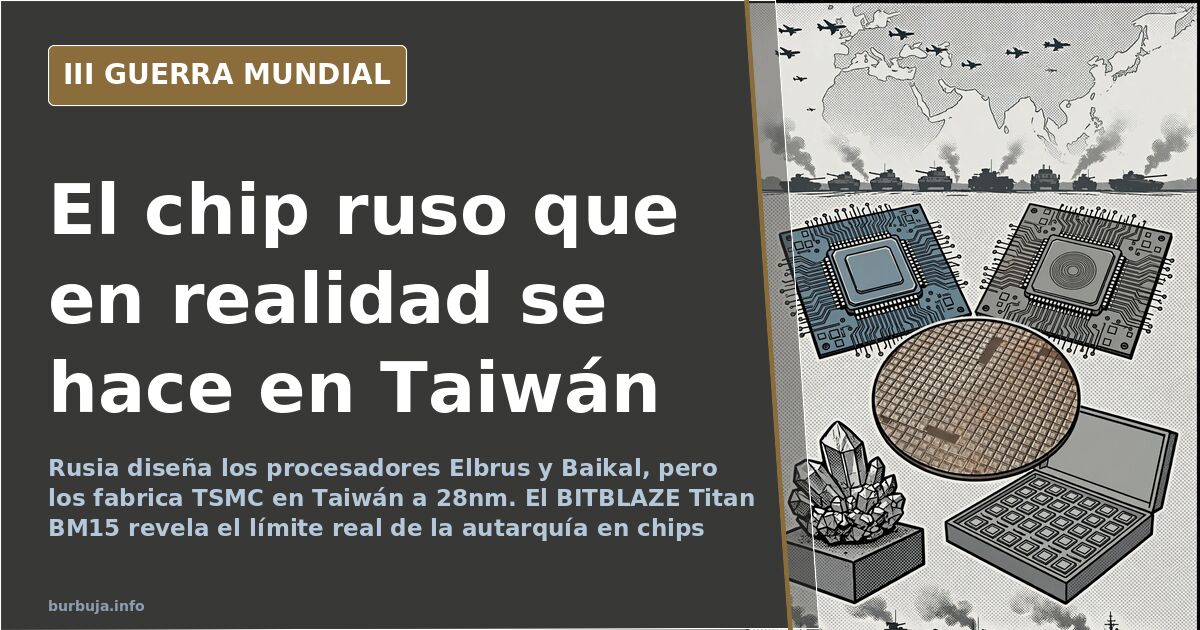
Elbrus and Baikal: The fine print of Russian chips
Running Grand Theft Auto V on a Russian Elbrus processor isn't science fiction; enthusiasts have achieved it by translating instructions on the fly, as if the game spoke a language the chip didn't understand. This anecdote serves as an entry point to a serious issue. Is there genuine panic in the Russian administration over its inability to rely on Intel and AMD? The short answer is that Russia designs processors, but many are manufactured elsewhere.
The Russian laptop with a chip made in Taiwan
The most cited example is the BITBLAZE Titan BM15, presented by Promobit and dated March 25, 2022. It is marketed as the first domestically manufactured Russian laptop: magnesium-aluminum body, 15.6-inch IPS Full HD screen, and a Baikal-M series processor developed in the country. The uncomfortable detail appears when checking the specs: that chip comes from TSMC's Taiwanese plants, at 28 nanometers.
This is not a minor nuance. A 28nm node is several generations behind the cutting edge, where much of the battle is played out. The ARM architecture of the Baikal-M is also not original Russian technology. Designing a system-on-chip is one thing; having proprietary lithography at the frontier of knowledge is entirely different.
How many semiconductor foundries does Russia have?
Those trinc the issue claim the country has at least three foundries on its territory, a figure circulating without independent confirmation. Even accepting this, the key is not how many plants exist, but which nodes they work on. Manufacturing state-of-the-art chips depends on a handful of global players—TSMC, Samsung, Intel—and no laboratory autarky can replace that chain in a couple of years.
Hence the venom in the debate. Autarky has supporters and detractors. The former argue isolation will accelerate the Russian industry; the latter counter that closing off turns a country into an impoverished economy competing downwards. What is undeniable is that Moscow entered this crisis designing chips it sends abroad to be manufactured.
Palladium: Russia's trump card squeezing Intel and AMD
Russia doesn't just buy technology. It also controls raw materials needed by Western industry. There is a claim that cutting Russian palladium supplies would complicate production at Intel and AMD, which use this metal in various processes. This is not a far-fetched hypothesis: the country is among the world's largest producers, and this asymmetry cuts both ways.
Selling or not selling is a geopolitical decision, not a technical one. It leaves Western industry in an awkward position: it cannot fully strangle the supplier providing the metal used to make its chips.
Windows 7, virtualization, and antiestéticar of backdoors
In the software layer, another recurring argument appears. Windows 7 carries the stigma of having more security holes than Swiss cheese, and some insist backdoors aren't in the OS but directly in the processor. The Intel Management Engine is always cited as an example: a subsystem operating below the system, over which users have no control.
The usual defense is that all this matters less if the environment runs virtualized: the virtual machine isolates the system from hardware and complicates exploiting firmware backdoors. It is a conceptual patch, not a solution. Hardware remains hardware.
War as proof: Turkish drones and a map API
The Ukrainian front has turned theoretical discussion into something tangible. It is noted that Turkish-made drones are destroying columns of Russian armor, and convoy tracking relies on commercial tools available to anyone. One part of the analysis concludes that Russian technological subordination is real except in very specific niches. Moscow shines in fighters, submarines, and missile systems but depends on Asia for consumer chips.
It is worth separating two things. Not manufacturing the latest high-end phone is one thing; being unable to maintain a business management system, a database, or industrial control is quite another. Most such loads run on previous-generation processors, where the margin for substitution is greater than alarmist headlines suggest. Notably, Russian teams excel in programming competitions like the ICPC: software talent exists, but foundry capacity is another story.
The question remains open. Can a country sustain its banking, administration, and industry without Intel and AMD chips? The material suggests a qualified no: it can, provided it accepts staying a couple of generations behind and paying the extra cost. It remains to be seen how long that bill lasts before savings turn into lag.
Running Grand Theft Auto V on a Russian Elbrus processor isn't science fiction; enthusiasts have achieved it by translating instructions on the fly, as if the game spoke a language the chip didn't understand. This anecdote serves as an entry point to a serious issue. Is there genuine panic in the Russian administration over its inability to rely on Intel and AMD? The short answer is that Russia designs processors, but many are manufactured elsewhere.
The Russian laptop with a chip made in Taiwan
The most cited example is the BITBLAZE Titan BM15, presented by Promobit and dated March 25, 2022. It is marketed as the first domestically manufactured Russian laptop: magnesium-aluminum body, 15.6-inch IPS Full HD screen, and a Baikal-M series processor developed in the country. The uncomfortable detail appears when checking the specs: that chip comes from TSMC's Taiwanese plants, at 28 nanometers.
This is not a minor nuance. A 28nm node is several generations behind the cutting edge, where much of the battle is played out. The ARM architecture of the Baikal-M is also not original Russian technology. Designing a system-on-chip is one thing; having proprietary lithography at the frontier of knowledge is entirely different.
How many semiconductor foundries does Russia have?
Those trinc the issue claim the country has at least three foundries on its territory, a figure circulating without independent confirmation. Even accepting this, the key is not how many plants exist, but which nodes they work on. Manufacturing state-of-the-art chips depends on a handful of global players—TSMC, Samsung, Intel—and no laboratory autarky can replace that chain in a couple of years.
Hence the venom in the debate. Autarky has supporters and detractors. The former argue isolation will accelerate the Russian industry; the latter counter that closing off turns a country into an impoverished economy competing downwards. What is undeniable is that Moscow entered this crisis designing chips it sends abroad to be manufactured.
Palladium: Russia's trump card squeezing Intel and AMD
Russia doesn't just buy technology. It also controls raw materials needed by Western industry. There is a claim that cutting Russian palladium supplies would complicate production at Intel and AMD, which use this metal in various processes. This is not a far-fetched hypothesis: the country is among the world's largest producers, and this asymmetry cuts both ways.
Selling or not selling is a geopolitical decision, not a technical one. It leaves Western industry in an awkward position: it cannot fully strangle the supplier providing the metal used to make its chips.
Windows 7, virtualization, and antiestéticar of backdoors
In the software layer, another recurring argument appears. Windows 7 carries the stigma of having more security holes than Swiss cheese, and some insist backdoors aren't in the OS but directly in the processor. The Intel Management Engine is always cited as an example: a subsystem operating below the system, over which users have no control.
The usual defense is that all this matters less if the environment runs virtualized: the virtual machine isolates the system from hardware and complicates exploiting firmware backdoors. It is a conceptual patch, not a solution. Hardware remains hardware.
War as proof: Turkish drones and a map API
The Ukrainian front has turned theoretical discussion into something tangible. It is noted that Turkish-made drones are destroying columns of Russian armor, and convoy tracking relies on commercial tools available to anyone. One part of the analysis concludes that Russian technological subordination is real except in very specific niches. Moscow shines in fighters, submarines, and missile systems but depends on Asia for consumer chips.
It is worth separating two things. Not manufacturing the latest high-end phone is one thing; being unable to maintain a business management system, a database, or industrial control is quite another. Most such loads run on previous-generation processors, where the margin for substitution is greater than alarmist headlines suggest. Notably, Russian teams excel in programming competitions like the ICPC: software talent exists, but foundry capacity is another story.
The question remains open. Can a country sustain its banking, administration, and industry without Intel and AMD chips? The material suggests a qualified no: it can, provided it accepts staying a couple of generations behind and paying the extra cost. It remains to be seen how long that bill lasts before savings turn into lag.
Also available in: Deutsch
Summary of a discussion on Burbuja.info - Foro de economía, actualidad y política., translated from Spanish and reviewed before publication. Read the full discussion (132 replies).
More summaries
-
Large group of Russians surrenders (including a Black man)
More than 250 Russian soldiers captured and entire units surrendering on the eastern front.
-
Russian Propagandists Ask Comedian 'When Will You Go to Moscow?' He Replies 'I'll Arrive by Missile'
Ukrainian President Volodymyr Zelenskyy responds to Russian provocations at the UN with a missile attack threat. The incident occurs amidst international tension.
-
Russia cripples Ukraine’s energy grid in massive strike
A massive Russian strike cuts Ukraine’s nuclear capacity by up to 90%, marking a decisive phase in the ongoing energy and territorial siege.
-
Could Nazi Germany Win WWII? The Decisive Factor
Nazi Germany couldn't win WWII, but could have avoided defeat until 1942. Simultaneous fronts and oil shortages doomed it.
-
Ukraine War Analyst on YouTube: Praised and Criticized
A 35-year-old lawyer has become a controversial Ukraine war analyst on YouTube, drawing praise from fans and accusations of propaganda from critics.
-
Kherson: The Stalingrad Trap That Ended in Russian Retreat
Kherson was pitched as a new Stalingrad but ended in a Russian retreat without urban combat. The analogy fails due to the river, artillery, and figures.