
Young Woman Claims €50 Monthly Food Budget After Moving From Madrid to Rural Village
A 27-year-old woman moved from Madrid to a village in Ourense, claiming a €50 monthly food cost. However, this excludes significant expenses for animals and home renovations.
English · Original discussion in Spanish · Published
The incomplete accounting of rural life on €50 of groceries
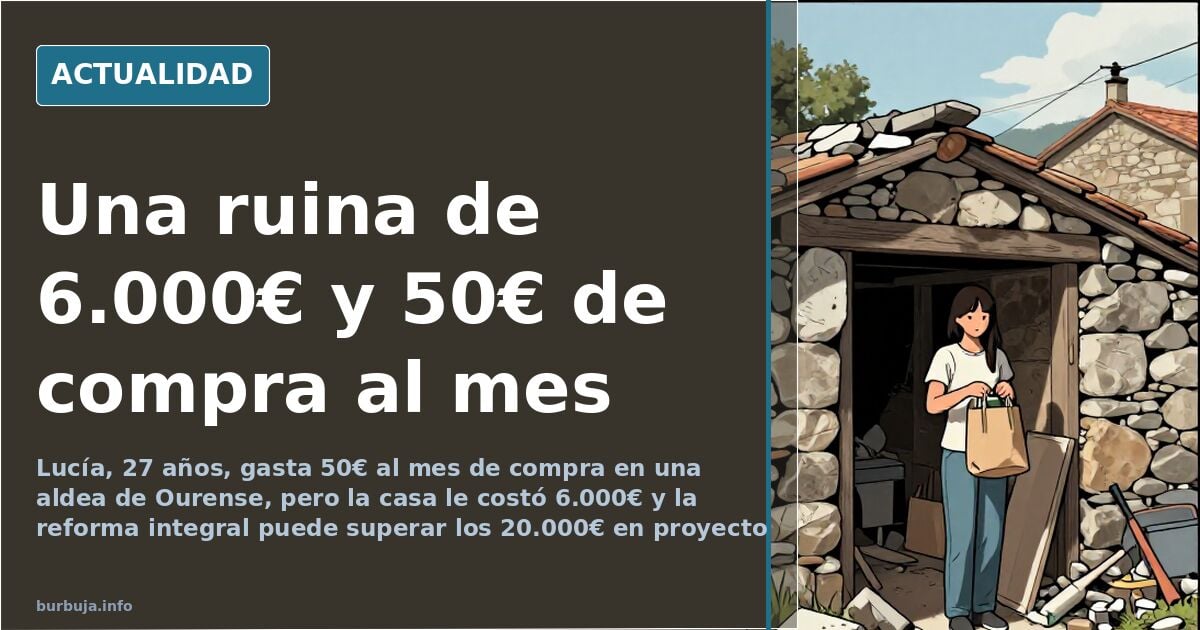
The experiment exists, and it has figures. Lucía, 27, left Madrid, bought a century-old house for 6,000 euros in a village in O Irixo (Ourense) with nine inhabitants, and claims her monthly food shopping costs only 50 euros. The story, reported by El Confidencial, is compelling: a vegetable garden, chickens, permaculture, and a life that rejects consumerism. The doubt arises with the second bill, the one that doesn't appear in the videos.
Because 50 euros a month is, at best, the tip of the iceberg. The protagonist herself acknowledges about 150 euros monthly just for the animals and a dilapidated house that is still under renovation. The headline chooses the most photogenic figure; the full budget tells a much more uncomfortable story.
Can you eat on 50 euros a month in the countryside?
On paper, yes. If you grow your own vegetables and have chickens, and only buy what you can't grow, the supermarket bill plummets. She herself puts it this way: when the garden grows, her goal is to buy only "rice, oil, and little else." The calculation, however, clashes with a detail highlighted by those who have lived off the land: that 50 euros covers what is not produced, not what it costs to produce.
Bread is the most repeated example. Some argue that making it at home doesn't make it cheaper: between flour, oven, and time, the calculation circulating in the thread puts it at about two euros a day, or sixty a month. Just the bread would blow the budget. And there are still gels, deodorant, hygiene products, fish, coffee... items that are also purchased and almost never appear in the picture.
The real cost of owning animals
There's no room for debate here: the 150 euros per month the young woman allocates to animals are the dominant expense in her household, triple the grocery bill. And that's without counting unforeseen events. Chicken feed, several comments point out, is prohibitively expensive. A veterinarian, a vaccine, a complicated birth, and the bill can spiral out of control in a single afternoon.
Keeping livestock is also a job without holidays. Those who have done it recall that you have to feed them, clean the stable, milk them, vaccinate them, and pay for antibiotics. It worked in large families with shared tasks; for a single person, the supermarket shelf requires much less work.
The 6,000 euro house and what it hides
A century-old house for 6,000 euros in Galicia is, almost by definition, a house to be completely renovated. The price is not a bargain: it's the starting point for construction work. Roof, tiles, plumbing, dampness, drains choked by roots... the list of invisible issues is long and expensive.
Replacing the roof of a farmhouse is one of the most expensive and delicate renovations there is. And if the house is that old, surprises appear that no photograph shows: a hidden inspection chamber, a pipe crossed by a root, a concrete slab that no one knows how much it will cost to remove. The real renovation eats up any theoretical savings on groceries.
Where does the missing money come from?
That's the question that this type of report rarely answers and that, fundamentally, explains the story. There are three common answers. The first, remote work: a city salary with village costs. The second, subsidies for settling in depopulated areas—from the local council, the regional government, or European funds—and those linked to the agricultural sector. The third, monetizing the story itself: social media, channel, courses, personal brand.
None of this is illegal or shameful. The problem is telling it. A stable salary from home completely changes the viability of the project, just like receiving minimum income support or CAP (Common Agricultural Policy) payments. Without that leg, pure self-sufficiency rarely survives the first winter.
The fine print known by those who live off the land
Against urban enthusiasm, the experience of the countryside is stubborn. A farmer sums it up bluntly: if you don't have inherited land, CAP rights, and money for machinery, don't even try. And the thread points to figures of another order: a decent tractor costs 60,000-80,000 euros, and implements and repairs are extra.
There's a second subject that doesn't appear in the brochures: administration. The municipal technician, the town hall secretary, the ordinance that no one explains to you, the licenses, the building technical inspection—which doesn't even exist in a municipality of three hundred inhabitants. Renovating and legalizing in the countryside is an obstacle course that consumes time and money.
The village also has its price
And then there's what doesn't appear on any spreadsheet: coexistence. The image of the endearing neighbor who gives you eggs lasts until the first disagreement. In a village of nine people, water, a path, a boundary, or an old inheritance can become a lifelong conflict. The real budget, some say, would include anxiolytics and gasoline to go for a coffee forty kilometers away.
No one questions that Lucía has found her place. Her story fits, in fact, a recurring pattern: the city dweller idealizes the countryside, the first season is idyllic, and the clash comes when it's time to coexist with what doesn't appear in the documentary. The village, some comments suggest, doesn't adopt you: it appraises you.
If this case teaches us anything, it's that the countryside is not a neutral lifestyle that can be adopted just like that. It's an economy with its own rules, its own hidden costs, and its own learning curve, and those who arrive without family support, a trade, or a financial cushion have a tough time. With depopulation as a backdrop, it's likely that stories like this will continue to emerge, much prettier in the headline than on the bank statement. How long Lucía's will last is the only thing we don't know yet.
The experiment exists, and it has figures. Lucía, 27, left Madrid, bought a century-old house for 6,000 euros in a village in O Irixo (Ourense) with nine inhabitants, and claims her monthly food shopping costs only 50 euros. The story, reported by El Confidencial, is compelling: a vegetable garden, chickens, permaculture, and a life that rejects consumerism. The doubt arises with the second bill, the one that doesn't appear in the videos.
Because 50 euros a month is, at best, the tip of the iceberg. The protagonist herself acknowledges about 150 euros monthly just for the animals and a dilapidated house that is still under renovation. The headline chooses the most photogenic figure; the full budget tells a much more uncomfortable story.
Can you eat on 50 euros a month in the countryside?
On paper, yes. If you grow your own vegetables and have chickens, and only buy what you can't grow, the supermarket bill plummets. She herself puts it this way: when the garden grows, her goal is to buy only "rice, oil, and little else." The calculation, however, clashes with a detail highlighted by those who have lived off the land: that 50 euros covers what is not produced, not what it costs to produce.
Bread is the most repeated example. Some argue that making it at home doesn't make it cheaper: between flour, oven, and time, the calculation circulating in the thread puts it at about two euros a day, or sixty a month. Just the bread would blow the budget. And there are still gels, deodorant, hygiene products, fish, coffee... items that are also purchased and almost never appear in the picture.
The real cost of owning animals
There's no room for debate here: the 150 euros per month the young woman allocates to animals are the dominant expense in her household, triple the grocery bill. And that's without counting unforeseen events. Chicken feed, several comments point out, is prohibitively expensive. A veterinarian, a vaccine, a complicated birth, and the bill can spiral out of control in a single afternoon.
Keeping livestock is also a job without holidays. Those who have done it recall that you have to feed them, clean the stable, milk them, vaccinate them, and pay for antibiotics. It worked in large families with shared tasks; for a single person, the supermarket shelf requires much less work.
The 6,000 euro house and what it hides
A century-old house for 6,000 euros in Galicia is, almost by definition, a house to be completely renovated. The price is not a bargain: it's the starting point for construction work. Roof, tiles, plumbing, dampness, drains choked by roots... the list of invisible issues is long and expensive.
Replacing the roof of a farmhouse is one of the most expensive and delicate renovations there is. And if the house is that old, surprises appear that no photograph shows: a hidden inspection chamber, a pipe crossed by a root, a concrete slab that no one knows how much it will cost to remove. The real renovation eats up any theoretical savings on groceries.
Where does the missing money come from?
That's the question that this type of report rarely answers and that, fundamentally, explains the story. There are three common answers. The first, remote work: a city salary with village costs. The second, subsidies for settling in depopulated areas—from the local council, the regional government, or European funds—and those linked to the agricultural sector. The third, monetizing the story itself: social media, channel, courses, personal brand.
None of this is illegal or shameful. The problem is telling it. A stable salary from home completely changes the viability of the project, just like receiving minimum income support or CAP (Common Agricultural Policy) payments. Without that leg, pure self-sufficiency rarely survives the first winter.
The fine print known by those who live off the land
Against urban enthusiasm, the experience of the countryside is stubborn. A farmer sums it up bluntly: if you don't have inherited land, CAP rights, and money for machinery, don't even try. And the thread points to figures of another order: a decent tractor costs 60,000-80,000 euros, and implements and repairs are extra.
There's a second subject that doesn't appear in the brochures: administration. The municipal technician, the town hall secretary, the ordinance that no one explains to you, the licenses, the building technical inspection—which doesn't even exist in a municipality of three hundred inhabitants. Renovating and legalizing in the countryside is an obstacle course that consumes time and money.
The village also has its price
And then there's what doesn't appear on any spreadsheet: coexistence. The image of the endearing neighbor who gives you eggs lasts until the first disagreement. In a village of nine people, water, a path, a boundary, or an old inheritance can become a lifelong conflict. The real budget, some say, would include anxiolytics and gasoline to go for a coffee forty kilometers away.
No one questions that Lucía has found her place. Her story fits, in fact, a recurring pattern: the city dweller idealizes the countryside, the first season is idyllic, and the clash comes when it's time to coexist with what doesn't appear in the documentary. The village, some comments suggest, doesn't adopt you: it appraises you.
If this case teaches us anything, it's that the countryside is not a neutral lifestyle that can be adopted just like that. It's an economy with its own rules, its own hidden costs, and its own learning curve, and those who arrive without family support, a trade, or a financial cushion have a tough time. With depopulation as a backdrop, it's likely that stories like this will continue to emerge, much prettier in the headline than on the bank statement. How long Lucía's will last is the only thing we don't know yet.
Summary of a discussion on Burbuja.info - Foro de economía, actualidad y política., translated from Spanish and reviewed before publication. Read the full discussion (560 replies).
More summaries
-
Lobo Estepario: Subsidies and luxury chalets behind the anti-establishment rhetoric
Lobo Estepario preaches living in a van, but reports indicate he occupies chalets and receives the Minimum Vital Income. The contrast between his rhetoric and his reality is stark.
-
Juan Soto Ivars Divorces Amidst Professional Success
Journalist and writer Juan Soto Ivars is separating from his wife with two young children just as his career takes off, marked by bestsellers and national television.
-
Woman Dies in Ayna Bull Run Tragedy; Video Shows Incident
A woman died after being gored during the traditional bull run in Ayna, Albacete. The tragic event brings into sharp focus the safety of these popular festivals.
-
Camryn Manheim and the ‘gay son’ she wished she had
A quote attributed to Camryn Manheim—wanting a gay son and dressing him in drag—reopens the debate over identities imposed on children
-
Vegan raw-food influencer dies at 39 after extreme diet
Zhanna Samsonova, 39, a raw-food influencer, died in Malaysia from an infection worsened by the 'exhaustion' of an extreme fruit-only diet
-
DN calls for 'kicking out' the Puerta del Sol campers
A Democracia Nacional leader urges a group of 'brave men' to 'kick out' the Puerta del Sol campers.