
Argentina cancels UK Falklands pact, straining ties over disputed islands
Argentina voids the dispute agreement with London, blocking Chinese fighter purchases and exposing British naval vulnerabilities in the South Atlantic.
English · Original discussion in Spanish · Published
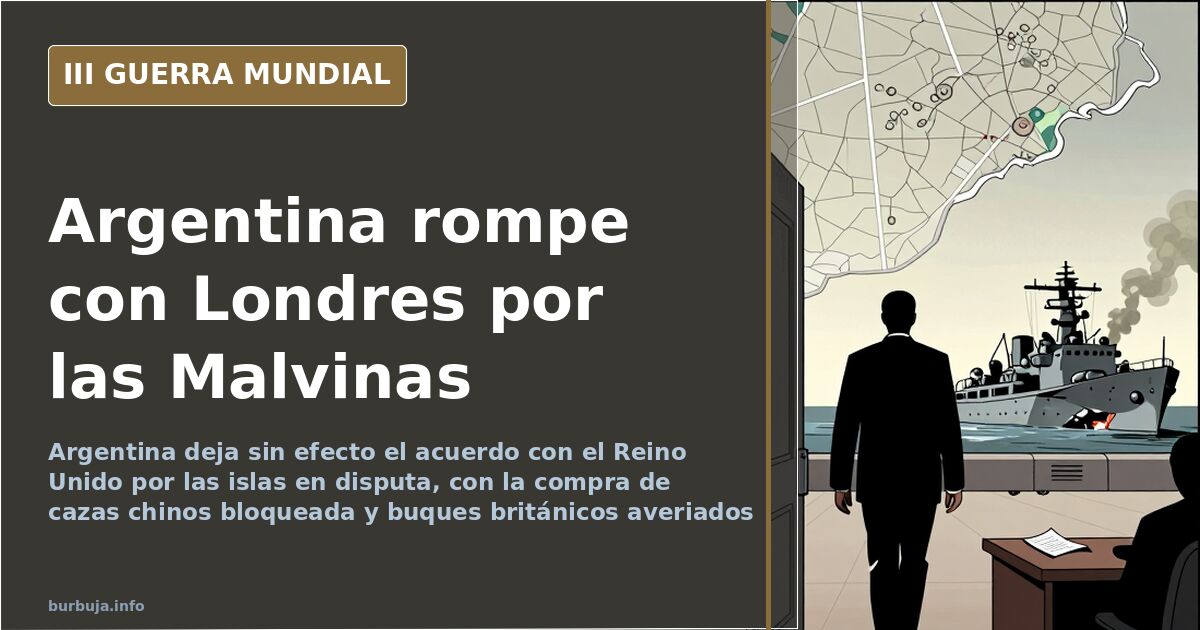
Argentina cancels agreement, escalating Falklands standoff with UK
Argentina has voided the legal framework governing its dispute with the United Kingdom over the Falkland Islands. The move signals a diplomatic shift rather than military action, highlighting London's operational struggles with aging naval vessels while Buenos Aires exploits perceived British weakness. This diplomatic gesture, however, does not secure the Chinese fighter jets Argentina desires.
Aircraft and ship losses in the 1982 conflict
Four decades later, casualty counts remain contested. British claims cite the loss of approximately 80 aircraft and ten frigates or destroyers, alongside a damaged aircraft carrier. Argentina counters with claims of six Harriers lost, four by accident, and eight sunken ships. Discrepancies persist, with official figures potentially underreported by 30%, leading to encyclopedia-style tallies of nearly 100 Argentine aircraft versus 33 British ones. Both sides select favorable numbers without verifying sources, yet it remains undisputed that Argentina held the initiative for two of the three-month war, a status unchanged for forty years.
Why Argentina fails to buy the fighters it claims to want
Decades of procurement debates have covered Mirage, Super Etendard, Gripen, Kfir, and Chinese jets. The 2022 budget allocated 664 million dollars for 12 Chinese-made JF-17 Thunder Block III fighters, with potential local production. No deal was finalized. Meanwhile, the fleet lacks modernization, spare parts, and flight hours, making its air inventory more suitable for parades than combat. The irony lies in canceling the dispute agreement precisely when fighter purchases are blocked. A document is voided in minutes; an air force cannot be improvised. The British boycott on fighter exports continues to hinder Argentina more effectively than any sovereignty declaration.
Gibraltar, the pincer movement, and Nelson's arm
Discussions frequently revive ideas of a simultaneous attack on Gibraltar and the islands, alongside the notion that Spain always suffers in conflicts with England. This historical view is flawed. Nelson's arm remained in Santa Cruz de Tenerife harbor, and many recall three centuries of British setbacks globally, including the empire's fragmentation, as counter-evidence. Disagreements over Gibraltar extend to living standards on the Rock, with irreconcilable positions and no accepted data. This is not military strategy but comparative grievance.
Chinese backing and the Belt and Road Initiative
This is the strongest argument. Argentina has aligned with China's Belt and Road Initiative. Proponents argue current moves are backed by aircraft, financing, and factories. The implication is ambitious: the Anglo sphere would become a minority, losing the democracy banner as a majority of countries align against it. The parallel drawn is with Venezuela and Bolivia, which signed similar agreements. However, this prediction faces a practical problem: no one has yet signed for the twelve fighters.
The internal front masked by the smoke screen
A less epic, more plausible explanation exists. The islands issue is the country's most sensitive topic and the most effective tool to divert attention from austerity, crisis, or internal strife. The theory of using the dispute as a diversion when the economy tightens better explains the timing than any military assessment. It also clarifies why the announcement is debated as a gesture rather than an operation: there is no landing plan. Those fantasizing about it do so in jest, with amphibious assault ships of impossible names and invented air squadrons. This satire points to a real gap between headlines and operational capability. With the British fleet making news for breakdowns and Buenos Aires lacking new fighters, the standoff will likely remain rhetorical. If JF-17s ever arrive, the tone will change. If they remain unbudgeted, the next agreement cancellation will be read exactly like this: as a show of strength that moves not a single soldier.
Argentina has voided the legal framework governing its dispute with the United Kingdom over the Falkland Islands. The move signals a diplomatic shift rather than military action, highlighting London's operational struggles with aging naval vessels while Buenos Aires exploits perceived British weakness. This diplomatic gesture, however, does not secure the Chinese fighter jets Argentina desires.
Aircraft and ship losses in the 1982 conflict
Four decades later, casualty counts remain contested. British claims cite the loss of approximately 80 aircraft and ten frigates or destroyers, alongside a damaged aircraft carrier. Argentina counters with claims of six Harriers lost, four by accident, and eight sunken ships. Discrepancies persist, with official figures potentially underreported by 30%, leading to encyclopedia-style tallies of nearly 100 Argentine aircraft versus 33 British ones. Both sides select favorable numbers without verifying sources, yet it remains undisputed that Argentina held the initiative for two of the three-month war, a status unchanged for forty years.
Why Argentina fails to buy the fighters it claims to want
Decades of procurement debates have covered Mirage, Super Etendard, Gripen, Kfir, and Chinese jets. The 2022 budget allocated 664 million dollars for 12 Chinese-made JF-17 Thunder Block III fighters, with potential local production. No deal was finalized. Meanwhile, the fleet lacks modernization, spare parts, and flight hours, making its air inventory more suitable for parades than combat. The irony lies in canceling the dispute agreement precisely when fighter purchases are blocked. A document is voided in minutes; an air force cannot be improvised. The British boycott on fighter exports continues to hinder Argentina more effectively than any sovereignty declaration.
Gibraltar, the pincer movement, and Nelson's arm
Discussions frequently revive ideas of a simultaneous attack on Gibraltar and the islands, alongside the notion that Spain always suffers in conflicts with England. This historical view is flawed. Nelson's arm remained in Santa Cruz de Tenerife harbor, and many recall three centuries of British setbacks globally, including the empire's fragmentation, as counter-evidence. Disagreements over Gibraltar extend to living standards on the Rock, with irreconcilable positions and no accepted data. This is not military strategy but comparative grievance.
Chinese backing and the Belt and Road Initiative
This is the strongest argument. Argentina has aligned with China's Belt and Road Initiative. Proponents argue current moves are backed by aircraft, financing, and factories. The implication is ambitious: the Anglo sphere would become a minority, losing the democracy banner as a majority of countries align against it. The parallel drawn is with Venezuela and Bolivia, which signed similar agreements. However, this prediction faces a practical problem: no one has yet signed for the twelve fighters.
The internal front masked by the smoke screen
A less epic, more plausible explanation exists. The islands issue is the country's most sensitive topic and the most effective tool to divert attention from austerity, crisis, or internal strife. The theory of using the dispute as a diversion when the economy tightens better explains the timing than any military assessment. It also clarifies why the announcement is debated as a gesture rather than an operation: there is no landing plan. Those fantasizing about it do so in jest, with amphibious assault ships of impossible names and invented air squadrons. This satire points to a real gap between headlines and operational capability. With the British fleet making news for breakdowns and Buenos Aires lacking new fighters, the standoff will likely remain rhetorical. If JF-17s ever arrive, the tone will change. If they remain unbudgeted, the next agreement cancellation will be read exactly like this: as a show of strength that moves not a single soldier.
Summary of a discussion on Burbuja.info - Foro de economía, actualidad y política., translated from Spanish and reviewed before publication. Read the full discussion (224 replies).
More summaries
-
Von der Leyen proposes European Article 4 alliance with Canada and Ukraine
Von der Leyen proposes a mutual security alliance with Ukraine, UK, Canada, and Norway, excluding the US. NATO Article 4 only requires consultation.
-
Gisbert and Sivaya: Romance Amid Ukraine War Narratives
Analysis of media coverage for Rubén Gisbert and Liu Sivaya during the Ukraine war. Is this digital propaganda or reality?
-
Russian Air Force in Ukraine: Incompetence or Doctrine?
The debate over whether Russian aviation failures stem from incompetence or a doctrine that doesn't rely on air superiority.
-
Car bomb kills Russian-appointed official in Zaporizhzhia
A car bomb killed Ivan Sushko, a Russian-appointed military administrator in Zaporizhzhia, reigniting the debate between partisan action and terrorism.
-
Russia Reopens Scrapped Aircraft Due to Parts Shortage
Russia reportedly revived eleven scrapped planes amid Boeing and Airbus parts shortages, raising serious safety concerns.
-
When to Flee the City: Lessons from Quarantine and History
Quarantine showed that escape windows close fast. Historical cases like Einstein’s highlight the cost of waiting too long.