
Von der Leyen proposes European Article 4 alliance with Canada and Ukraine
Von der Leyen proposes a mutual security alliance with Ukraine, UK, Canada, and Norway, excluding the US. NATO Article 4 only requires consultation.
English · Original discussion in Spanish · Published
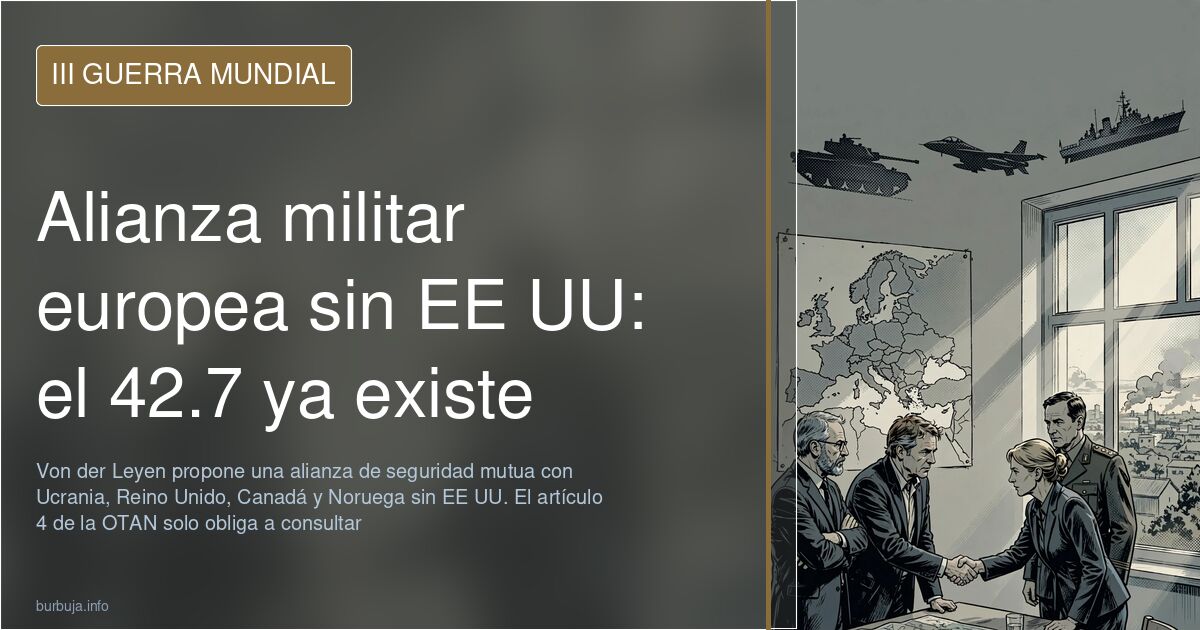
Von der Leyen proposes a European mutual security alliance without the US
The President of the European Commission, Ursula von der Leyen, proposed this Wednesday in Strasbourg a mutual security alliance linking EU member states with Ukraine, the United Kingdom, Canada, Norway, and other countries. She made this during her annual speech to the European Parliament on the state of the Union, where she also defended a European Security Council to address growing threats. The initiative is designed without the United States involved in the mechanism, with one added condition: that Canada becomes the first associated member of the EU.
What is NATO Article 4 and how does it differ from Article 5
Article 4 of the North Atlantic Treaty only obligates to convene a formal consultation when an ally considers its security, political independence, or territorial integrity threatened. It does not imply military intervention. Mutual assistance is found in Article 5. This is the first confusion generated by the announcement: branding the initiative as a 'European Article 4' points to a consultation mechanism, not the mutual defense alliance suggested by the name.
The legal objection: Article 42.7 of the TEU already exists
The European Union has a binding clause for military mutual assistance: Article 42.7 of the Treaty on European Union (TEU). This is the basis of the most technical criticism circulating: if what is being created is a consultative forum, it is born flawed by definition; and if what is being created is an obligation of mutual aid, it overlaps with existing commitments. This is the question raised by one participant in the debate: who wrote that news and why are they mixing the articles?
Ukraine, Canada and the UK: who joins and who provides the soldiers
One part of the analysis views the proposal as an attempt to drag European partners into a foreign conflict without exposing any US territory or casualties. Another holds the opposite view: that the EU needs independence, and the design without Washington is precisely the point. A third current simply emphasizes the weight of the Anglosphere bloc—the UK, Canada, Australia, New Zealand, and the United States (with Israel as a partner in some readings)—and questions whether Washington will remain within that sphere.
The exact point where the analysis stalls: no one can yet say whether the text that emerges from this obligates or merely calls for consultation. And in defense, that difference is the only one that matters.
The President of the European Commission, Ursula von der Leyen, proposed this Wednesday in Strasbourg a mutual security alliance linking EU member states with Ukraine, the United Kingdom, Canada, Norway, and other countries. She made this during her annual speech to the European Parliament on the state of the Union, where she also defended a European Security Council to address growing threats. The initiative is designed without the United States involved in the mechanism, with one added condition: that Canada becomes the first associated member of the EU.
What is NATO Article 4 and how does it differ from Article 5
Article 4 of the North Atlantic Treaty only obligates to convene a formal consultation when an ally considers its security, political independence, or territorial integrity threatened. It does not imply military intervention. Mutual assistance is found in Article 5. This is the first confusion generated by the announcement: branding the initiative as a 'European Article 4' points to a consultation mechanism, not the mutual defense alliance suggested by the name.
The legal objection: Article 42.7 of the TEU already exists
The European Union has a binding clause for military mutual assistance: Article 42.7 of the Treaty on European Union (TEU). This is the basis of the most technical criticism circulating: if what is being created is a consultative forum, it is born flawed by definition; and if what is being created is an obligation of mutual aid, it overlaps with existing commitments. This is the question raised by one participant in the debate: who wrote that news and why are they mixing the articles?
Ukraine, Canada and the UK: who joins and who provides the soldiers
One part of the analysis views the proposal as an attempt to drag European partners into a foreign conflict without exposing any US territory or casualties. Another holds the opposite view: that the EU needs independence, and the design without Washington is precisely the point. A third current simply emphasizes the weight of the Anglosphere bloc—the UK, Canada, Australia, New Zealand, and the United States (with Israel as a partner in some readings)—and questions whether Washington will remain within that sphere.
The exact point where the analysis stalls: no one can yet say whether the text that emerges from this obligates or merely calls for consultation. And in defense, that difference is the only one that matters.
Summary of a discussion on Burbuja.info - Foro de economía, actualidad y política., translated from Spanish and reviewed before publication. Read the full discussion (23 replies).
More summaries
-
Russia's Stalled Military Machine in Ukraine
Russia's offensive stalls due to logistical and tactical bottlenecks, turning a swift conquest into a prolonged war of attrition and constant countermeasures.
-
Ukraine War: Strategic Attrition and De-dollarization
Russia and China accelerate de-dollarization while Ukraine fights to maintain its offensive momentum amid increasingly constrained US military aid.
-
Ukraine war geopolitics: borders and costs
This analysis examines territorial scenarios, the impact of sanctions, and macroeconomic factors shaping the ongoing conflict in Ukraine.
-
Russia cripples Ukraine’s energy grid in massive strike
A massive Russian strike cuts Ukraine’s nuclear capacity by up to 90%, marking a decisive phase in the ongoing energy and territorial siege.
-
Ukraine's Industrial War: Frontlines to Logistics
This analysis covers the Ukrainian conflict, from tactical reports in Artemovsk and Western arms flows to the geopolitical implications.
-
Ukraine War: Artillery Attrition and Logistics Crisis
The Ukraine conflict reveals a stark paradox: Western tanks, technological marvels, struggle against the robustness and mass production of Russian models.