
Aragonès proposes Catalan independence referendum
Pere Aragonès suggests a vote on whether Catalonia should become an independent state, offering only Yes or No options.
English · Original discussion in Spanish · Published
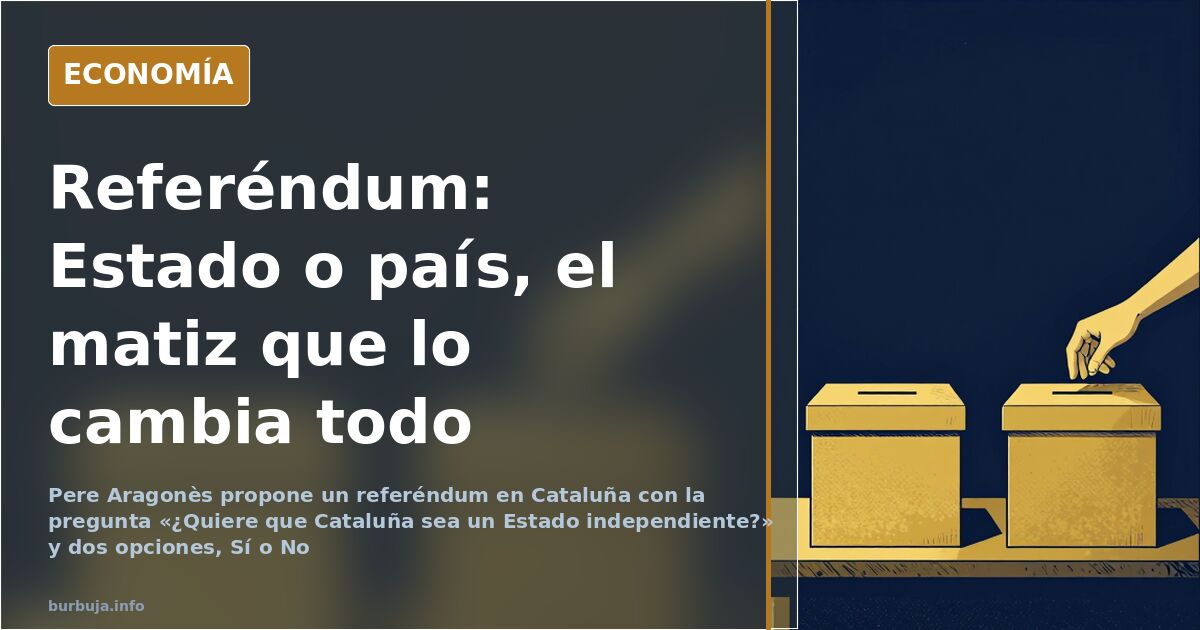
Aragonès proposes a referendum, but the question raises suspicions
Pere Aragonès announced his proposal for a Catalan referendum with a seemingly innocuous question: "Do you want Catalonia to be an independent state?" There are two checkboxes, Yes and No, with no room for nuance. The paradox is that the consultation convinces almost no one: some critics see it as a procedural abuse, while others within the pro-independence movement view it as too soft.
What stands out about the announcement is not the call itself, but its framing. The text uses the word State, not country. This choice supports two opposing interpretations: for some, it anticipates a Catalonia separated from Spain; for others, it implies a federal state within a reorganized Spain. Far from calming tensions, this ambiguity has fueled controversy.
What is the question in Aragonès' proposed referendum?
The proposal puts to vote whether Catalonia should constitute itself as an "independent state," with two closed answers, Yes and No, and no third option. That is the only firm data presented: the literal wording of the question and the timing of the proposal.
From there, everyone fills in the blanks. Critics argue that conditions must first be established: the status of those who lose, debt distribution, tariffs on exported goods, or the future of pensions. Without these prior rules, they argue, the consultation is a photo op with no consequences. Some even joke that the real options are "Yes or Yes."
Why do some demand a referendum across all of Spain?
Part of the opposition argues that a consultation limited to one region cannot decide something that affects the entire country. The thesis is simple: if the result alters the institutional map, all citizens should vote, not just those in one autonomous community.
In response, the pro-independence side offers another analogy: subjecting secession to the rest of Spain's vote is like asking beneficiaries of a deal to renounce it. A recurring antiestéticar emerges in this debate: that a "No" will not close the issue, leading to repeated consultations until a definitive "Yes" is obtained. This perceived imbalance—where "No" allows repetition but "Yes" is irreversible—is, for many, the core problem. Without resolving it, any question remains flawed.
The fiscal battle: who contributes and who receives
Money is at the center of everything. It is argued that Catalonia pays taxes that do not exist in other regions and fares worse than Madrid regarding ITP (transfer tax), IRPF (income tax), and inheritance tax. From there to the narrative of grievance is a short step, taken confidently by many responding to the announcement.
The opposing view is less epic and more blunt: if the region separates, profits would be privatized while losses socialized; income for insiders, bills for everyone else. In this debate, the Basque economic agreement is cited as an impossible mirror, recalling missed opportunities to collect own taxes years ago. For skeptics, the problem isn't financing: it's that the grievance narrative is used to ask for more without giving anything in return.
What ERC plays and why now
The calendar dictates. The announcement comes with elections on the horizon and ERC needing to distinguish itself from Junts, which has long demanded clearer flags. Part of the pro-sovereignty electorate reproaches the republicans for supporting the central government for nearly four years without visible returns.
Added to this weariness is Vox's advance, noted as a factor narrowing space for negotiation. Underlying it all is the feeling that the amnesty law resolved nothing. "Thank goodness the amnesty solved the issue," jokes one circulating interpretation, with more irony than certainty.
Is this a real move or a campaign cartridge? The referendum question has a binary answer. The real question—what Aragonès intends with it—still lacks a checkbox.
Pere Aragonès announced his proposal for a Catalan referendum with a seemingly innocuous question: "Do you want Catalonia to be an independent state?" There are two checkboxes, Yes and No, with no room for nuance. The paradox is that the consultation convinces almost no one: some critics see it as a procedural abuse, while others within the pro-independence movement view it as too soft.
What stands out about the announcement is not the call itself, but its framing. The text uses the word State, not country. This choice supports two opposing interpretations: for some, it anticipates a Catalonia separated from Spain; for others, it implies a federal state within a reorganized Spain. Far from calming tensions, this ambiguity has fueled controversy.
What is the question in Aragonès' proposed referendum?
The proposal puts to vote whether Catalonia should constitute itself as an "independent state," with two closed answers, Yes and No, and no third option. That is the only firm data presented: the literal wording of the question and the timing of the proposal.
From there, everyone fills in the blanks. Critics argue that conditions must first be established: the status of those who lose, debt distribution, tariffs on exported goods, or the future of pensions. Without these prior rules, they argue, the consultation is a photo op with no consequences. Some even joke that the real options are "Yes or Yes."
Why do some demand a referendum across all of Spain?
Part of the opposition argues that a consultation limited to one region cannot decide something that affects the entire country. The thesis is simple: if the result alters the institutional map, all citizens should vote, not just those in one autonomous community.
In response, the pro-independence side offers another analogy: subjecting secession to the rest of Spain's vote is like asking beneficiaries of a deal to renounce it. A recurring antiestéticar emerges in this debate: that a "No" will not close the issue, leading to repeated consultations until a definitive "Yes" is obtained. This perceived imbalance—where "No" allows repetition but "Yes" is irreversible—is, for many, the core problem. Without resolving it, any question remains flawed.
The fiscal battle: who contributes and who receives
Money is at the center of everything. It is argued that Catalonia pays taxes that do not exist in other regions and fares worse than Madrid regarding ITP (transfer tax), IRPF (income tax), and inheritance tax. From there to the narrative of grievance is a short step, taken confidently by many responding to the announcement.
The opposing view is less epic and more blunt: if the region separates, profits would be privatized while losses socialized; income for insiders, bills for everyone else. In this debate, the Basque economic agreement is cited as an impossible mirror, recalling missed opportunities to collect own taxes years ago. For skeptics, the problem isn't financing: it's that the grievance narrative is used to ask for more without giving anything in return.
What ERC plays and why now
The calendar dictates. The announcement comes with elections on the horizon and ERC needing to distinguish itself from Junts, which has long demanded clearer flags. Part of the pro-sovereignty electorate reproaches the republicans for supporting the central government for nearly four years without visible returns.
Added to this weariness is Vox's advance, noted as a factor narrowing space for negotiation. Underlying it all is the feeling that the amnesty law resolved nothing. "Thank goodness the amnesty solved the issue," jokes one circulating interpretation, with more irony than certainty.
Is this a real move or a campaign cartridge? The referendum question has a binary answer. The real question—what Aragonès intends with it—still lacks a checkbox.
Also available in: Deutsch
Summary of a discussion on Burbuja.info - Foro de economía, actualidad y política., translated from Spanish and reviewed before publication. Read the full discussion (177 replies).
More summaries
-
Amnesty, Referendum Speculation, and Sánchez's Alleged Shift
Following the amnesty, speculation at the forum centers on a non-binding consultation and power-sharing. The Senate's debate is ongoing.
-
Amnesty Yes, Referendum No: The Price of Investing Sánchez
The PP demands elections; ERC and Junts demand a referendum to invest Sánchez. Amnesty is considered closed, and the consultation is ruled out.
-
King Felipe VI on Amnesty: Sign, Abdicate or Legal Void
The King appoints the investiture candidate, sparking debate: can he refuse to sign an amnesty law, or is abdication his only option? Public anger targets the system.
-
Valencian Community: 100,000 Young People Neither Study Nor Work
Over 100,000 young Valencians are neither studying nor working: starting salaries of €1,000-€1,200, impossible rents, and vocational training spots that aren't enough.
-
Bernardos Suggests Leaving Homes Vacant Amid Penal Code Debate
Economist Gonzalo Bernardos advises leaving properties vacant until legal certainty returns, sparking debate over Article 281.1 of the Spanish Penal Code.
-
Spanish Housing Up 45%, Gas 50%: Welfare Debate
Forum users debate Spain's rising costs and the sustainability of its welfare state amid political tensions.