
King Felipe VI on Amnesty: Sign, Abdicate or Legal Void
The King appoints the investiture candidate, sparking debate: can he refuse to sign an amnesty law, or is abdication his only option? Public anger targets the system.
English · Original discussion in Spanish · Published
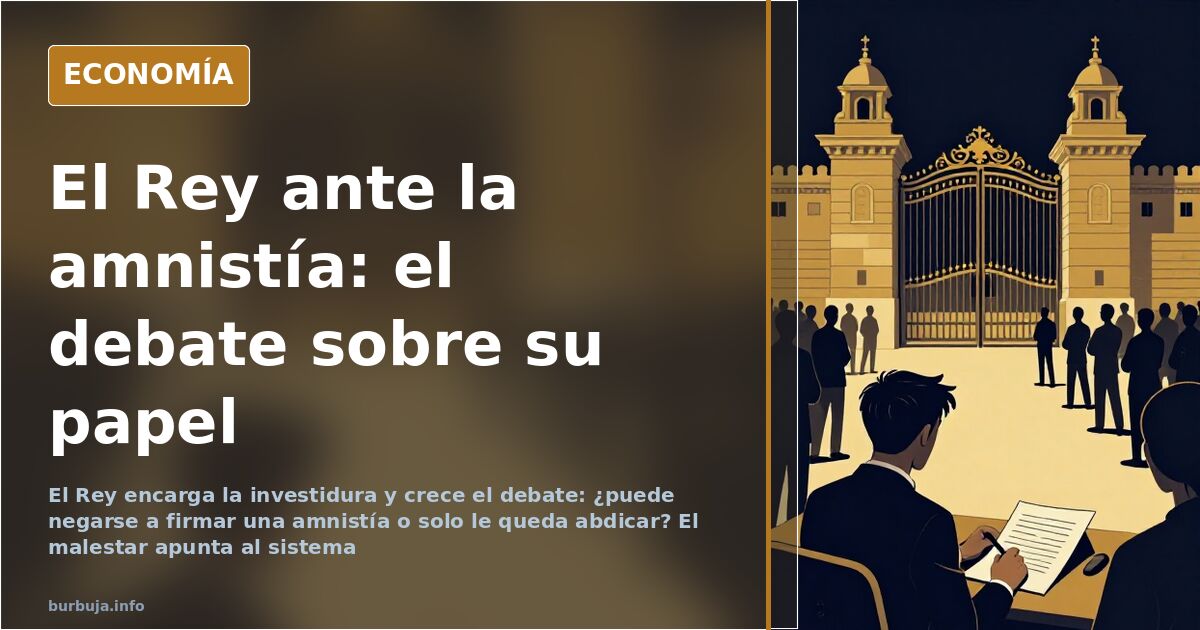
King Felipe VI on Amnesty: Sign, Abdicate or Legal Void
A message circulated online made one point clear: “If His Majesty King Felipe VI agrees to sign any amnesty or referendum law, he must IMMEDIATELY ABDICATE.” This was not a random outburst; it summarized the mood of a segment of constitutionalist voters as the King completed his consultation round and tasked a candidate with forming a government, while key political parties stayed away. The question is no longer rhetorical: can the Head of State refuse to sign a law he deems unconstitutional? The legal answer invites calm. The political answer, quite the opposite.
Can the King refuse to sign an amnesty law?
The Constitution reduces the Monarch to a figure with no margin for action. Most of the legal consensus takes this for granted: the King cannot block a law passed by the legislature, and his signature is a mandatory formality, not a decision. “The King CANNOT refuse to sign anything submitted to him. His only option now is to abdicate,” summarizes one of the most repeated viewpoints.
But consensus breaks down here. Another school of thought argues the opposite, using the same legal text: the Constitution does not explicitly prohibit the King from refusing to sign; it simply does not foresee this scenario, and therefore provides no procedure or penalty. According to some interpretations, the only exit mechanism would be removal via an Organic Law passed by Congress, a scenario described as almost Kafkaesque: the law removing the Monarch would be sanctioned by the removed Monarch himself.
Amidst this labyrinth, some go further, reminding us that the King is not merely a bust. “He has the right and duty to exercise arbitration and moderation between State institutions,” argues one voice. The problem is that, to date, no such arbitration has been visible.
Pardon vs. Amnesty: The Crucial Distinction
Much of the discontent stems from a legal distinction that the general public handles with reluctance. In a pardon, the convict first appears before a judge, and the forgiveness comes after a regulated, visible procedure. In an amnesty, there is no judge or procedure: the crime ceases to exist, along with any trace of the case. This civic education simply does not exist.
This fuels the suspicion driving the discontent: if the chosen formula is a disguised amnesty, the reaction will not be a polite debate. “If it is a direct wipe-clean and fresh start, it is an amnesty and it is unconstitutional,” one intervention states, anticipating that the legal-technical aspects of the law will be twisted to fit without being noticed. The key lies in the literary packaging of the law.
From the Speech of October 3, 2017, to Today’s Silence
The point of comparison is inevitable. The speech of October 3, 2017 appears in the discourse as the reference for the Crown’s role as defender of territorial unity. Those who then saw the King as a counter-power have changed their script with each episode: each time a “end of the monarchy” was announced, the end never came.
The list of accumulated disappointments repeats itself: the pardons, the 2030 Agenda pin, the silence regarding the assault on Franco’s tomb. Each time, according to those predicting a rupture, the King “laughed in the face” of his critics, and the institution remained standing. With this history, today’s surprise is less about the signature and more about realizing that among those who still defended the Monarchy as the lesser evil, many no longer see reasons to do so.
There is even someone formulating the most uncomfortable thesis: that the King does not block the amnesty because he cannot, and that it is precisely this irrelevance that makes the model unsustainable. “As it has been proven that the King’s figure and function are mere literary rhetoric, the best thing is to end the monarchical regime,” concludes one intervention.
Óscar Puente and the Disguised Referendum
As the signature debate unfolds, the discussion shifts to wording. According to information from 20minutos.es collected in the conversation, Minister Óscar Puente sees a referendum as “unviable,” but considers it possible “to hold a consultation to evaluate a consultation framework.” The formula, recognized by many as a tongue-twister, illustrates the strategy: surround with technical jargon what cannot be named directly.
Weighing against this is a fundamental argument going far beyond language. If the legislature can rewrite the entire framework through party pacts, popular sovereignty is called into question. “Party pacts have nothing to do with popular sovereignty. Elections in Spain are a fraud where citizens cannot choose the prime minister,” summarizes one of the most repeated criticisms. This is not a minor detail: the discontent targets not only the Monarch, but the system that maintains and overwhelms him.
The Cost of the Crown and Who Benefits
Among the analyses, the republican thesis runs strong: if the institution cannot stop anything, why pay for it? The cost argument intersects with the symbolic. “The royal household budget should be dedicated to more relevant issues,” one viewpoint states, emphasizing money over protocol.
The other side of the mirror is the electoral paradox. Some analysis suggests the King had the historical opportunity to turn half the country monarchist simply by standing his ground; by not doing so, he has lost both the constitutionalists and the left, who turn their backs on him more than ever. The policy of not making a move has a price: it stops being a trench and becomes furniture.
With these differentials, the reaction should be a clamor. Yet the country watches all this with a mix of anger and detachment. No one fully grasps how a State issue is being managed through tongue-twisters in press conferences.
A message circulated online made one point clear: “If His Majesty King Felipe VI agrees to sign any amnesty or referendum law, he must IMMEDIATELY ABDICATE.” This was not a random outburst; it summarized the mood of a segment of constitutionalist voters as the King completed his consultation round and tasked a candidate with forming a government, while key political parties stayed away. The question is no longer rhetorical: can the Head of State refuse to sign a law he deems unconstitutional? The legal answer invites calm. The political answer, quite the opposite.
Can the King refuse to sign an amnesty law?
The Constitution reduces the Monarch to a figure with no margin for action. Most of the legal consensus takes this for granted: the King cannot block a law passed by the legislature, and his signature is a mandatory formality, not a decision. “The King CANNOT refuse to sign anything submitted to him. His only option now is to abdicate,” summarizes one of the most repeated viewpoints.
But consensus breaks down here. Another school of thought argues the opposite, using the same legal text: the Constitution does not explicitly prohibit the King from refusing to sign; it simply does not foresee this scenario, and therefore provides no procedure or penalty. According to some interpretations, the only exit mechanism would be removal via an Organic Law passed by Congress, a scenario described as almost Kafkaesque: the law removing the Monarch would be sanctioned by the removed Monarch himself.
Amidst this labyrinth, some go further, reminding us that the King is not merely a bust. “He has the right and duty to exercise arbitration and moderation between State institutions,” argues one voice. The problem is that, to date, no such arbitration has been visible.
Pardon vs. Amnesty: The Crucial Distinction
Much of the discontent stems from a legal distinction that the general public handles with reluctance. In a pardon, the convict first appears before a judge, and the forgiveness comes after a regulated, visible procedure. In an amnesty, there is no judge or procedure: the crime ceases to exist, along with any trace of the case. This civic education simply does not exist.
This fuels the suspicion driving the discontent: if the chosen formula is a disguised amnesty, the reaction will not be a polite debate. “If it is a direct wipe-clean and fresh start, it is an amnesty and it is unconstitutional,” one intervention states, anticipating that the legal-technical aspects of the law will be twisted to fit without being noticed. The key lies in the literary packaging of the law.
From the Speech of October 3, 2017, to Today’s Silence
The point of comparison is inevitable. The speech of October 3, 2017 appears in the discourse as the reference for the Crown’s role as defender of territorial unity. Those who then saw the King as a counter-power have changed their script with each episode: each time a “end of the monarchy” was announced, the end never came.
The list of accumulated disappointments repeats itself: the pardons, the 2030 Agenda pin, the silence regarding the assault on Franco’s tomb. Each time, according to those predicting a rupture, the King “laughed in the face” of his critics, and the institution remained standing. With this history, today’s surprise is less about the signature and more about realizing that among those who still defended the Monarchy as the lesser evil, many no longer see reasons to do so.
There is even someone formulating the most uncomfortable thesis: that the King does not block the amnesty because he cannot, and that it is precisely this irrelevance that makes the model unsustainable. “As it has been proven that the King’s figure and function are mere literary rhetoric, the best thing is to end the monarchical regime,” concludes one intervention.
Óscar Puente and the Disguised Referendum
As the signature debate unfolds, the discussion shifts to wording. According to information from 20minutos.es collected in the conversation, Minister Óscar Puente sees a referendum as “unviable,” but considers it possible “to hold a consultation to evaluate a consultation framework.” The formula, recognized by many as a tongue-twister, illustrates the strategy: surround with technical jargon what cannot be named directly.
Weighing against this is a fundamental argument going far beyond language. If the legislature can rewrite the entire framework through party pacts, popular sovereignty is called into question. “Party pacts have nothing to do with popular sovereignty. Elections in Spain are a fraud where citizens cannot choose the prime minister,” summarizes one of the most repeated criticisms. This is not a minor detail: the discontent targets not only the Monarch, but the system that maintains and overwhelms him.
The Cost of the Crown and Who Benefits
Among the analyses, the republican thesis runs strong: if the institution cannot stop anything, why pay for it? The cost argument intersects with the symbolic. “The royal household budget should be dedicated to more relevant issues,” one viewpoint states, emphasizing money over protocol.
The other side of the mirror is the electoral paradox. Some analysis suggests the King had the historical opportunity to turn half the country monarchist simply by standing his ground; by not doing so, he has lost both the constitutionalists and the left, who turn their backs on him more than ever. The policy of not making a move has a price: it stops being a trench and becomes furniture.
With these differentials, the reaction should be a clamor. Yet the country watches all this with a mix of anger and detachment. No one fully grasps how a State issue is being managed through tongue-twisters in press conferences.
Also available in: Deutsch
Summary of a discussion on Burbuja.info - Foro de economía, actualidad y política., translated from Spanish and reviewed before publication. Read the full discussion (247 replies).
More summaries
-
Conde Pumpido's Son Arrested for Alleged Sexual Assault
Son of the Constitutional Court President released without bail after a group sexual assault accusation amid amnesty proceedings.
-
Man sentenced to 4.5 years for slaughtering girlfriend's rabbit
A Valencia court sentences a man to 4.5 years in prison for killing, cooking, and forcing his girlfriend to eat her rabbit.
-
Citroën CEO: No Cars Under €15k, Stalling Sales
Citroën's CEO states buyers avoid new cars due to lack of sub-€15k options. We analyze prices, wages, and quality in the current auto market.
-
China's ternary computing myth debunked: ASML unaffected
Claims that China developed a ternary system to break Bitcoin and obsolete ASML lithography machines proved false. Market data shows no impact.
-
Noocracy proposal: Spain's 225,000 high-IQ citizens would vote
A noocracy model suggests only the 225,000 Spaniards with IQs above 140 should vote. It features rotation and claims to prevent corruption.
-
Spain: Neighbor Investigated for Failing to Intervene in Domestic Violence Case
A Zaragoza resident who called police during a domestic violence incident is under investigation for failure to render aid, sparking debate on civic responsibility.