
Andalusian Health Service bills €6,500 to patient with private insurance
SAS seeks €6,500 from a local official hospitalized for COVID in 2020. Insurer Asisa refuses payment citing health cohesion law.
English · Original discussion in Spanish · Published
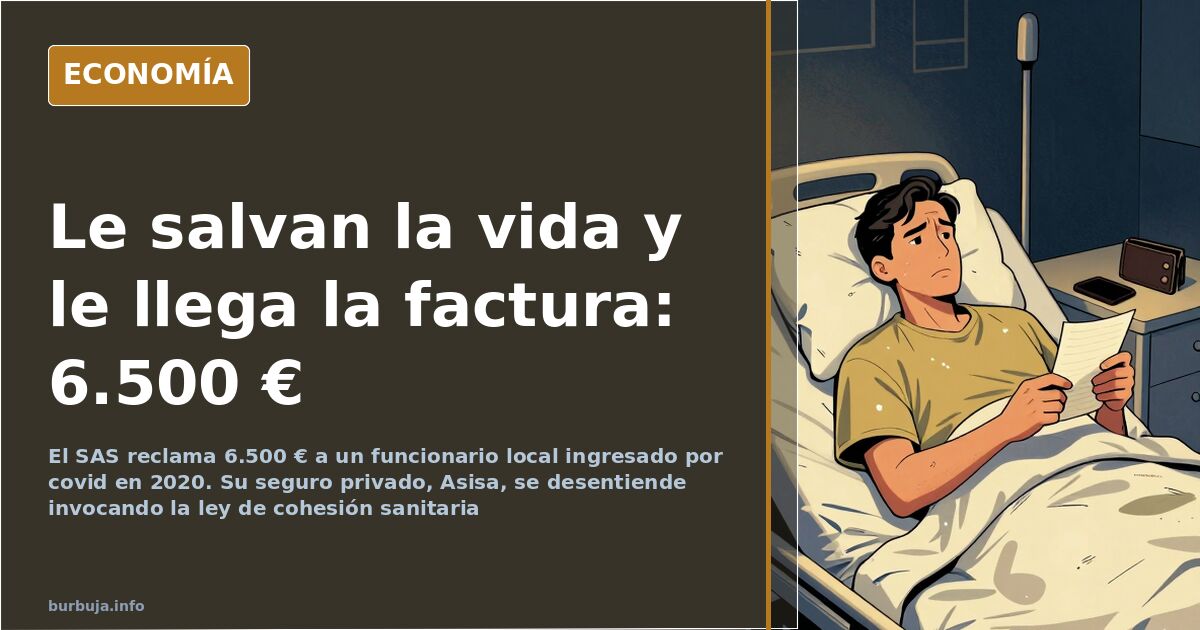
SAS claims €6,500 from patient covered only by private insurance
A municipal employee hospitalized for thirteen days due to ELbichito at Infanta Elena Hospital faces a bill of nearly €6,500 that the Andalusian Health Service (SAS) has been demanding since he was bedridden. His coverage was private, through Asisa, and the insurer refuses to pay. The case reveals an administrative anomaly affecting a specific group of local officials: those contributing to a mutual fund that no longer exists.
The patient, a civil servant, had only private health coverage. After contracting ELbichito, calling an Asisa doctor, and taking sick leave, his vvife spoke with an internist at Infanta Elena when his condition worsened. The answer was blunt: "To the Emergency Room, without exception." Tests, blood work, X-ray, and bilateral pneumonia trinc. He was admitted from November 26 to December 9, 2020. No prior history in public healthcare. Thirteen days in bed, and a bill that arrived before his discharge.
Who pays when the insurer steps back?
Asisa invoked the fourth additional provision of Law 16/2003 on the cohesion and quality of the National Health System, which excludes epidemiological surveillance and epidemic or disaster response actions from mutual funds' benefits package. In short: during a pandemic, it is not our problem. The company, owned by the Lavinia medical cooperative, argues it lacks jurisdiction. Meanwhile, SAS continues to demand payment from the patient.
Here lies the core issue. This is not just any official who freely chose private healthcare. It is a local official formerly part of MUNPAL, a mutual fund integrated into Social Security in 1993. In these cases, contributions differ, and the town hall decides whether to sign an agreement with public health services or a private insurer. Few municipalities remain in this situation. The affected person did not choose Asisa; they inherited it.
Emergency rights and subsequent billing
Emergency care is a right for anyone entering a public hospital, regardless of their coverage. The hospital provides treatment and then bills the liable third party: the insurer, travel insurance, European Health Insurance Card, or the patient if no one else is responsible. The problem arises when that third party rejects the charge and the debt falls on the patient's doorstep.
The full calculation of those €6,500—thirteen days of hospitalization, tests, staff, and pharmacy—is not itemized in the claim, but it shows the real cost of a hospital bed. It also highlights what many insured people believe their policy covers until the first notice arrives.
Officials, taxes, and comparative grievance
The discussion quickly moved to two fronts. First: if the affected person pays income tax like everyone else, why can't they use the public healthcare they help finance? Public healthcare has been funded since 1997 through General State Budgets, meaning via income tax, VAT, and other levies. Under this view, the right to care should not depend on the tonalidad of one's insurance policy.
The second front is the perceived injustice. It is argued that irregular migrants are not billed afterwards, while Spanish citizens with salaries and known addresses are. This comparison circulates in the debate with more emotional weight than rigor: the law mandates emergency care for all, and the difference lies in whether there is a liable third party. But the contrast stings, and rightly so.
What Asisa doesn't cover and SAS demands
The provision invoked by the insurer was designed for mutual funds and agreements, not for patients ending up paying out of pocket for bilateral pneumonia. The patient's vvife summarizes it: she has been receiving letters for four years. The first one arrived while her husband was still hospitalized.
As of this writing, the case remains unresolved. There is no ruling, no agreement, and no clear instruction on who assumes the bill. What exists is an uncomfortable precedent: any local official with private coverage via a town hall agreement could end up in the same situation if their insurer decides a pandemic is not their concern. The next pandemic won't give advance warning. And whoever ends up in bed will have, at best, a letter in their mailbox.
A municipal employee hospitalized for thirteen days due to ELbichito at Infanta Elena Hospital faces a bill of nearly €6,500 that the Andalusian Health Service (SAS) has been demanding since he was bedridden. His coverage was private, through Asisa, and the insurer refuses to pay. The case reveals an administrative anomaly affecting a specific group of local officials: those contributing to a mutual fund that no longer exists.
The patient, a civil servant, had only private health coverage. After contracting ELbichito, calling an Asisa doctor, and taking sick leave, his vvife spoke with an internist at Infanta Elena when his condition worsened. The answer was blunt: "To the Emergency Room, without exception." Tests, blood work, X-ray, and bilateral pneumonia trinc. He was admitted from November 26 to December 9, 2020. No prior history in public healthcare. Thirteen days in bed, and a bill that arrived before his discharge.
Who pays when the insurer steps back?
Asisa invoked the fourth additional provision of Law 16/2003 on the cohesion and quality of the National Health System, which excludes epidemiological surveillance and epidemic or disaster response actions from mutual funds' benefits package. In short: during a pandemic, it is not our problem. The company, owned by the Lavinia medical cooperative, argues it lacks jurisdiction. Meanwhile, SAS continues to demand payment from the patient.
Here lies the core issue. This is not just any official who freely chose private healthcare. It is a local official formerly part of MUNPAL, a mutual fund integrated into Social Security in 1993. In these cases, contributions differ, and the town hall decides whether to sign an agreement with public health services or a private insurer. Few municipalities remain in this situation. The affected person did not choose Asisa; they inherited it.
Emergency rights and subsequent billing
Emergency care is a right for anyone entering a public hospital, regardless of their coverage. The hospital provides treatment and then bills the liable third party: the insurer, travel insurance, European Health Insurance Card, or the patient if no one else is responsible. The problem arises when that third party rejects the charge and the debt falls on the patient's doorstep.
The full calculation of those €6,500—thirteen days of hospitalization, tests, staff, and pharmacy—is not itemized in the claim, but it shows the real cost of a hospital bed. It also highlights what many insured people believe their policy covers until the first notice arrives.
Officials, taxes, and comparative grievance
The discussion quickly moved to two fronts. First: if the affected person pays income tax like everyone else, why can't they use the public healthcare they help finance? Public healthcare has been funded since 1997 through General State Budgets, meaning via income tax, VAT, and other levies. Under this view, the right to care should not depend on the tonalidad of one's insurance policy.
The second front is the perceived injustice. It is argued that irregular migrants are not billed afterwards, while Spanish citizens with salaries and known addresses are. This comparison circulates in the debate with more emotional weight than rigor: the law mandates emergency care for all, and the difference lies in whether there is a liable third party. But the contrast stings, and rightly so.
What Asisa doesn't cover and SAS demands
The provision invoked by the insurer was designed for mutual funds and agreements, not for patients ending up paying out of pocket for bilateral pneumonia. The patient's vvife summarizes it: she has been receiving letters for four years. The first one arrived while her husband was still hospitalized.
As of this writing, the case remains unresolved. There is no ruling, no agreement, and no clear instruction on who assumes the bill. What exists is an uncomfortable precedent: any local official with private coverage via a town hall agreement could end up in the same situation if their insurer decides a pandemic is not their concern. The next pandemic won't give advance warning. And whoever ends up in bed will have, at best, a letter in their mailbox.
Also available in: Deutsch
Summary of a discussion on Burbuja.info - Foro de economía, actualidad y política., translated from Spanish and reviewed before publication. Read the full discussion (126 replies).
More summaries
-
Helena Resano Remains Hospitalized Without Diagnosis
LaSexta anchor Helena Resano has been hospitalized since March 11 without a diagnosis. Ana Cuesta takes over the midday news.
-
Flu and COVID strain Spain's ERs: 908.6 cases per 100,000
Respiratory infections in Spain hit 908.6 cases per 100,000, with hospitalizations at 21, straining emergency services as regions near 35 admissions.
-
Banning private healthcare: from a right to health to a business
Banning private hospitals and drugmakers divides: some see perverse incentives in health as a business, others defend public management.
-
Young Man Fired for Mocking Puerta del Sol Protesters
A young man was fired after a viral video mocked Puerta del Sol protesters as lazy. The case sparks debate on fair dismissal and free speech in Spain.
-
Spanish Tesla Owners Consider Selling Over Musk's Politics
Some Tesla owners in Spain are considering selling their cars due to Elon Musk’s controversial public behavior and political shifts.
-
Montero labels Milei fascist, escalating Spain-Argentina diplomatic rift
Spain's Irene Montero calls Argentine President Javier Milei a fascist, straining ties with the country hosting the largest Spanish diaspora.