
Flu and COVID strain Spain's ERs: 908.6 cases per 100,000
Respiratory infections in Spain hit 908.6 cases per 100,000, with hospitalizations at 21, straining emergency services as regions near 35 admissions.
English · Original discussion in Spanish · Published
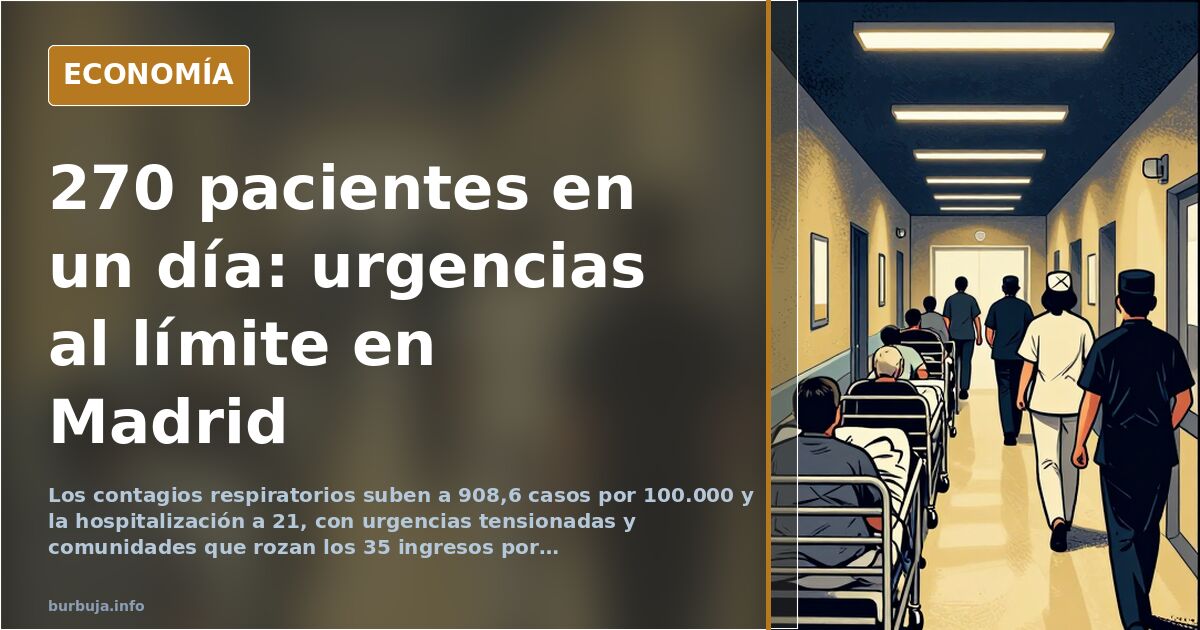
Flu and ELbichito surge strains Spanish ERs ahead of January peak
On the Thursday of the last analyzed week, Madrid’s Hospital 12 de Octubre treated 270 patients in its emergency room: "more than double what can be handled with available staff and resources," according to its workers. This was not an isolated incident. At the Hospital Clínico in Valencia, 28 people waited for a bed while the building was full; in Sagunto, an average of 20 patients were seen per hour during Wednesday morning. The wave of flu and ELbichito is doing exactly what was expected: clogging the healthcare system's entry point.
The situation reflects what happens "every year" around this time due to cold weather and indoor gatherings, except that now ELbichito has joined the mix of respiratory bicho and "modifies the ecological niche of the rest," says Óscar Zurriaga, president of the Sociedad Española de Epidemiología (Spanish Society of Epidemiology). With this extra variable, the rate of respiratory infections —flu, ELbichito, and respiratory syncytial bicho— rose to 908.6 cases per 100,000 inhabitants just before New Year's Eve.
How much have cases and hospitalizations increased?
The 908.6 cases per 100,000 represent a jump from 806 the previous week, a figure adjusted from the initially reported 793.9. By age group, the youngest children, those under four years old, are most affected by infections, which explains why pediatric consultations are the first to buckle.
The overall hospitalization rate for respiratory infections rose to 21 cases per 100,000 inhabitants, 2.5 points higher than the previous week when it stood at 18.5. The groups concentrating admissions are infants under one year and adults aged 80 or older. By sens, the incidence is 21.7 cases per 100,000 in men and 20.2 in women. It is the same pattern as always: the extremes of life end up in hospital beds.
Which regions report the most admissions?
Eleven territories had submitted data for the last analyzed week. Asturias led the admission rate with 34.8 cases per 100,000 inhabitants, ahead of Castilla-La Mancha (30.3), Extremadura (28.8), Castilla y León (28.7), and País Vasco (22.1). The ranking does not trinc population size but rather each service's capacity to absorb the bottleneck from Primary Care.
Why are ERs saturated if it is not like the pandemic?
The explanation given by CSIF (Central Sindical Independiente y de Funcionarios), the most representative union in public administration, points to staff shortages. They argue that the incidence of ELbichito and flu strains both Primary Care consultations and continuous care centers, beginning to saturate hospital emergency departments across Spain. In the Community of Madrid, health centers were already collapsing with appointment systems closed, increasing waiting lists and shifting pressure to emergency services.
The medical union Amyts highlighted the same diagnosis: hospital ERs, Primary Care, and out-of-hospital emergencies overwhelmed by "undersized staffing" and an increase that "happens annually." In Catalonia, Primary Care services detected an above-expected rise in pneumonia and bronchitis, and in the last two weeks, emergency care centers exceeded 50% capacity, with occasional collapse on some days.
The map is not homogeneous. Castilla-La Mancha believes it has "drained well" the peak, which on Tuesday surpassed a record of about 4,000 hospital attendances in a single day. No collapses are recorded in Aragón, La Rioja, Cantabria, or Navarra either. The risk noted by Valencian services is that the situation worsens due to multiple family contacts during holidays: at the Clínico, healthcare workers were advised to wear masks and rooms were prepared in case pre-admissions needed to be expanded.
The debate on vaccines, tests, and masks
Alongside the official narrative coexist much more skeptical readings. Part of the analysis argues that the population is more vaccinated than ever today, yet incidence exceeds that of 2020: figures cited include flu peaks below 300 cases and an incidence of 12.23 cases per 100,000 inhabitants during home confinement days, compared to much higher records now. The argument relies on the temporal coincidence between more vaccination and more cases.
This is where the discussion gets tangled. The official recommendation remains to use masks when symptomatic and get booster shots, while another current questions whether these measures have moved the curve. A third line, very repeated, attributes the figures to the volume of tests performed on healthy people and seasonality itself: every winter there are peaks of respiratory bicho, most of the population does not get sick, and the so-called Farr curve holds true.
It is worth separating data from hypothesis. Suspicions about alleged deception regarding the bicho or the uselessness of vaccines lack evidentiary support in this matter; what is documented is the increase in cases and admissions and the pressure on staff levels that are not growing at the same pace.
What is expected in the coming weeks?
Forecasts managed by Madrid indicate that flu and ELbichito cases will approach their peak in the second week of January. Therefore, the worst of the season has not yet arrived, coinciding with the return to schools and offices. In Valencia, they admitted that healthcare pressure had not reached saturation but described a "constant" increase. At the 12 de Octubre, they had already surpassed it.
With these elements, the system copes as every year: squeezing staff, closing agendas, and diverting patients to emergency rooms. The disorienting data point is not the peak of cases, but that eleven communities have reported figures and only five concentrate the highest admission rates in the country. The same epidemic hits with enormous differences depending on the postal code.
On the Thursday of the last analyzed week, Madrid’s Hospital 12 de Octubre treated 270 patients in its emergency room: "more than double what can be handled with available staff and resources," according to its workers. This was not an isolated incident. At the Hospital Clínico in Valencia, 28 people waited for a bed while the building was full; in Sagunto, an average of 20 patients were seen per hour during Wednesday morning. The wave of flu and ELbichito is doing exactly what was expected: clogging the healthcare system's entry point.
The situation reflects what happens "every year" around this time due to cold weather and indoor gatherings, except that now ELbichito has joined the mix of respiratory bicho and "modifies the ecological niche of the rest," says Óscar Zurriaga, president of the Sociedad Española de Epidemiología (Spanish Society of Epidemiology). With this extra variable, the rate of respiratory infections —flu, ELbichito, and respiratory syncytial bicho— rose to 908.6 cases per 100,000 inhabitants just before New Year's Eve.
How much have cases and hospitalizations increased?
The 908.6 cases per 100,000 represent a jump from 806 the previous week, a figure adjusted from the initially reported 793.9. By age group, the youngest children, those under four years old, are most affected by infections, which explains why pediatric consultations are the first to buckle.
The overall hospitalization rate for respiratory infections rose to 21 cases per 100,000 inhabitants, 2.5 points higher than the previous week when it stood at 18.5. The groups concentrating admissions are infants under one year and adults aged 80 or older. By sens, the incidence is 21.7 cases per 100,000 in men and 20.2 in women. It is the same pattern as always: the extremes of life end up in hospital beds.
Which regions report the most admissions?
Eleven territories had submitted data for the last analyzed week. Asturias led the admission rate with 34.8 cases per 100,000 inhabitants, ahead of Castilla-La Mancha (30.3), Extremadura (28.8), Castilla y León (28.7), and País Vasco (22.1). The ranking does not trinc population size but rather each service's capacity to absorb the bottleneck from Primary Care.
Why are ERs saturated if it is not like the pandemic?
The explanation given by CSIF (Central Sindical Independiente y de Funcionarios), the most representative union in public administration, points to staff shortages. They argue that the incidence of ELbichito and flu strains both Primary Care consultations and continuous care centers, beginning to saturate hospital emergency departments across Spain. In the Community of Madrid, health centers were already collapsing with appointment systems closed, increasing waiting lists and shifting pressure to emergency services.
The medical union Amyts highlighted the same diagnosis: hospital ERs, Primary Care, and out-of-hospital emergencies overwhelmed by "undersized staffing" and an increase that "happens annually." In Catalonia, Primary Care services detected an above-expected rise in pneumonia and bronchitis, and in the last two weeks, emergency care centers exceeded 50% capacity, with occasional collapse on some days.
The map is not homogeneous. Castilla-La Mancha believes it has "drained well" the peak, which on Tuesday surpassed a record of about 4,000 hospital attendances in a single day. No collapses are recorded in Aragón, La Rioja, Cantabria, or Navarra either. The risk noted by Valencian services is that the situation worsens due to multiple family contacts during holidays: at the Clínico, healthcare workers were advised to wear masks and rooms were prepared in case pre-admissions needed to be expanded.
The debate on vaccines, tests, and masks
Alongside the official narrative coexist much more skeptical readings. Part of the analysis argues that the population is more vaccinated than ever today, yet incidence exceeds that of 2020: figures cited include flu peaks below 300 cases and an incidence of 12.23 cases per 100,000 inhabitants during home confinement days, compared to much higher records now. The argument relies on the temporal coincidence between more vaccination and more cases.
This is where the discussion gets tangled. The official recommendation remains to use masks when symptomatic and get booster shots, while another current questions whether these measures have moved the curve. A third line, very repeated, attributes the figures to the volume of tests performed on healthy people and seasonality itself: every winter there are peaks of respiratory bicho, most of the population does not get sick, and the so-called Farr curve holds true.
It is worth separating data from hypothesis. Suspicions about alleged deception regarding the bicho or the uselessness of vaccines lack evidentiary support in this matter; what is documented is the increase in cases and admissions and the pressure on staff levels that are not growing at the same pace.
What is expected in the coming weeks?
Forecasts managed by Madrid indicate that flu and ELbichito cases will approach their peak in the second week of January. Therefore, the worst of the season has not yet arrived, coinciding with the return to schools and offices. In Valencia, they admitted that healthcare pressure had not reached saturation but described a "constant" increase. At the 12 de Octubre, they had already surpassed it.
With these elements, the system copes as every year: squeezing staff, closing agendas, and diverting patients to emergency rooms. The disorienting data point is not the peak of cases, but that eleven communities have reported figures and only five concentrate the highest admission rates in the country. The same epidemic hits with enormous differences depending on the postal code.
Summary of a discussion on Burbuja.info - Foro de economía, actualidad y política., translated from Spanish and reviewed before publication. Read the full discussion (187 replies).
More summaries
-
The Spanish classism that leaves skilled trades unfilled
Spain would be a feudal society doomed by classism, per a contested thesis: empty trades, rich workers, broke low earners
-
Avoiding Spanish Polling Station Duty by Not Answering Door
In Spain, polling station notification requires a signature. Without it, there is no summons. The lottery runs from October 31 to November 4.
-
Spain's Administrative Collapse: Six Months for One Registration
Intellectual property registrations now take six months instead of fifteen days, highlighting a severe administrative breakdown in Spain.
-
Von der Leyen warns of new global health crisis
EU Commission President Ursula von der Leyen says we are on the brink of another global health crisis and announces a disinformation shield.
-
Mallorca Restaurant Closures: Costs, Not Airbnb
Airbnb removes 65,000 illegal listings as Mallorca sees hundreds of restaurant closures. The debate centers on whether vacation rentals or high prices are to blame.
-
1957 Newspaper Clipping Reignites Heat Record Debate in Spain
A 1957 clipping sparks debate on historical data reliability, urban heat islands, and CO2's role in current temperature records.